




























Views
Downloads
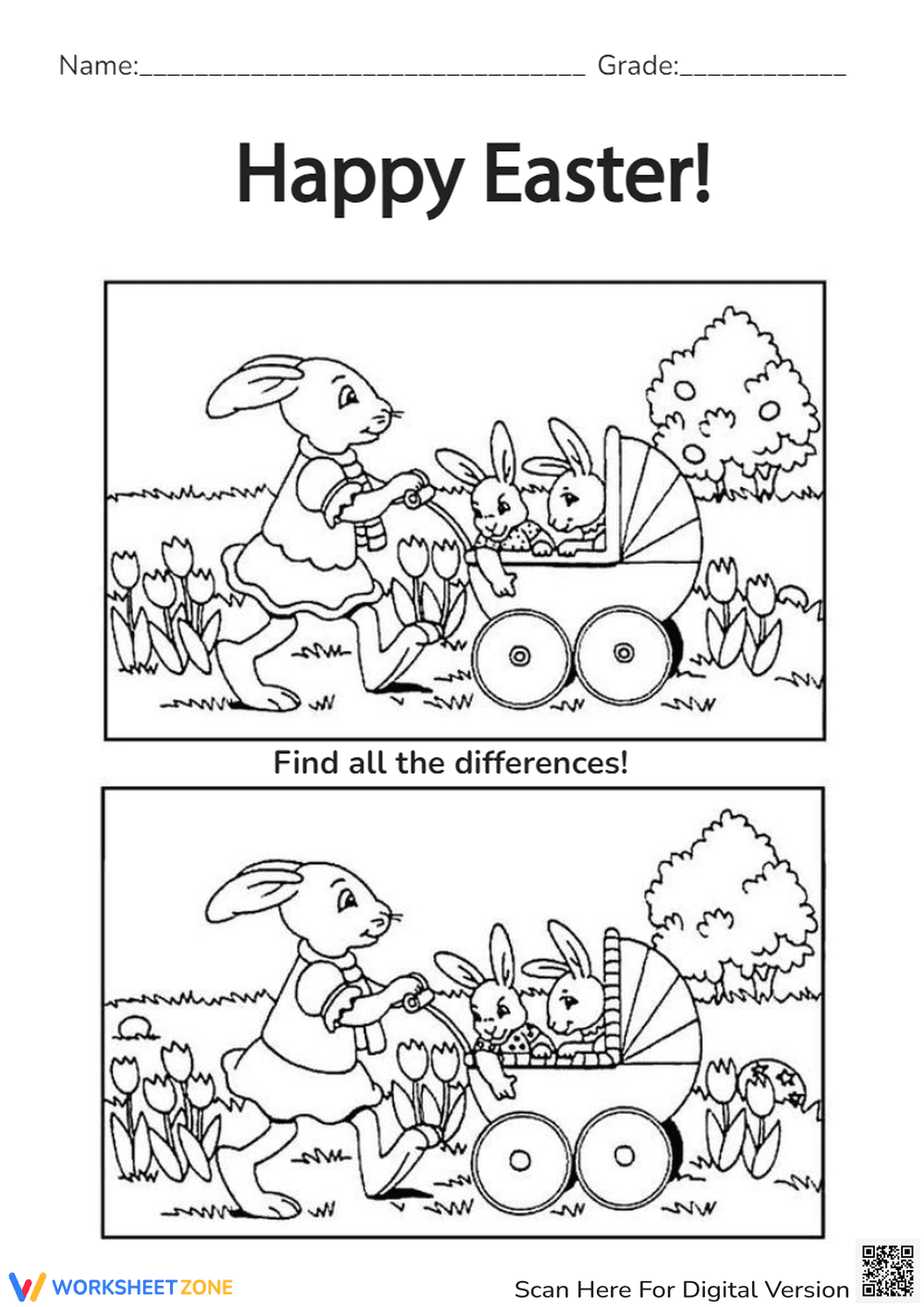

Printable Easter Spot the Difference Worksheet | Grades K-2

Paste this activity's link or code into your existing LMS (Google Classroom, Canvas, Teams, Schoology, Moodle, etc.).
Students can open and work on the activity right away, with no student login required.
You'll still be able to track student progress and results from your teacher account.
This Easter-themed visual discrimination worksheet helps young learners develop critical attention to detail by identifying subtle differences between two festive illustrations. Students engage with a charming scene of a bunny family, sharpening their observational skills while celebrating the holiday. It provides an immediate, high-interest activity that supports early literacy and cognitive development.
At a Glance
- Grade: K-2 · Subject: Visual Perception
- Standard:
CCSS.ELA-LITERACY.RF.K.1— Recognize and distinguish visual features and details in images and print- Skill Focus: Visual discrimination & observation
- Format: 1 page · 1 task · Answer key included · PDF
- Best For: Morning work or holiday centers
- Time: 10–15 minutes
Inside this resource, you will find a single-page PDF featuring two side-by-side illustrations of an Easter bunny pushing a stroller. The worksheet is designed with clear, bold lines suitable for coloring once the differences are found. It includes a dedicated space for student names and grades, ensuring easy organization for the teacher and a sense of ownership for the student.
This resource is designed for a zero-prep classroom environment. First, print the single-page PDF (30 seconds). Next, distribute the sheets to students during a transition or as a holiday-themed morning starter (1 minute). Finally, review the findings as a whole group to encourage descriptive language and spatial vocabulary (5 minutes). Total teacher preparation time is under 2 minutes, making it an ideal choice for busy seasonal weeks.
This worksheet aligns with CCSS.ELA-LITERACY.RF.K.1, which requires students to demonstrate an understanding of the organization and basic features of print, including the ability to distinguish visual details. By identifying differences in complex images, students build the foundational scanning skills necessary for reading. Both standard codes can be copied directly into lesson plans, IEP goals, or district curriculum mapping tools.
Use this worksheet as a warm-up activity during the week leading up to Easter break. It serves as an excellent formative assessment for tracking a student's ability to focus on small details and maintain task persistence. For an extension, ask students to describe the differences using complete sentences, such as "The bunny in the stroller has a different ear shape," to integrate oral language practice into the visual task.
This activity is ideal for Preschool through Grade 2 students, including those receiving occupational therapy for visual tracking or fine motor support. It pairs naturally with an Easter-themed read-aloud or a coloring station. The simple layout ensures it is accessible for English Language Learners who are building basic descriptive vocabulary while engaging with culturally relevant holiday imagery.
Research from Fisher & Frey (2014) emphasizes the importance of visual literacy as a precursor to traditional reading fluency. This Easter worksheet targets visual discrimination, a core component of CCSS.ELA-LITERACY.RF.K.1, by requiring students to scan and compare complex visual fields. Developing these search and find skills correlates with improved orthographic processing, which is the brain's ability to recognize letter patterns and shapes. According to the NAEP, early intervention in visual-spatial tasks supports long-term success in both ELA and STEM subjects. By providing 1 focused task that requires sustained attention, this resource helps bridge the gap between play-based learning and academic rigor. The 10-15 minute completion time aligns with developmentally appropriate attention spans for early elementary learners. This standalone activity provides measurable evidence of a student's ability to recognize and distinguish visual features within a structured, holiday-themed context.


