


























Views
Downloads

Design a Book Cover Worksheet | Grade 2 Essential
Paste this activity's link or code into your existing LMS (Google Classroom, Canvas, Teams, Schoology, Moodle, etc.).
Students can open and work on the activity right away, with no student login required.
You'll still be able to track student progress and results from your teacher account.
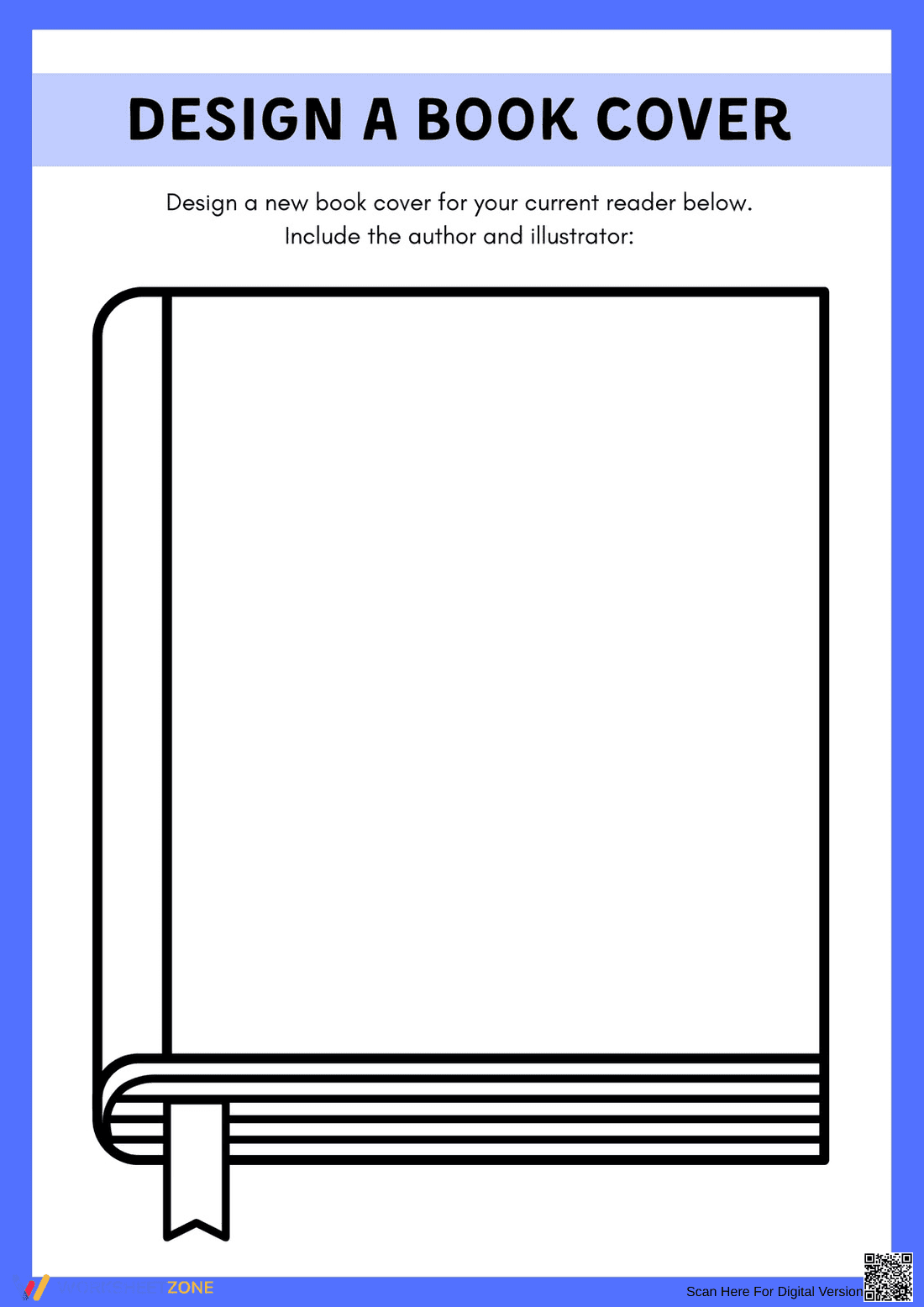
This Grade 2 ELA worksheet invites students to synthesize their reading by creating an original book cover. By translating narrative themes into visual art, learners demonstrate a deeper understanding of characters and setting while practicing the identification of key text features like author and illustrator names. It is a perfect tool for library sessions or literacy centers.
At a Glance
- Grade: 2 · Subject: ELA / Library
- Standard:
CCSS.ELA-LITERACY.RL.2.7— Use illustrations and words to demonstrate understanding of characters, setting, or plot- Skill Focus: Visualizing text and identifying roles
- Format: 1 page · 1 creative task · No answer key needed · PDF
- Best For: Post-reading comprehension and creative assessment
- Time: 15–20 minutes
What's Inside
This single-page PDF features a large, clear book outline designed for maximum creative space. The worksheet includes specific prompts for students to write the title, author, and illustrator, ensuring they recognize these essential bibliographic elements. The minimalist design prevents visual clutter, allowing students to focus entirely on their artistic interpretation of the story they have just read.
Zero-Prep Workflow
- Print: Print the single-page PDF for your entire class in under 30 seconds.
- Distribute: Hand out the sheets along with crayons or colored pencils as students finish their independent reading.
- Review: Quickly review the covers to assess student comprehension of the book's central themes or characters.
Total teacher preparation time is under 2 minutes, making this an ideal sub plan or transition activity.
Standards Alignment
This activity aligns with `CCSS.ELA-LITERACY.RL.2.7`, which requires students to use information gained from illustrations and words to demonstrate understanding of a text. By creating their own illustrations, students reverse-engineer this process, showing mastery of the relationship between text and image. Both standard codes can be copied directly into lesson plans, IEP goals, or district curriculum mapping tools.
How to Use It
Use this worksheet as a formative assessment after a whole-class read-aloud to see which students can identify the most significant scene or character. Alternatively, place it in a library center as a "Book Recommendation" activity where students design covers for books they loved. Observe whether students include relevant details from the plot in their drawings to gauge their level of engagement. Expected completion time is 15 to 20 minutes.
Who It's For
This resource is ideal for Grade 2 students but is easily adaptable for Kindergarten through Grade 3. It specifically supports visual learners and English Language Learners who may express comprehension more effectively through drawing than writing. Pair this with a "Parts of a Book" anchor chart or a direct instruction lesson on the roles of authors and illustrators.
Research by Fisher & Frey (2014) emphasizes the importance of "visualizing and verbalizing" as a core strategy for improving reading comprehension across all grade levels. When students are tasked with creating a visual representation of a text, they engage in higher-order thinking by selecting the most salient details to represent the whole. This worksheet facilitates that cognitive process by providing a structured yet open-ended canvas for creative synthesis. According to the NAEP, students who can successfully integrate visual and textual information show higher proficiency in overall literacy. By requiring the inclusion of the author and illustrator, the worksheet also reinforces foundational bibliographic knowledge essential for early research skills. This 1-page activity serves as a bridge between artistic expression and academic rigor, making it a versatile addition to any elementary literacy curriculum or school library program.


