


























Views
Downloads
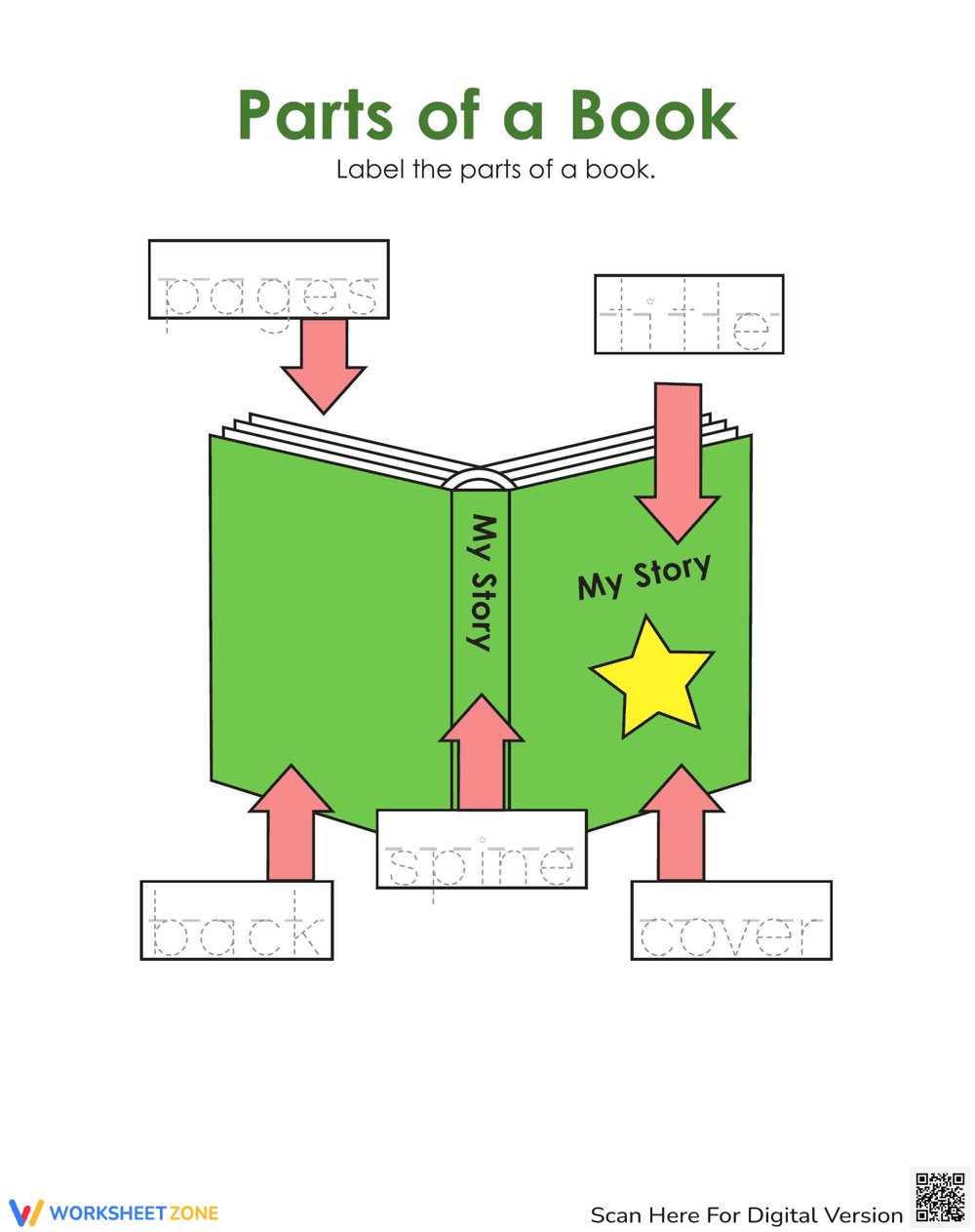

Kindergarten Parts of a Book — Printable No-Prep Worksheet
Paste this activity's link or code into your existing LMS (Google Classroom, Canvas, Teams, Schoology, Moodle, etc.).
Students can open and work on the activity right away, with no student login required.
You'll still be able to track student progress and results from your teacher account.
This printable parts of a book worksheet helps preschool and kindergarten students identify key book components. Learners trace and label five essential terms—title, spine, pages, cover, and back—to build foundational print awareness. Mastering these concepts prepares early readers for structured literacy activities and independent library exploration.
At a Glance
- Grade: Kindergarten · Subject: Early Literacy
- Standard:
CCSS.ELA-LITERACY.RI.K.5— Identify front cover, back cover, and title page of a book- Skill Focus: Book anatomy labeling and word tracing
- Format: 1 page · 5 problems · Answer key not included · PDF
- Best For: Morning work or introduction to library rules
- Time: 10–15 minutes
This single-page resource features a clear, colorful illustration of an open book with arrows pointing to its primary structural elements. Five dashed-line boxes contain the words "pages," "title," "spine," "back," and "cover" in a dotted tracing font. This design combines fine motor practice with vocabulary acquisition, allowing young learners to trace the letters before identifying where each label belongs on the diagram.
The zero-prep workflow makes this resource exceptionally easy to integrate into busy school days. First, print the single-page PDF, which takes less than 1 minute of teacher preparation time. Second, distribute the sheets to students along with pencils or crayons for a quick 10-minute independent activity. Finally, review the labeled parts as a whole group in under 2 minutes by holding up a physical picture book. This simple structure also makes the worksheet an ideal emergency sub plan.
This activity aligns directly with the Common Core State Standard CCSS.ELA-LITERACY.RI.K.5, which requires students to identify the front cover, back cover, and title page of a book. By labeling these physical components, students develop the print concepts necessary for early reading success. Both standard codes can be copied directly into lesson plans, IEP goals, or district curriculum mapping tools.
Use this worksheet during direct instruction when introducing library navigation or book handling rules. Alternatively, assign it as a formative assessment after read-aloud sessions to observe if students can point to the spine or cover on their own books. The entire activity takes approximately 15 minutes to complete.
This resource is designed for preschool and kindergarten students who are beginning to interact with print materials. It serves as an excellent accommodation for English language learners needing visual vocabulary support. Pair this worksheet with a physical read-aloud book or an anchor chart displaying book anatomy.
Early childhood literacy research emphasizes that physical print awareness is a critical precursor to reading comprehension. According to the Fisher & Frey (2014) framework for gradual release of responsibility, explicit instruction in book anatomy helps young learners navigate texts systematically. When students understand where to find the title, spine, and cover, they develop spatial orientation skills that facilitate left-to-right tracking. This worksheet operationalizes these findings by combining visual labeling with tactile tracing exercises. By targeting CCSS.ELA-LITERACY.RI.K.5, the activity ensures that kindergarteners master the basic structural elements of literature before transitioning to complex decoding tasks. Educators can confidently integrate this structured practice into early reading modules, knowing it aligns with established developmental milestones in print concepts and fine motor control.


