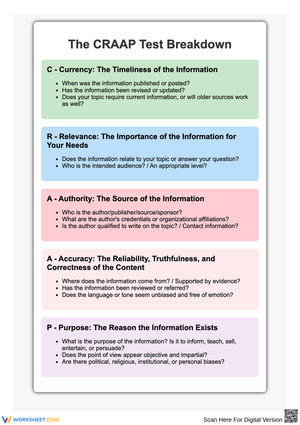
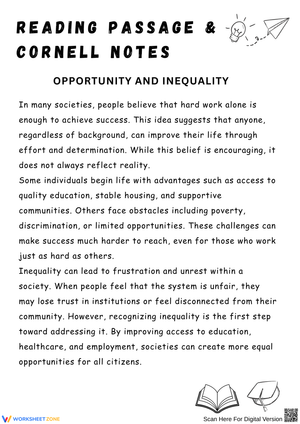
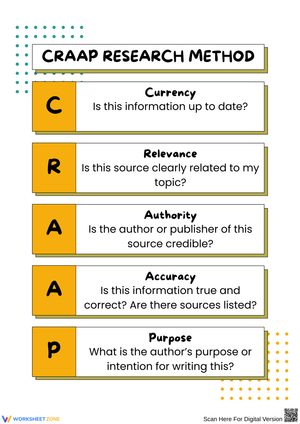
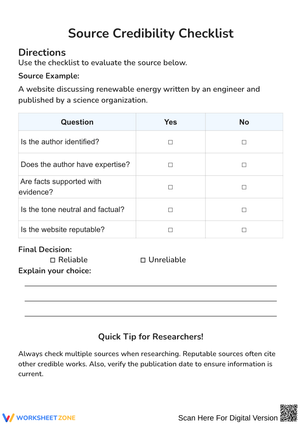
These research strategies worksheets for 9th grade address one of the most persistent gaps in freshman English: students who can locate information but have no systematic method for evaluating or documenting it honestly. The set covers the full research arc — from refining an inquiry question through synthesizing evidence across multiple sources — and each worksheet stands alone, so teachers can assign them in sequence during a unit or pull individual ones into existing lesson plans without rebuilding anything.
The Specific Skills Each Worksheet Targets
The inquiry question worksheet starts where the process actually starts: distinguishing between a topic, a research question, and a thesis statement. Students underline the analytical verb in a set of sample questions, then revise a group of closed or hopelessly broad prompts — the kind that send students toward confirmation rather than investigation — into workable, open-ended ones. A two-test revision protocol is built into the worksheet: first, identify what kind of analysis the question requires; second, check whether a single encyclopedia entry could answer it. If yes, the question is not ready.
The Boolean search worksheet includes a prediction step that most database tutorials skip. Before running any search, students write down how they expect their results to change when they swap AND for OR, or add NOT before a term. After running the search, they compare the prediction to the actual output. That sequence — predict, search, reflect — builds real search logic rather than mechanical keyword entry.
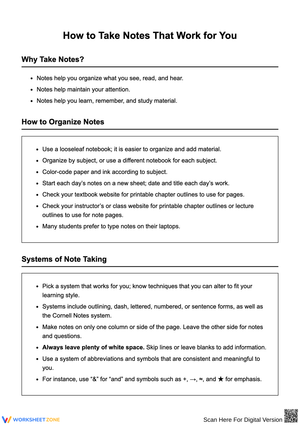
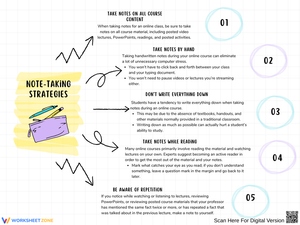
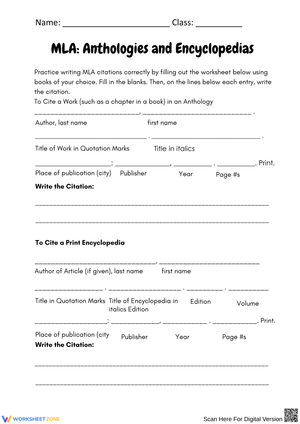
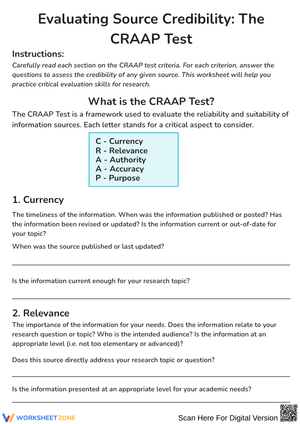
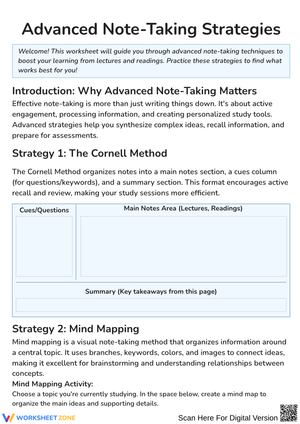
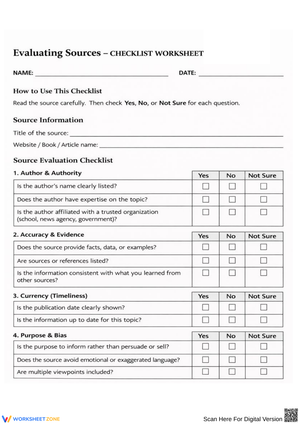
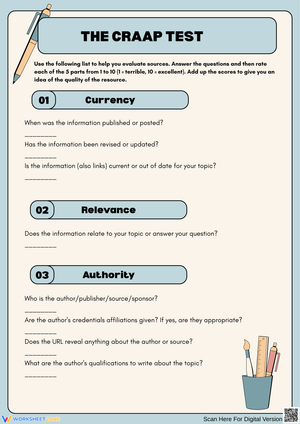
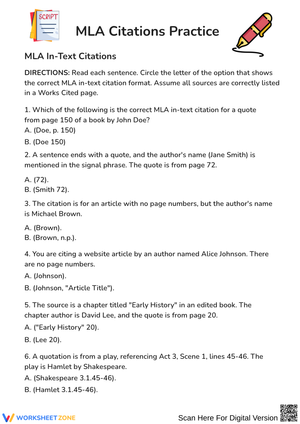
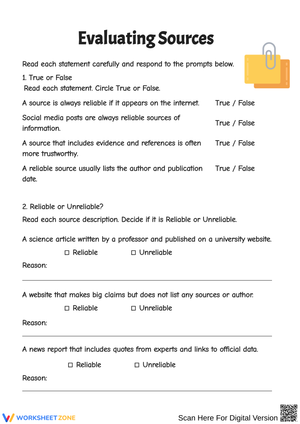
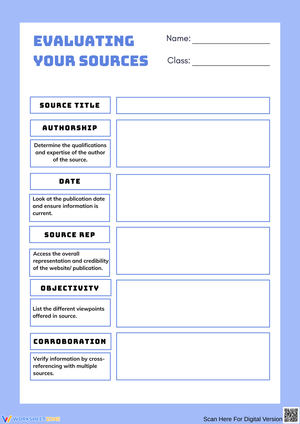
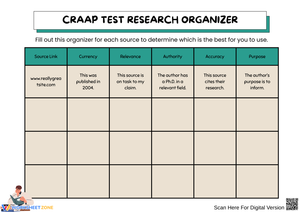
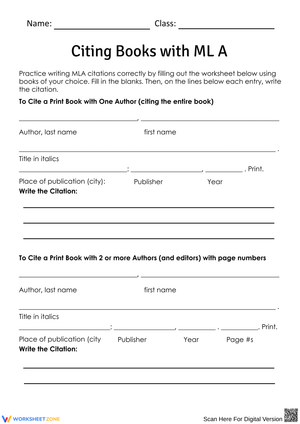
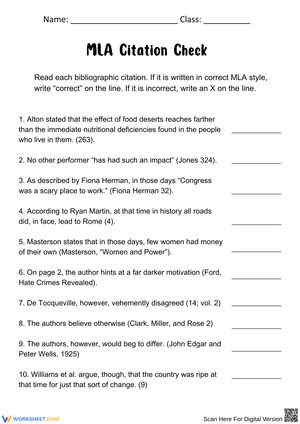
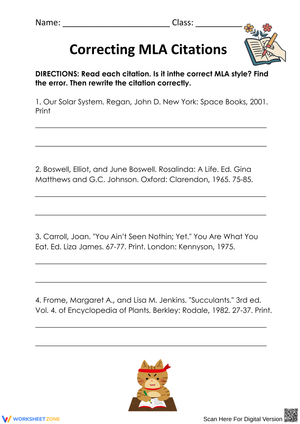
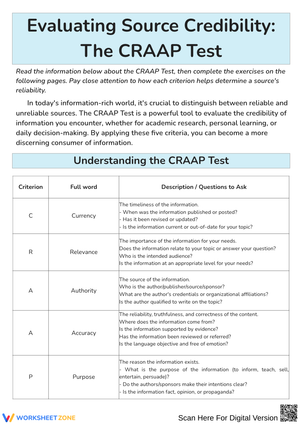
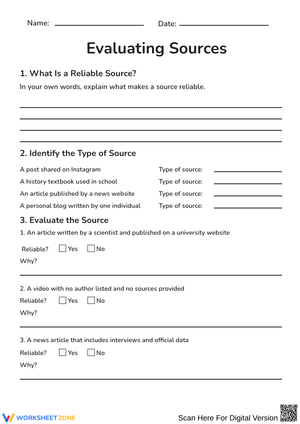
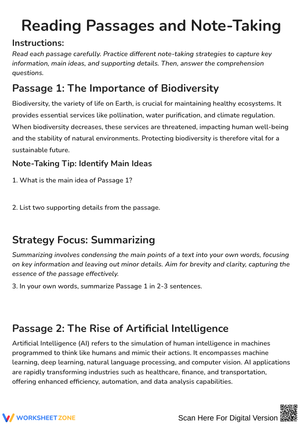
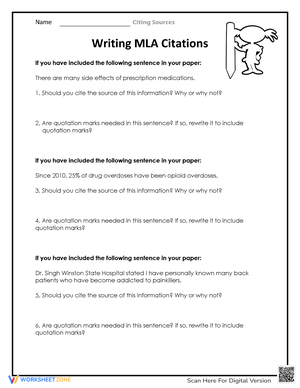
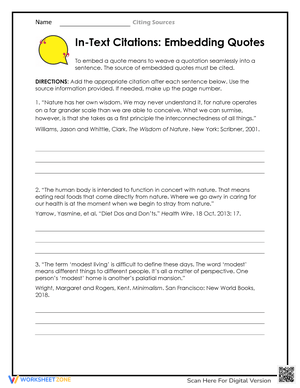
Source credibility work uses the SIFT method: Stop, Investigate the source, Find better coverage, Trace claims to their original context. Each step has its own column in a four-part table, which makes student reasoning visible and allows teachers to pinpoint exactly where it breaks down. The three-column note-taking worksheet — source citation, specific claim or data, student's own annotation connecting the point to the argument — trains students to interact analytically with sources rather than collect quotations in bulk. The MLA citation worksheet presents scrambled source information across four different media types; students reassemble each citation, which forces attention to punctuation and capitalization in an applied context rather than in the abstract.
Where 9th Grade Research Reasoning Breaks Down
The most common failure point is the research question itself. Students arrive with thesis statements dressed up as questions. "Is social media harmful to teenagers?" is a yes/no prompt — it sends students looking for confirmation, not evidence. The inquiry question worksheet catches this before students open a database, but teachers should plan on individual conferences with roughly a third of the class before those questions are genuinely functional.
On the SIFT worksheet, the "Trace" step is where student reasoning reliably stalls. Most 9th graders can note that a source has an author and a publication date; far fewer can follow a claim cited in a health blog back to the original study and determine whether they have actually read the primary source. The worksheet requires students to locate the origin of at least one claim in every article they evaluate. That single requirement generates more genuine disagreement — and therefore more teachable classroom discussion — than any other exercise in the set.
The synonym-swap error surfaces reliably in the note-taking worksheet. A student changes "adolescents" to "teenagers" and "utilize" to "use" and considers the passage paraphrased. The worksheet addresses this directly by asking students to rewrite the same passage three times using entirely different sentence structure — not vocabulary substitution. Students who rely on word-swapping see quickly, on the second or third attempt, why that approach does not count as paraphrasing.
Standard Alignment
Research strategies worksheets for 9th grade address CCSS.ELA-LITERACY.W.9-10.7, which asks students to conduct short and sustained research projects and refine inquiry based on what they find, and CCSS.ELA-LITERACY.W.9-10.8, which requires gathering relevant information from multiple print and digital sources, assessing credibility, and integrating evidence while avoiding plagiarism. These two standards are functionally inseparable: a student who cannot evaluate a source cannot integrate it responsibly. The set keeps evaluation and note-taking in close sequence rather than treating them as separate instructional units, which reflects how a careful researcher actually moves between those two tasks.
Working These Worksheets Into a Research Unit
The most effective approach is phase-by-phase assignment across a three- to four-week unit. Use the inquiry question worksheet as a gate: students do not open a database until the question passes the two-test revision protocol. The Boolean search and SIFT worksheets belong in the active source-gathering phase. The synthesis mapping worksheet — which asks students to identify what one source addresses that another ignores, then use that gap to locate a third source — comes last, after students have at least three evaluated sources in hand. Gaps in evidence are not visible until students are holding multiple sources simultaneously.
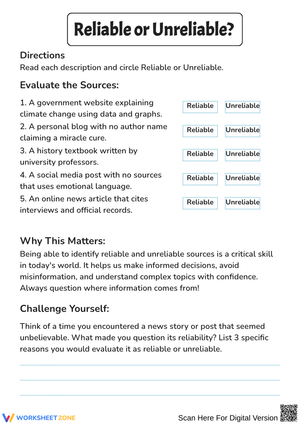
One high-yield activity pairs naturally with the SIFT worksheet. Print five different articles on the same topic — a peer-reviewed journal abstract, a .gov agency page, a news editorial, an advocacy organization's fact sheet, and a blog post with no named author — and give students six to eight minutes at each station to complete the evaluation before rotating. The debrief is where the real work happens: students who found the advocacy fact sheet most convincing often discover it is the least traceable. That moment of friction is difficult to manufacture through lecture alone.
Research strategies worksheets for 9th grade also function well as peer review tools. After students complete their SIFT evaluation worksheets independently, partners review each other's reasoning in the "Trace" column specifically. Disagreements about whether a source qualifies as credible open authentic argument about evidence standards — more productive, in most classes, than a teacher-led discussion of the same question.
Adapting the Set for Different Student Levels
For students who struggle with the note-taking worksheet, pre-filling the source citation column removes one layer of cognitive demand without changing the analytical work of identifying claims and writing annotations. Students who freeze when a worksheet is completely blank make measurably more progress with that structure already in place.
Research strategies worksheets for 9th grade extend naturally for advanced students by adding one requirement to the SIFT worksheet: for every source rated as credible, students must locate a source that contradicts it and determine which one traces to stronger primary evidence. That task is genuinely harder than evaluating a single source in isolation, and it keeps capable researchers working at a higher analytical level without moving them off the shared materials entirely.
Frequently Asked Questions
Can these worksheets be used in a fully digital classroom?
Yes. PDF annotation tools available in Google Chrome, Adobe Acrobat Reader, and most LMS platforms allow students to type directly onto each worksheet. The structured table formats in the SIFT and note-taking worksheets translate cleanly to digital annotation without losing functionality.
What do I do when students disagree about whether a source is credible?
That disagreement is the lesson. Ask both students to show their work in the "Trace" column and identify where their reasoning diverges. Often the student who rated the source as credible stopped at the author's credentials without following the underlying claim to its origin. Making that gap visible — ideally in front of the class — is more effective than providing a correct answer.
How do I help students who keep writing thesis statements instead of research questions?
The most direct intervention is a single test: "Could a student who disagrees with you use this question to start their own research?" If the answer is no — if the question already implies a conclusion — it needs revision. Students who see their prompt fail that test usually understand the problem immediately and can revise without additional explanation.
Is the MLA citation worksheet aligned to the current edition of MLA style?
Yes. The worksheet reflects MLA 9th edition formatting, including the core elements framework and updated conventions for digital sources. Posting a link to the Purdue OWL alongside the worksheet gives students a reference they can return to independently during revision.












 Interactive Worksheet Maker
 Quiz Maker
 Word Search Maker
 Crossword Puzzle Maker
 Word Scramble Generator
 Sentence Scramble Generator
 Handwriting Worksheet Generator
 Name Tracing Generator
 Fill In The Blank Generator