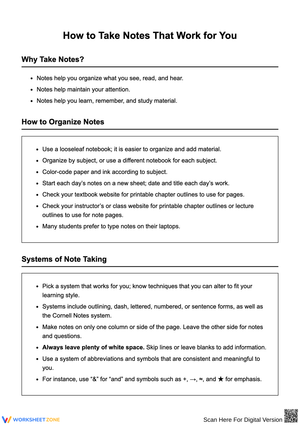
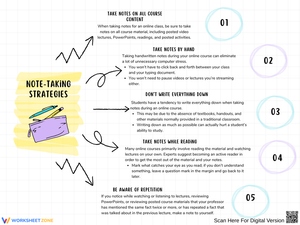
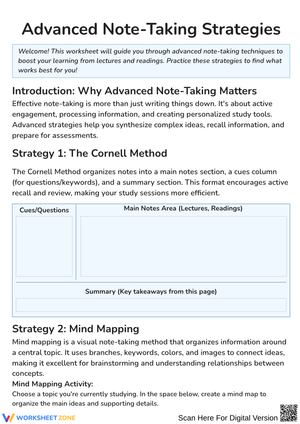
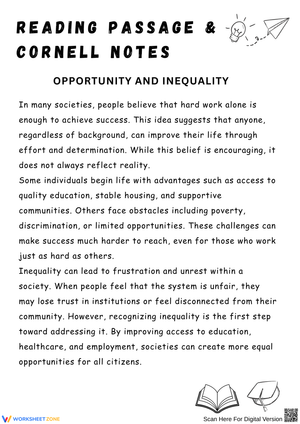
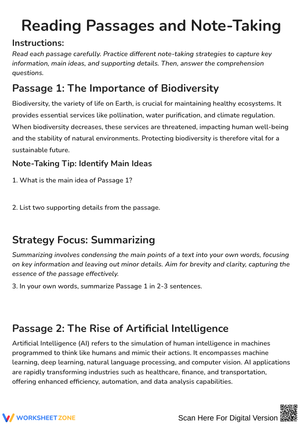
These note taking worksheets for 9th grade give research-unit teachers a concrete starting point for one of the harder transitions in secondary ELA — moving students from annotating a single text to managing multiple sources across a sustained project. The set covers three formats: Cornell-style column layouts, structured outline templates, and source-tracking organizers with dedicated fields for direct quotes, paraphrase, and full citation data. Each worksheet is print-ready, which matters when library periods are short and setup time is not.
What the Set Covers, Format by Format
The three worksheet types each handle a different part of the research process:
- Cornell-layout worksheets — students record main ideas in the wide right column while reading, then close the source and write cue questions in the narrow left column, then write a summary paragraph at the bottom from memory. The sequencing is intentional: summarizing after reading forces synthesis rather than transcription.
- Outline-format worksheets — students map a source's hierarchical structure, distinguishing a central claim from the layers of evidence that support it. Marking levels of specificity — main point, supporting reason, concrete example — builds the analytical reading habit that 9th-grade argument writing demands.
- Source-tracking worksheets — three physically distinct boxes: the author's exact words marked for quotation, the student's paraphrase written without looking back at the source, and the full citation completed before any notes are taken.
That last format is the most direct plagiarism-prevention tool in the set. Students cannot blur the line between borrowed language and their own when the two occupy labeled, separated spaces on the same worksheet.
Standard Alignment
These worksheets address CCSS ELA Writing Standards W.9-10.7 and W.9-10.8. W.9-10.7 asks students to conduct sustained research projects that investigate a focused question through multiple sources — the source-tracking worksheets map directly onto that work during a multi-day unit. W.9-10.8 is more granular: students must evaluate credibility, integrate information selectively into their writing, and avoid plagiarism by following citation conventions. In practical terms, W.9-10.8 is where most 9th-grade research instruction breaks down. Students who find sources easily often cannot articulate why a source is credible, and students who take careful notes frequently lose track of which note belongs to which source by the time drafting begins. The worksheets address both problems — a credibility-check field in the source header and a citation block required before any notes are recorded.
Fitting These Worksheets Into Your Research Unit
The most reliable starting point is a live model before students work independently. Project the Cornell template, read one paragraph of a short article together, and think aloud through every decision: is this detail a main idea or supporting evidence? Can I paraphrase this sentence right now, or do I need more context from the paragraph ahead? That ten-minute demonstration prevents the blank-stare paralysis that appears when students face an empty template for the first time and are not sure what counts as a note worth keeping.
During multi-day library or laptop research blocks, note taking worksheets for 9th grade work well as end-of-period check-ins. Students hand in their completed organizer before leaving — not for a grade, but as a formative snapshot. Scanning the cue columns of 30 worksheets takes about five minutes and tells a teacher which students are generating genuine questions about their sources and which are restating the source title in question form. That information shapes the next day's opening instruction.
Common Mistakes Students Make That These Worksheets Help You Catch
The most consistent error in 9th-grade research notes is the synonym-swap paraphrase. A student reads "the treaty significantly altered regional trade networks" and writes "the treaty greatly changed regional trade networks." Every content word is swapped, but the sentence structure is lifted intact. When the worksheet provides physically distinct boxes for quoted language and paraphrased language, students face the decision at the moment they pick up the pen: am I comfortable putting this in quotation marks, or am I actually restating it in my own words? Many students discover in that moment that they cannot yet paraphrase the passage — which is useful diagnostic information that a blank notebook page would never surface.
The second recurring problem is source drift. A student takes strong notes on one article, moves through three others during the same class period, and later cannot link a specific statistic to its origin. Requiring students to fill in the bibliographic header at the top of each worksheet before writing any notes addresses this directly. It adds about 90 seconds per source and eliminates most of the citation panic that surfaces the night before a paper is due.
Differentiating These Worksheets Across Ability Levels
For students who need more structure early in a unit, note taking worksheets for 9th grade can be modified by pre-filling the cue column with teacher-generated questions, so students begin with a reading purpose already in place. That change removes one layer of meta-level decision-making — what matters in this source? — and lets students concentrate entirely on comprehension and evidence-gathering. Students who freeze at that meta-level question are often fully capable of locating strong evidence once someone tells them what to look for.
Students who are ready for greater challenge can complete a synthesis row across three or four finished worksheets — identifying where sources agree, where they diverge, and where one source addresses a gap the others leave open. That cross-source analysis is the intellectual move that separates strong 9th-grade research writing from source-stacking that accumulates evidence without building an actual argument.
Frequently Asked Questions
Which format should students use when reading a source for the first time?
The Cornell layout tends to produce better results on first-read encounters because it separates recording from processing — students write during reading and return to generate questions and the summary afterward. The outline format is more useful when students revisit a source to locate evidence for a specific claim they are already building.
How many worksheets should a student complete for a standard research paper?
One organizer per source is a practical floor. A five-paragraph argumentative paper drawing on three to five sources typically produces three to five completed worksheets. Longer projects benefit from an additional synthesis organizer where students map notes across sources against their working thesis claims.
Should these be graded, or used as formative tools?
Both uses are legitimate. Treating the worksheets as formative throughout most of the unit and grading only the final completed set gives students room to work through the format without penalizing early mistakes. Grading note quality before students are comfortable with the templates tends to produce neater-looking but less honest work — students optimize for appearance rather than utility.
Do these worksheets transfer to subjects outside ELA?
The source-tracking and outline worksheets move directly to social studies and science research projects without modification. The Cornell layout works in any course where students record information from a lecture or nonfiction text. Note taking worksheets for 9th grade originate from an ELA research context, but the bibliographic fields and quote-versus-paraphrase structure apply wherever students handle secondary sources responsibly.












 Interactive Worksheet Maker
 Quiz Maker
 Word Search Maker
 Crossword Puzzle Maker
 Word Scramble Generator
 Sentence Scramble Generator
 Handwriting Worksheet Generator
 Name Tracing Generator
 Fill In The Blank Generator