


























0
Views
0
Downloads

0.0
0
Save
0 Likes
Share
Primary & Secondary Sources: True or False Worksheet
0 Views
0 Downloads
Paste this activity's link or code into your existing LMS (Google Classroom, Canvas, Teams, Schoology, Moodle, etc.).
Students can open and work on the activity right away, with no student login required.
You'll still be able to track student progress and results from your teacher account.
Information
Description
What It Is:
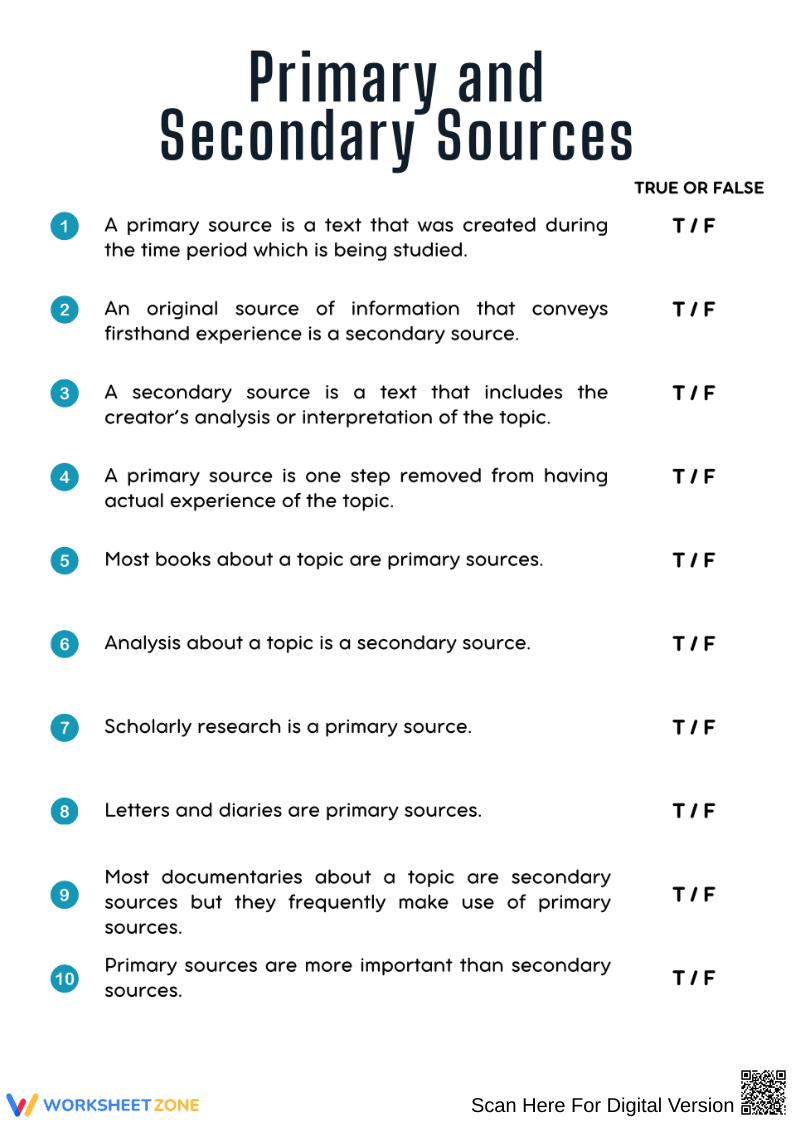
A true-or-false worksheet that helps students distinguish between primary and secondary sources. The activity includes ten statements about the characteristics of different types of sources—such as letters, diaries, scholarly research, analysis, and original documents—requiring students to determine whether each statement is accurate.
Why Use It:
Understanding the difference between primary and secondary sources is essential for historical thinking and research literacy. This worksheet strengthens students’ ability to recognize firsthand accounts, interpretive texts, and information one step removed from events. It supports social studies, research skills, and document analysis lessons by reinforcing key definitions and misconceptions.
How to Use It:
• Students read each statement and mark it as True (T) or False (F).
• Review answers as a class and discuss why certain statements are incorrect to clarify misunderstandings.
• Use as an introductory warm-up, independent practice, bell-ringer activity, or quick assessment.
• Extend learning by having students provide examples of primary and secondary sources for each statement.
Grade Suitability:
Best suited for Grades 5–9.
• Ideal for history units, research skills lessons, and source evaluation activities.
• Supports ELL students with clear, simple statements that reinforce academic vocabulary.
Target Users:
Social studies teachers, history instructors, librarians, tutors, and homeschool educators teaching research skills, evidence evaluation, and historical literacy.
A true-or-false worksheet that helps students distinguish between primary and secondary sources. The activity includes ten statements about the characteristics of different types of sources—such as letters, diaries, scholarly research, analysis, and original documents—requiring students to determine whether each statement is accurate.
Why Use It:
Understanding the difference between primary and secondary sources is essential for historical thinking and research literacy. This worksheet strengthens students’ ability to recognize firsthand accounts, interpretive texts, and information one step removed from events. It supports social studies, research skills, and document analysis lessons by reinforcing key definitions and misconceptions.
How to Use It:
• Students read each statement and mark it as True (T) or False (F).
• Review answers as a class and discuss why certain statements are incorrect to clarify misunderstandings.
• Use as an introductory warm-up, independent practice, bell-ringer activity, or quick assessment.
• Extend learning by having students provide examples of primary and secondary sources for each statement.
Grade Suitability:
Best suited for Grades 5–9.
• Ideal for history units, research skills lessons, and source evaluation activities.
• Supports ELL students with clear, simple statements that reinforce academic vocabulary.
Target Users:
Social studies teachers, history instructors, librarians, tutors, and homeschool educators teaching research skills, evidence evaluation, and historical literacy.


