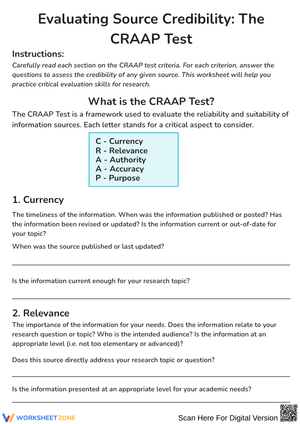
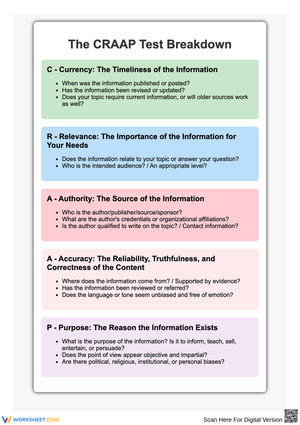
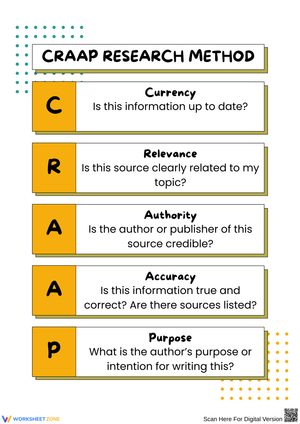
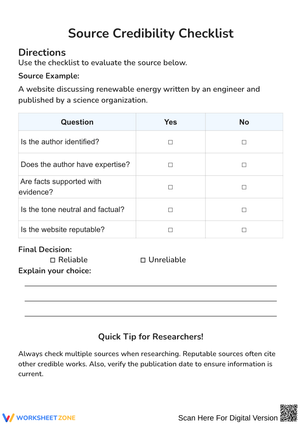
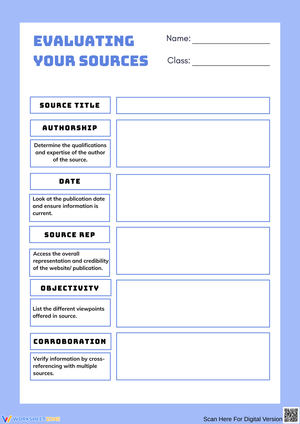
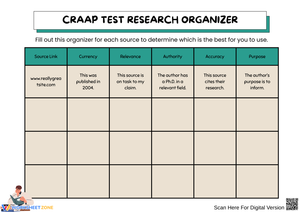
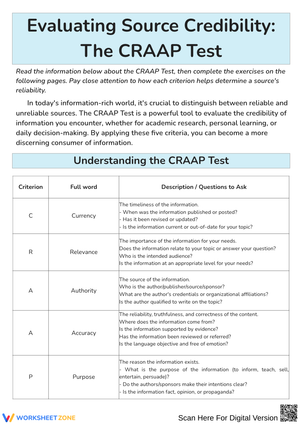
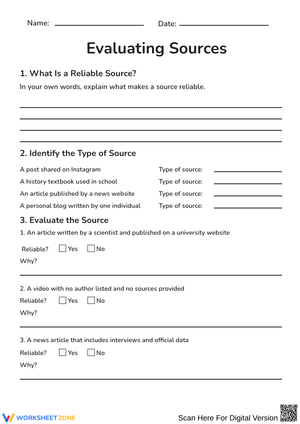
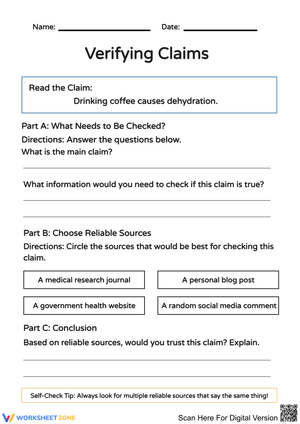
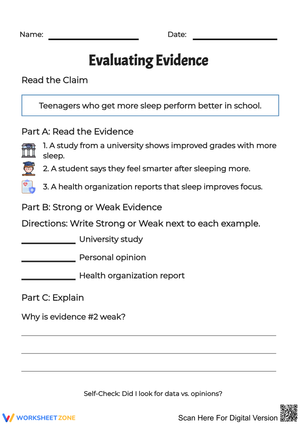
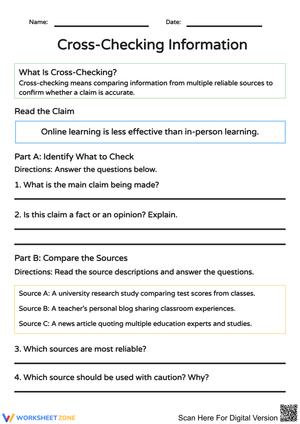
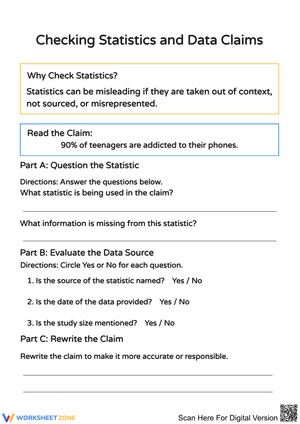
These assessing credibility of sources printable worksheets for 9th grade target a specific transition point in student research development — the moment when locating information is no longer enough and vetting it becomes the actual task. Each worksheet isolates a discrete evaluation skill: checking author credentials against external sources, identifying publication funding and bias, recognizing sponsored content markers, and using lateral reading to investigate a site's reputation before reading it through. Teachers get a structured set of tools that carries instruction from teacher-modeled practice through independent student application, and the skills transfer cleanly across ELA, social studies, and science research assignments.
Skills These Worksheets Build
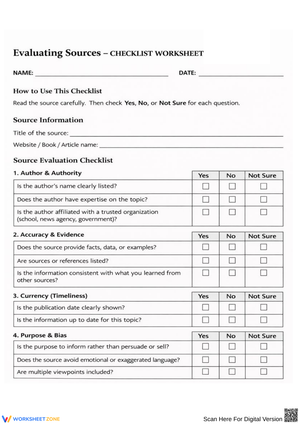
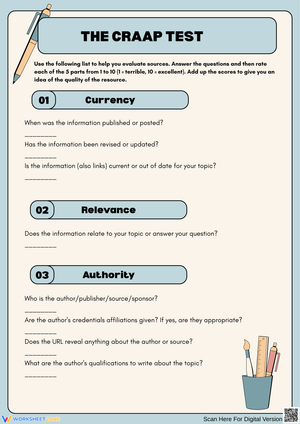
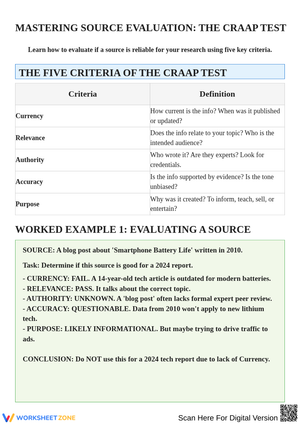
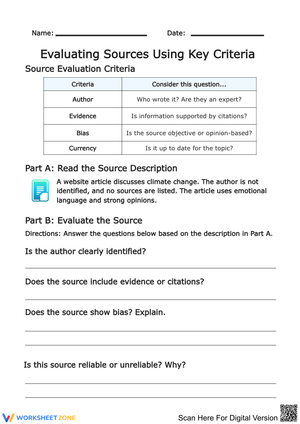
The set covers the full arc of source evaluation as ninth graders encounter it in real research situations. Early worksheets walk students through the CRAAP test framework — Currency, Relevance, Authority, Accuracy, and Purpose — with fields that require documented evidence rather than general impressions. Instead of asking "Is this a credible source?" the worksheet asks students to record the author's institutional affiliation, locate the publication date relative to their research question, and identify where the article's evidence actually comes from. That level of specificity is what slows students down enough to think critically.
Later worksheets focus on lateral reading, a method developed by the Stanford History Education Group through their Civic Online Reasoning research. Instead of reading an article from top to bottom and judging it by its internal logic, students stop at the publication name, open a new browser tab, and search for what independent sources — fact-checkers, reference databases, journalism-review organizations — say about that outlet's funding, ownership, and track record. One worksheet specifically guides students to check Wikipedia's sourcing on an organization and record what they find before returning to the original article. That habit — checking the reputation before reading the content — is the most durable research skill students can leave ninth grade carrying.
Across the full set, students practice these specific skills:
- Interpreting domain extensions — and understanding why .org alone isn't a credibility signal
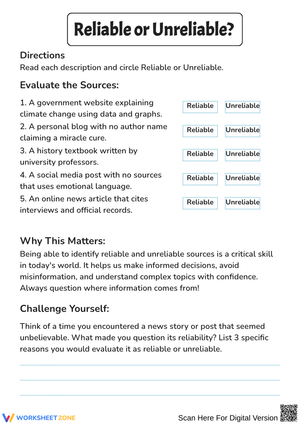
- Distinguishing informational, persuasive, and commercial purpose in a text
- Locating and reading "About," "Funding," and "Staff" pages to assess organizational transparency
- Identifying sponsored content labels including "Promoted," "Partner Content," and "Paid Post"
- Comparing two articles on the same topic to detect framing and omission differences
- Recording external fact-checker findings as documented evidence for a credibility judgment
Student Mistakes Worth Anticipating Before You Assign Research
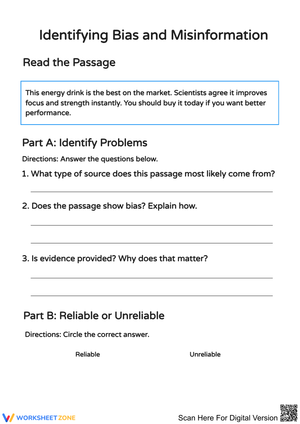
The most persistent error isn't a lack of effort — it's appearance-based trust. Ninth graders consistently rate websites as credible based on visual design: clean layout, professional photography, absence of typos. A well-funded advocacy organization with a deliberate agenda clears all of those bars while publishing content that misrepresents or selectively omits peer-reviewed data. These worksheets push past surface appearance by requiring specific documentary evidence — an actual author name checked against a secondary source, not just a byline on the article itself. When students have to write down where they verified the author's credentials and find a blank space staring back at them, that blank space is instructional.
A second pattern surfaces reliably in early research drafts: students treat .org as a reliability signal. They'll cite an industry trade association or a political advocacy group as "a nonprofit source" without investigating who funds it. One worksheet asks students to search "[organization name] + funding" and record what they find before reaching any credibility conclusion. Even after classroom discussion of this point, the assumption that .org means neutral is durable enough to require the structured documentation step to dislodge it. The third pattern worth anticipating is vertical reading — students work through a biased article, accept its internal logic, and never leave the page to check what others say about that outlet. The lateral reading worksheets are the direct intervention for that habit.
How to Build These Worksheets Into Your Research Unit
Place the CRAAP test worksheets early in a research unit — before students have committed to any sources. That timing matters because once a student has written a paragraph around an article, they will defend that article's credibility regardless of what a credibility checklist reveals. Run the first worksheet as a whole-class exercise: project the graphic organizer, select a neutral sample article, and work through every field out loud. Let students argue about whether the author qualifies as authoritative. That debate is productive — it surfaces the judgment calls the worksheet will ask them to make independently.
The lateral reading worksheets work best in a computer lab block or during a class research day when students have live browser access. Pair students for this round, with one person reading the original article while the other opens new tabs to search for external information on the outlet. They swap roles for a second source. Structuring it as a two-person task makes the tab-opening feel like a natural research move rather than an extra burden, and students carry the habit more reliably into independent work afterward.
For independent application, require a completed credibility assessment worksheet for every source a student plans to cite. This turns each worksheet into a process checkpoint embedded in the research itself. If a completed worksheet shows a student cited an industry-funded think tank without noting the conflict of interest, the conference question writes itself: "What did you find when you searched for this organization's funding?" The worksheet should have that field filled in, which makes the follow-up conversation specific rather than general.
Standard Alignment
The primary standard is CCSS.ELA-LITERACY.W.9-10.8, which requires students to gather relevant information from multiple authoritative print and digital sources, assess the usefulness of each source in answering the research question, and integrate information selectively while avoiding plagiarism. Connecting assessing credibility of sources printable worksheets for 9th grade directly to this standard gives teachers a clear rationale for requiring the evaluation process as a graded component of research — not optional enrichment. The "assess the usefulness" clause in W.9-10.8 is the part of the standard most often skipped because it is the hardest to document; these worksheets are where that documentation happens.
The set also addresses CCSS.ELA-LITERACY.RI.9-10.6 — analyzing point of view, purpose, and rhetoric in informational texts — and CCSS.ELA-LITERACY.RI.9-10.8, which focuses on evaluating the argument, the validity of the reasoning, and the relevance and sufficiency of evidence. Together, these three standards describe a reader who doesn't simply consume a text but interrogates the conditions under which it was produced.
Differentiating These Worksheets Across Ability Levels
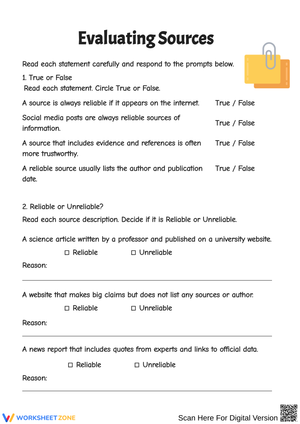
For students who struggle to evaluate an unfamiliar source independently, narrow the variables before widening them. Assign two pre-selected articles on the same topic — one from a clearly authoritative outlet, one from a transparently biased or commercially motivated source — and have students run the credibility checklist on both simultaneously. The contrast between sources does analytical work that an isolated unfamiliar article won't. Sentence frames also give hesitant students a starting structure without doing the thinking for them: "I could not verify this author's credentials because..." or "This source appears commercially motivated because the article..."
Students who are ready for more complexity can treat the worksheet fields as a floor rather than a ceiling. Ask them to evaluate a source that looks authoritative on the surface but carries institutional bias — a university research center funded by a pharmaceutical company, or a journalism outlet with a documented political lean not disclosed in its mission statement. Once the worksheet fields are complete, require a written source evaluation paragraph: here is what I found, here is what it means for the argument I am building, and here is my decision about whether to cite this source or find a better one. For assessing credibility of sources printable worksheets for 9th grade to serve students across ability levels, the structure stays consistent while the complexity of the assigned source and the follow-up expectation shift.
Frequently Asked Questions
Do the lateral reading worksheets require live internet access during class?
The CRAAP test worksheets work with print sources, distributed PDFs, or any article students have downloaded ahead of time — no live browser needed. The lateral reading worksheets are a different situation. By definition, lateral reading requires students to open new tabs and search for information about the original source, so those worksheets require device access. Teachers in low-tech classrooms often run the lateral reading worksheet as a whole-class demonstration projected from the teacher's device, then assign the print-based credibility worksheets for individual practice or homework.
How much class time should I budget for each worksheet?
A CRAAP test worksheet typically runs 15–25 minutes for a ninth grader working with a moderately complex article. The lateral reading worksheets take closer to 30–40 minutes once students include the search and documentation steps. Budget extra time the first run-through — the unfamiliarity of the process slows things down — but pace picks up considerably on the second and third use as the evaluation routine becomes habitual.
Can these worksheets be used in social studies or science classes?
The evaluation skills these worksheets address apply wherever students are selecting sources to support a claim. Assessing credibility of sources printable worksheets for 9th grade work in social studies units on media and propaganda, in science classes distinguishing peer-reviewed research from popular-press reporting, and in health classes evaluating nutritional or medical information. The CRAAP test and lateral reading frameworks aren't ELA-specific — they're domain-general research skills that every subject-area teacher benefits from reinforcing when students are gathering evidence.
At what point in a research unit should I introduce these?
Before students commit to any sources — ideally in the first or second class period of a research unit, after the research prompt is established but before students begin searching. The reason for that timing is as much psychological as it is pedagogical: once a student has built a paragraph around a source, they have a stake in defending that source's credibility. Running the evaluation worksheets before the writing begins keeps the assessment judgment clean and separate from whatever investment students have already made in their drafts.












 Interactive Worksheet Maker
 Quiz Maker
 Word Search Maker
 Crossword Puzzle Maker
 Word Scramble Generator
 Sentence Scramble Generator
 Handwriting Worksheet Generator
 Name Tracing Generator
 Fill In The Blank Generator