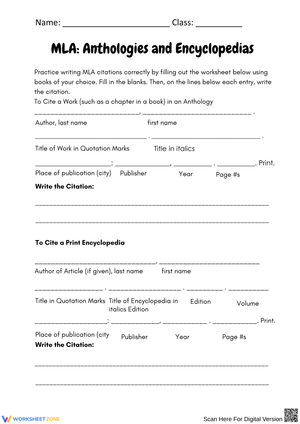
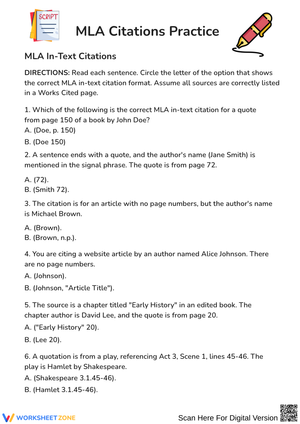
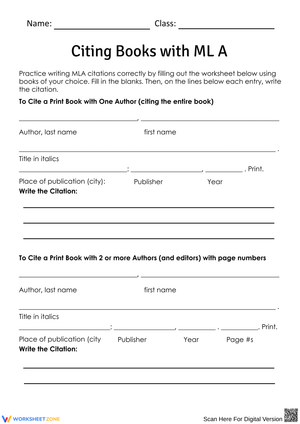
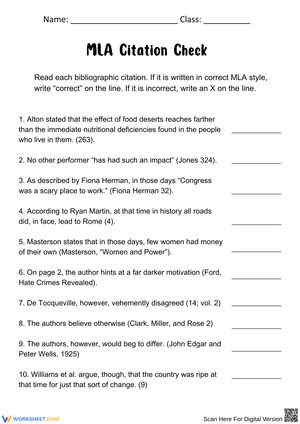
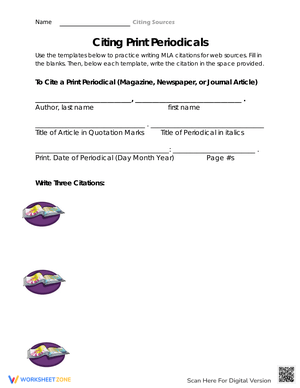
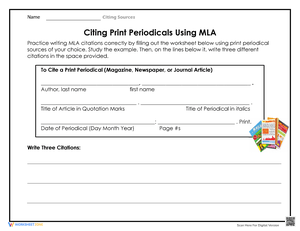
These citing sources pdf worksheets for 9th grade give teachers ready-to-use practice materials for every stage of MLA attribution instruction — identifying core elements, constructing Works Cited entries, placing in-text citations correctly, and learning to tell genuine paraphrasing apart from patchwriting. The set covers both the mechanics and the reasoning, so students don't just memorize a format; they understand what a citation is doing inside an argument.
What Each Worksheet Targets
Each worksheet addresses a distinct slice of citation work rather than covering everything at once. That narrowness is intentional — ninth graders absorb formatting rules better when one concept is isolated per practice session. The specific skills across the set include:
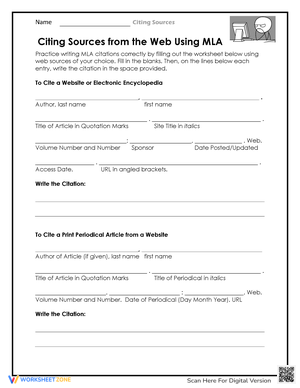
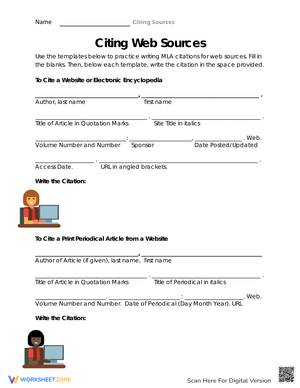
- Identifying the nine MLA core elements in a given source: author, title, container, other contributors, version, number, publisher, publication date, and location
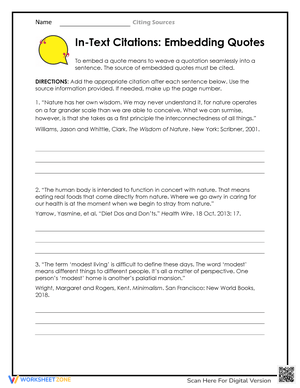
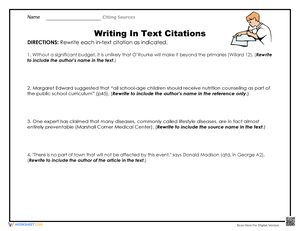
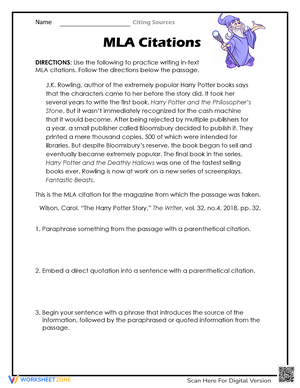
- Writing parenthetical in-text citations with correct punctuation placement — the period falls after the closing parenthesis, not before it
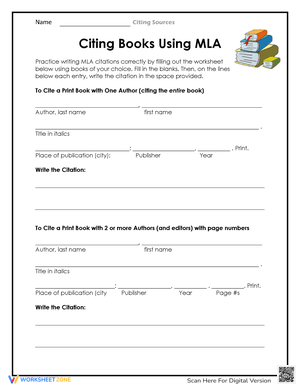
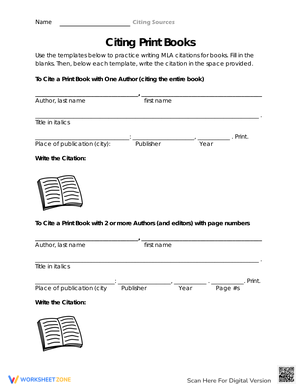
- Constructing Works Cited entries for print books, websites, database articles, and videos
- Distinguishing a properly paraphrased sentence from a patchwritten one
- Handling missing source information: no listed author, no publication date, no page numbers for online sources
- Citing AI-generated content using current MLA guidance — a scenario that shows up in actual ninth-grade research now
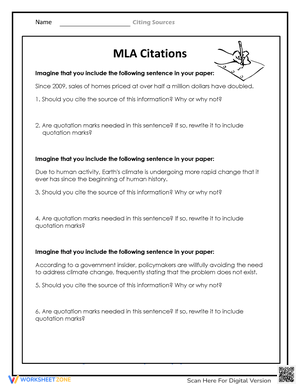
- Recognizing which facts qualify as common knowledge and which require attribution
Frequent Student Errors Worth Catching Before the Research Paper
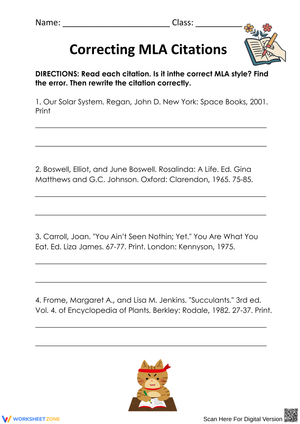
The mistakes that show up most consistently in ninth-grade research papers fall into two categories: punctuation placement and incomplete container information. On the punctuation side, students routinely write the period before the parenthetical — "The study confirmed the results. (García 23)" — which reverses the MLA rule entirely. These worksheets ask students to correct sample citations where punctuation is deliberately wrong, which surfaces that error before it gets locked into graded writing habits.
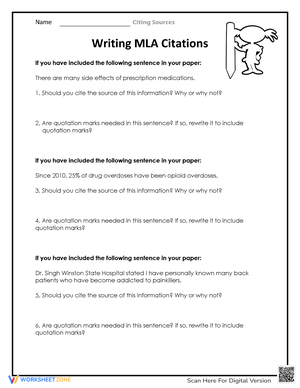
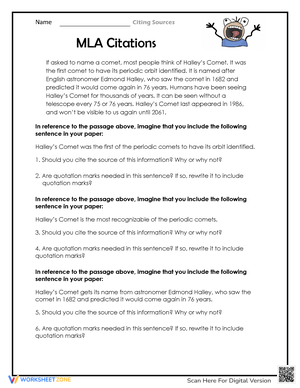
The deeper problem is patchwriting. Students often believe they have paraphrased a source when they have actually copied the sentence structure and swapped a handful of synonyms. A student who reads "Coastal erosion accelerates when protective vegetation is removed" and writes "The removal of protective plants speeds up coastal erosion" has stayed uncomfortably close to the original. Each worksheet addressing paraphrasing includes a model source passage alongside three student rewrites — one that is a direct quote, one that is patchwritten, and one that is a genuine paraphrase — so students practice making that distinction before drafting independently. Handling sources with no listed author also trips up ninth graders; they either omit the citation entirely or write "Unknown" in the author field, neither of which is correct MLA practice.
Building These Worksheets Into Your Lesson Sequence
Citation instruction lands better when it's distributed across several weeks rather than front-loaded into a single unit. Using one worksheet as a ten-minute opener three times a week accomplishes more than a full-period citation lesson, because students get repeated low-stakes exposure to the format before they need to apply it independently in a research paper. The opener model also lets you time each worksheet to the phase of writing: core-elements identification during the research-gathering week, in-text citation drills while students draft body paragraphs, and Works Cited construction during revision.
One classroom move that lands with particular impact comes when you introduce the MLA container concept. Bring a cereal box and a DVD case to class. Have students use the worksheet to map the physical object's labeling — brand name, product name, manufacturer — onto the MLA core elements: container, title, publisher. Ninth graders who think in concrete terms lock onto this before they ever open a database. The worksheet becomes a reference they return to when something like a journal article inside a database (source inside a container inside another container) starts to feel abstract. Citing sources pdf worksheets for 9th grade that pair a physical-world example with an actual academic citation give students a mental anchor that holds across the semester, not just through the lesson.
Standard Alignment
These worksheets address CCSS.ELA-LITERACY.W.9-10.8, which requires students to gather information from multiple authoritative print and digital sources, integrate it selectively into their writing, and follow a standard format for citation. That standard is where the gap between eighth and ninth grade becomes visible: eighth-grade citation expectations focus on basic sourcing, while W.9-10.8 adds source evaluation and disciplined integration. The worksheets also reinforce W.9-10.6, which covers using technology to produce and publish writing, since many of the source types students practice citing — digital articles, embedded videos, AI tools — appear in technology-integrated assignments. For teachers in states with adapted standards, the skills map cleanly to secondary research and writing strands.
Differentiating the Set Across Ability Levels
For students who are still shaky on what a source is, the core-elements worksheets work well with a completed example already filled into the first row — students use that model entry as a reference while attempting the rows below. That's a low-lift adjustment that keeps the task intact without removing the thinking. Citing sources pdf worksheets for 9th grade also have real value at the other end of the ability range: strong writers who format entries correctly benefit most from the comparison tasks, where two nearly identical citations differ by a single element and students have to identify the error and explain why it matters.
For English language learners, the vocabulary of citation adds a layer of difficulty that goes beyond formatting. Words like "container," "contributor," and "location" carry technical meanings that differ from everyday usage. Pre-teaching those nine MLA core-element terms with brief written definitions before the worksheet task reduces the language barrier without simplifying the citation work itself. Peer annotation — where a partner circle-marks each correctly identified core element — gives ELL students low-pressure immediate feedback during the practice session rather than waiting for teacher review.
Frequently Asked Questions
Do these worksheets cover MLA, APA, or both?
The set focuses on MLA 9th Edition, which is the standard format in high school ELA classrooms and the one most ninth graders will use throughout secondary school. APA is more common in college-level social science writing; introducing it alongside MLA at this grade level creates confusion rather than flexibility. Teachers whose departments require APA for specific research assignments can use the core-elements worksheets as a bridge, since both formats draw on the same underlying source components even when the formatting rules diverge.
How do I handle the AI citation question — students ask it constantly now?
Current MLA guidance treats AI-generated text as a source that requires attribution. The format uses the prompt as the title, the AI tool (e.g., ChatGPT) as the container, the company as the publisher, and the date of generation as the publication date. Citing sources pdf worksheets for 9th grade that include AI citation scenarios prepare students for a source type they are already using, and the practice opens a productive classroom conversation about when and whether AI tools belong in research at all.
What is the difference between a Works Cited page and a Bibliography, and do I need to teach both?
A Works Cited page lists only the sources a student directly quoted or paraphrased inside the paper. A Bibliography includes everything consulted during research, whether cited in the text or not. For ninth-grade ELA, Works Cited is the correct requirement — it's what MLA specifies and it holds students accountable for integrating specific evidence. Teaching the distinction takes one direct explanation; the worksheets in this set focus on Works Cited construction, which is the skill students actually need for their papers.
What do students do when they can't find all the citation information for a source?
MLA allows students to omit any core element that genuinely does not exist for a given source — the citation simply moves to the next available element. The set includes worksheets with intentionally incomplete source cards, where students construct the most accurate citation possible from the available data and note which elements are absent. That practice eliminates the common response of abandoning a valid source entirely because the author name isn't visible on the page.












 Interactive Worksheet Maker
 Quiz Maker
 Word Search Maker
 Crossword Puzzle Maker
 Word Scramble Generator
 Sentence Scramble Generator
 Handwriting Worksheet Generator
 Name Tracing Generator
 Fill In The Blank Generator