




























Views
Downloads


Printable Exponents Rules Worksheet | Grades 6-8 Math

Paste this activity's link or code into your existing LMS (Google Classroom, Canvas, Teams, Schoology, Moodle, etc.).
Students can open and work on the activity right away, with no student login required.
You'll still be able to track student progress and results from your teacher account.
Mastering the intricacies of algebraic expressions begins with a firm grasp of exponent properties. This comprehensive four-page worksheet is designed to guide students through the systematic application of the product and power rules. By transitioning from basic single-variable simplifications to complex multi-variable challenges, learners build the procedural fluency necessary for advanced algebraic success.
At a Glance
- Grade: 8 · Subject: Math
- Standard:
CCSS.MATH.CONTENT.8.EE.A.1— Apply exponent properties to generate equivalent numerical expressions- Skill Focus: Product and power of powers rules
- Format: 4 pages · 21 problems · Answer key included · PDF
- Best For: Middle school algebra independent practice
- Time: 30–45 minutes
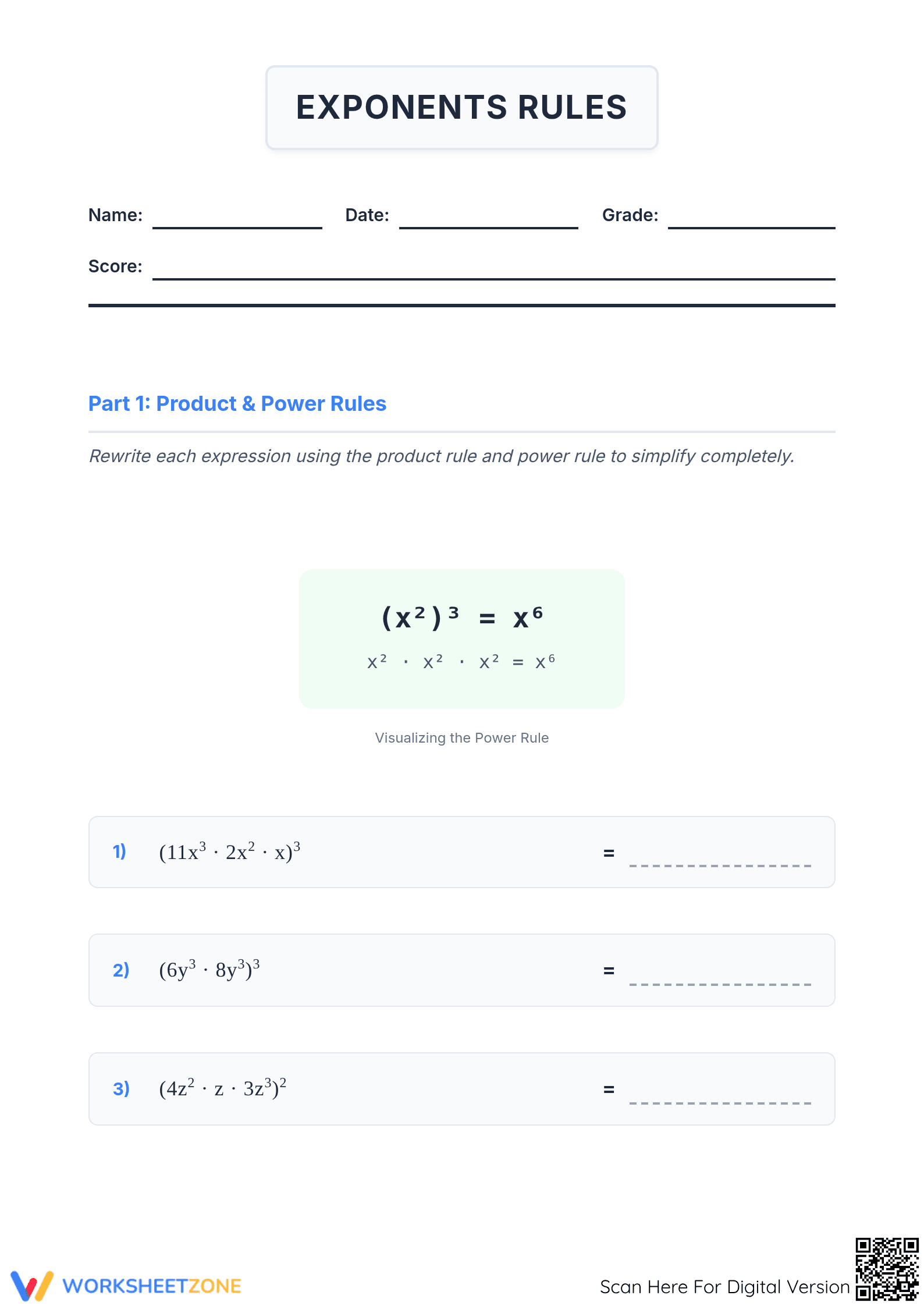
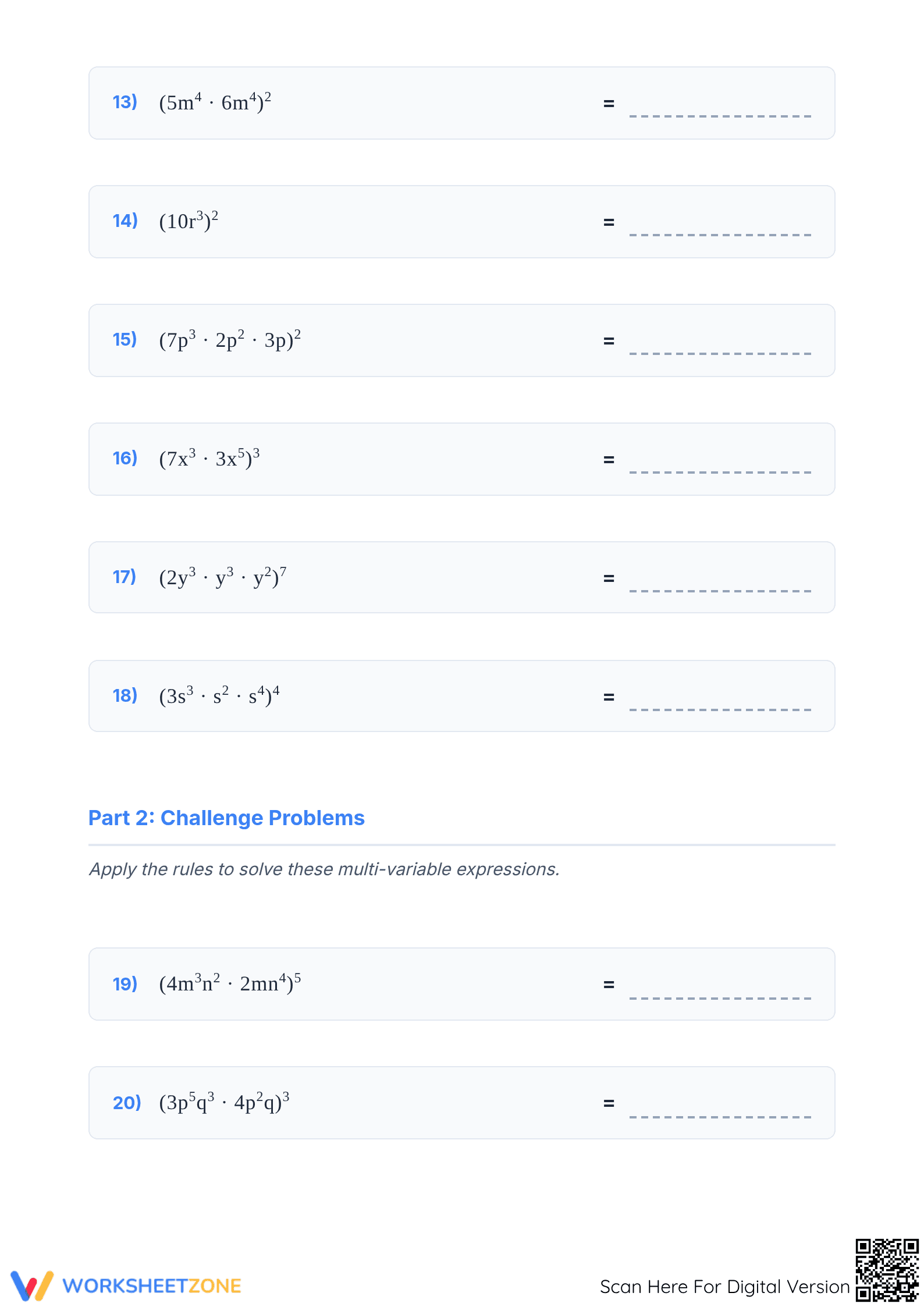
This resource contains a total of 21 problems spread across four clearly organized pages. It begins with a visualization of the power rule to ground student understanding before moving into eighteen structured practice items. The final page features a dedicated challenge section with multi-variable problems and a conceptual reflection question. A full answer key is provided for immediate feedback and grading efficiency.
- Guided Practice: Problems 1-6 offer introductory single-variable expressions, applying the power rule as modeled in the visual example.
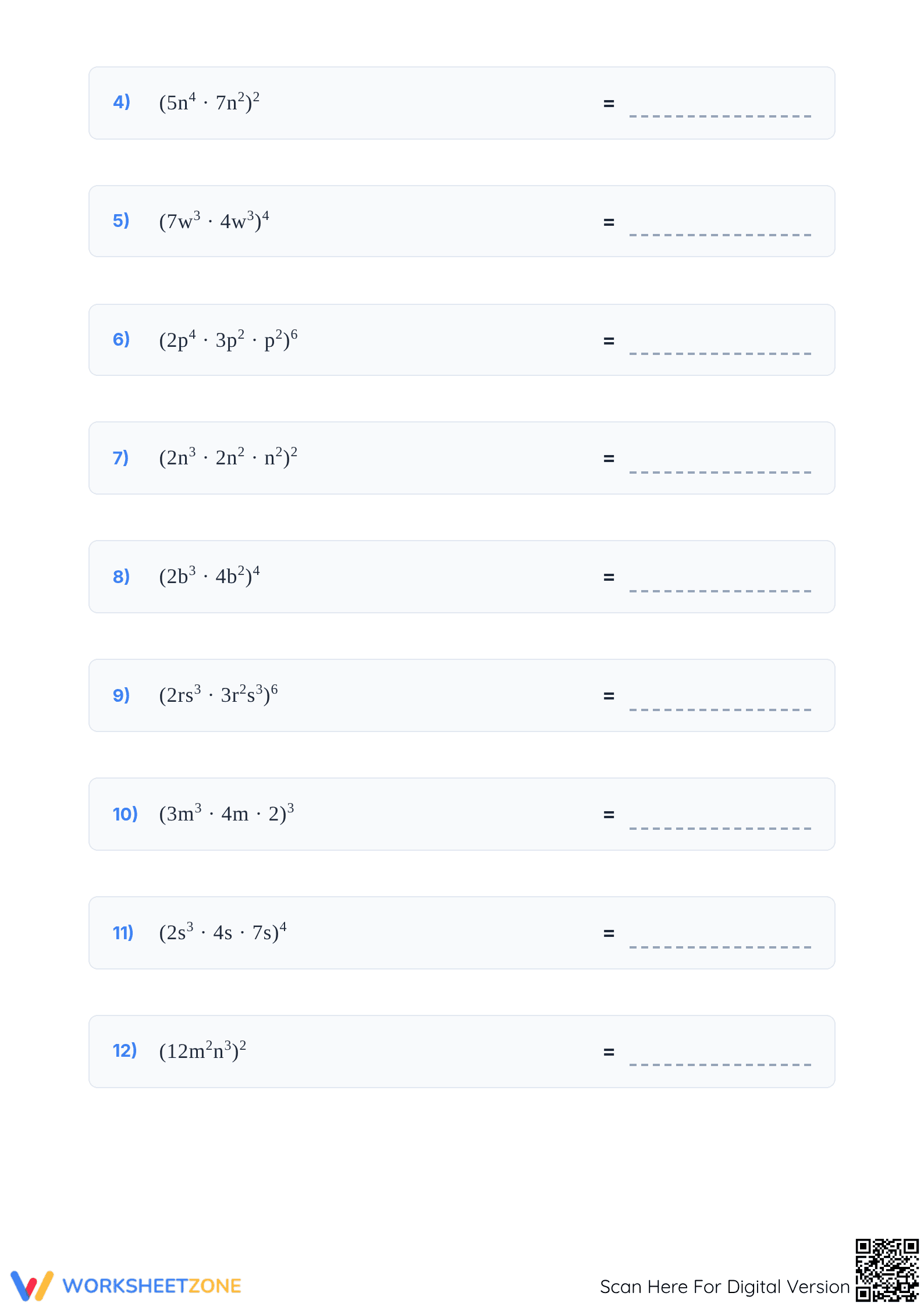
- Supported Practice: Problems 7-18 introduce coefficients and multiple terms, requiring the simultaneous application of both product and power rules.
- Independent Practice: The challenge section features multi-variable expressions and a conceptual short-answer question assessing the underlying logic of base-ten operations.
This sequence follows a gradual-release model, moving from scaffolded repetition to independent mastery of complex algebraic structures.
Aligned to CCSS.MATH.CONTENT.8.EE.A.1, this worksheet focuses on knowing and applying the properties of integer exponents to generate equivalent numerical expressions. It also supports the development of algebraic reasoning by bridging middle school foundations with high school expectations. Both standard codes can be copied directly into lesson plans, IEP goals, or district curriculum mapping tools.
This worksheet is ideal for use during the independent practice phase of a lesson or as a comprehensive homework assignment. For formative assessment, observe students during the transition to the challenge section (problems 19-20) to identify those struggling with multi-variable terms. Expected completion time is approximately 30 to 45 minutes depending on student familiarity with the rules.
Designed for Grade 8 students, this material is also suitable for Grade 6 and 7 enrichment or as a review for Algebra 1. It pairs naturally with a lesson on base-ten operations or an anchor chart detailing the laws of exponents. Differentiation is supported through the inclusion of tiered difficulty levels within the problem set.
According to the common core standards for eighth-grade mathematics, specifically CCSS.MATH.CONTENT.8.EE.A.1, students must demonstrate proficiency in applying the properties of integer exponents to generate equivalent numerical expressions. This worksheet provides a rigorous pathway to this goal by systematically isolating the product and power rules before integrating them into multi-variable challenge problems. Educational research by Fisher & Frey (2014) emphasizes the importance of a gradual release of responsibility model, which is mirrored here through the progression from simple, single-variable expressions to complex, higher-order application tasks. By requiring students to not only compute but also articulate the conceptual logic behind exponent addition, this resource ensures that procedural fluency is grounded in deep mathematical understanding. This alignment with evidence-based instructional design makes the material an essential component of any middle school curriculum focused on algebraic foundations and the preparation for high school level mathematics.


