


























Views
Downloads


Exponents Rules Practice | Grade 8 Essential Worksheet
Paste this activity's link or code into your existing LMS (Google Classroom, Canvas, Teams, Schoology, Moodle, etc.).
Students can open and work on the activity right away, with no student login required.
You'll still be able to track student progress and results from your teacher account.
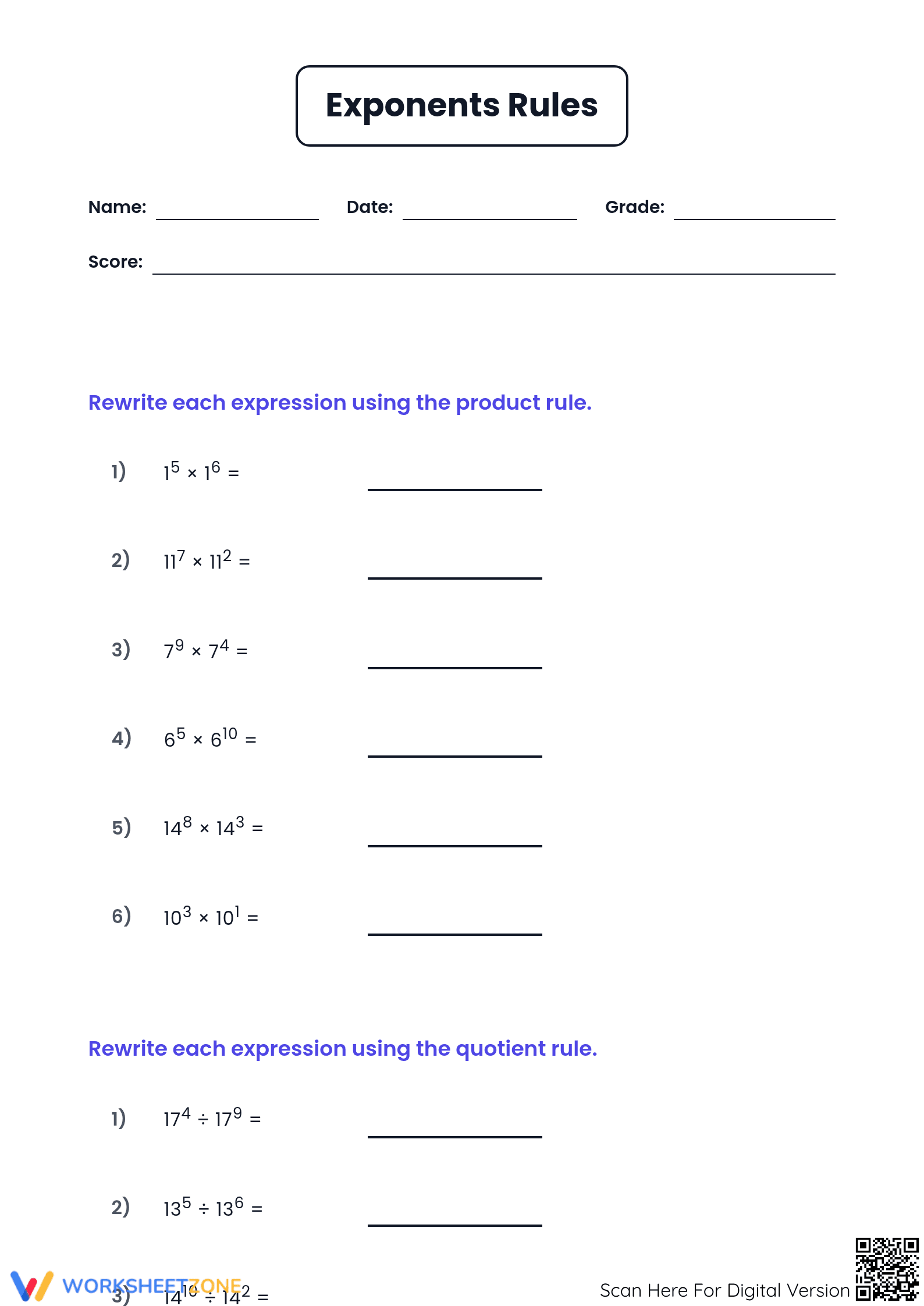
This comprehensive exponents rules worksheet provides students with targeted practice across the product, quotient, and power rules. By working through structured exercises, learners develop the procedural fluency needed to simplify complex numerical expressions. This resource is designed to bridge the gap between initial instruction and mastery through clear categorization and progressive difficulty.
At a Glance
- Grade: 8 · Subject: Math
- Standard:
CCSS.MATH.CONTENT.8.EE.A.1— Apply integer exponent properties to generate equivalent numerical expressions- Skill Focus: Laws of Exponents (Product, Quotient, Power)
- Format: 3 pages · 22 problems · Answer key included · PDF
- Best For: Homework, Quiz Prep, or Independent Practice
- Time: 25–35 minutes
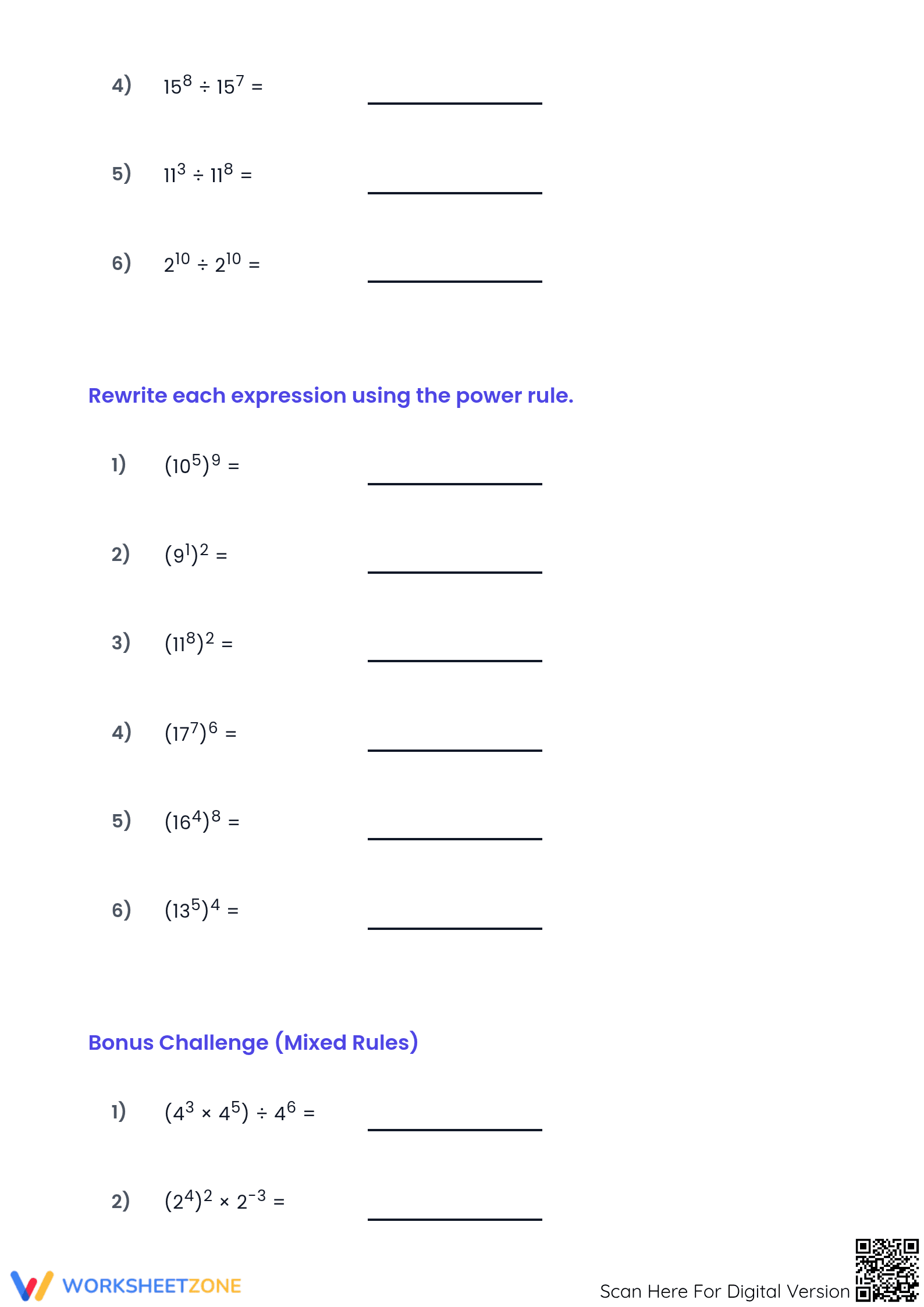
This three-page PDF contains twenty-two problems organized by specific exponent rules. The set includes six problems for the product rule, six for the quotient rule, and six for the power rule. The final page features a four-problem "Bonus Challenge" requiring students to combine multiple laws. A full answer key ensures efficient grading and immediate feedback for learners.
Zero-Prep Workflow
- Step 1: Print. Send the three-page PDF to your printer in seconds for immediate use.
- Step 2: Distribute. Hand out the worksheets to students as they enter the classroom or start a station.
- Step 3: Review. Use the included answer key to review results as a whole class or individually.
Total teacher preparation time is less than two minutes, making this an ideal solution for substitute plans or urgent instructional needs.
The primary focus of this worksheet is CCSS.MATH.CONTENT.8.EE.A.1: "Know and apply the properties of integer exponents to generate equivalent numerical expressions." Students must recognize when to add, subtract, or multiply exponents based on the operation performed on the base. Both standard codes can be copied directly into lesson plans, IEP goals, or district curriculum mapping tools to track student proficiency.
This worksheet is best used as a formative assessment after the initial introduction of exponent laws. Teachers can assign the first two pages as independent practice during class, using the Bonus Challenge as an extension for early finishers. Alternatively, use it as a comprehensive homework assignment to reinforce skills before a unit test. Observe how students handle the mixed-rule problems to identify lingering misconceptions about order of operations.
Designed for Grade 8 students, this resource is also appropriate for high school algebra students requiring a refresher on exponent properties. The clear labeling of rules provides necessary scaffolding for struggling learners, while the bonus section offers the rigor required for advanced students. It pairs naturally with direct instruction or anchor charts detailing the fundamental laws of exponents.
According to the principles of gradual release of responsibility (Fisher & Frey, 2014), students require structured opportunities to practice new mathematical concepts before moving toward independent mastery. This worksheet facilitates that process by categorizing problems by specific laws (product, quotient, and power rules) before challenging students with mixed-rule applications. By isolating each property, the resource reduces cognitive load during the initial practice phase, allowing students to build confidence. The inclusion of multi-step "Bonus Challenge" problems aligns with research suggesting that interleaved practice—mixing different types of problems—enhances long-term retention and the ability to transfer skills to new contexts. This standards-aligned tool (CCSS.MATH.CONTENT.8.EE.A.1) ensures that students are performing grade-level work that meets rigorous state and national expectations for mathematical proficiency. Educators can reliably use this 22-problem set to measure student progress and inform future instructional decisions regarding the laws of exponents.


