


























Views
Downloads


Printable Laws of Exponents Worksheet | Grade 9 Aligned
Paste this activity's link or code into your existing LMS (Google Classroom, Canvas, Teams, Schoology, Moodle, etc.).
Students can open and work on the activity right away, with no student login required.
You'll still be able to track student progress and results from your teacher account.
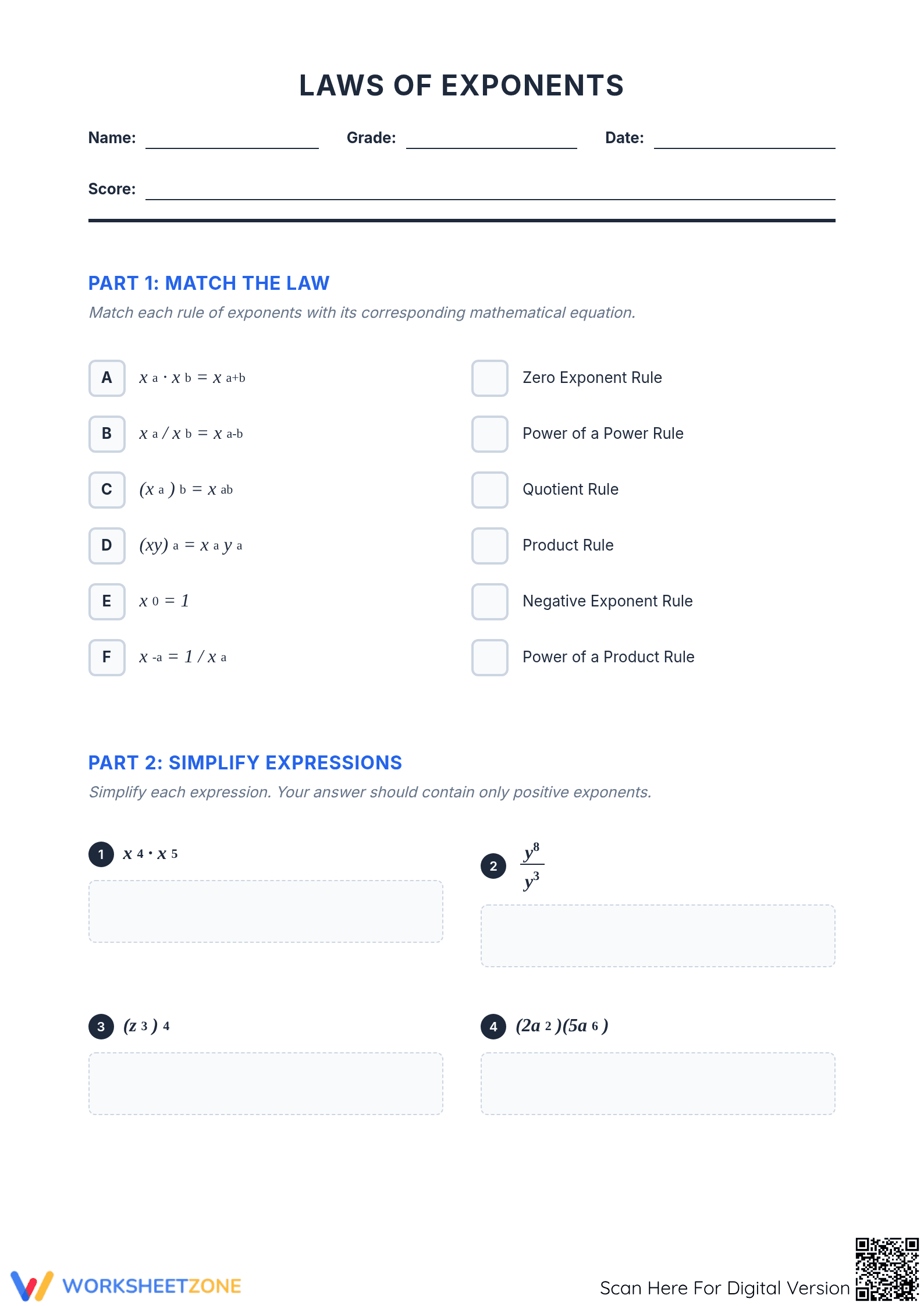
This Grade 9 laws of exponents worksheet helps students master the fundamental rules of algebra through structured practice. By simplifying complex expressions, learners build the procedural fluency required for higher-level mathematics. The clear layout ensures students focus on the logic of each law before tackling multi-step algebraic transformations for mastery.
At a Glance
- Grade: 9 · Subject: Algebra
- Standard:
8.EE.A.1— Apply the properties of integer exponents to generate equivalent numerical expressions- Skill Focus: Laws of Exponents
- Format: 3 pages · 20 problems · Answer key included · PDF
- Best For: Algebra 1 skill reinforcement
- Time: 25–40 minutes
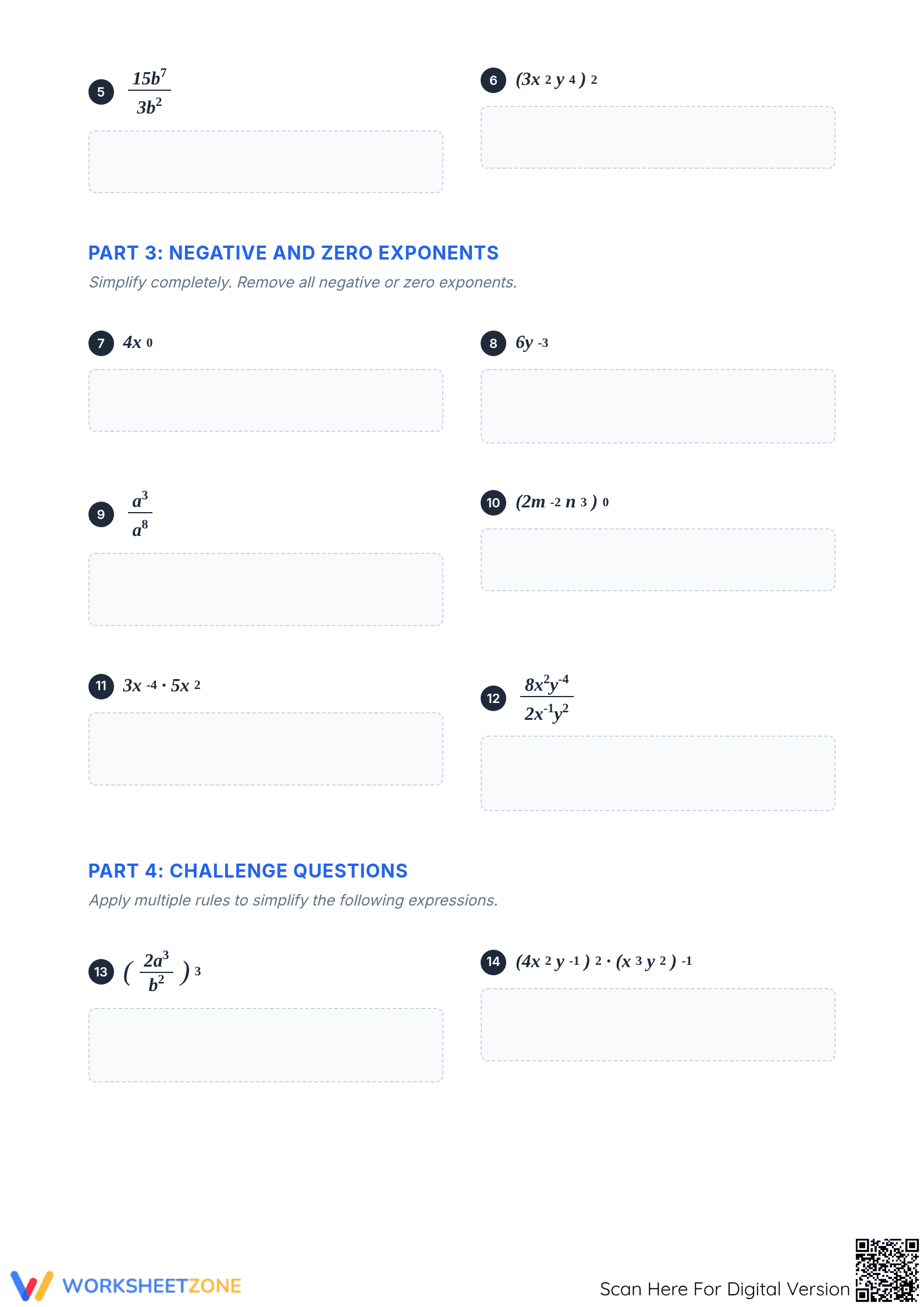
What's Inside: This resource contains three comprehensive pages designed to take students from recognition to application. It features a rule-matching section, sixteen simplification problems of increasing complexity, and two intense challenge questions. Every page includes organized workspace, and a full answer key is provided to facilitate quick grading or student self-correction.
Skill Progression
- Guided Practice: Students begin with 6 matching tasks that connect mathematical equations to their specific exponent laws, establishing a firm conceptual foundation.
- Supported Practice: The middle section provides 10 simplification tasks that isolate individual rules like the Quotient and Power of a Power laws.
- Independent Practice: The final page presents 4 challenge problems requiring students to combine multiple rules, including negative and zero exponents, in complex multi-variable expressions.
This sequence follows the gradual-release model, ensuring students master basic properties before applying them to sophisticated algebraic structures.
Standards Alignment
The primary focus of this worksheet is 8.EE.A.1: Know and apply the properties of integer exponents to generate equivalent numerical expressions. It also supports HSA-SSE.A.2 by requiring students to use the structure of an expression to identify ways to rewrite it. Both standard codes can be copied directly into lesson plans, IEP goals, or district curriculum mapping tools.
How to Use It
Distribute this worksheet after a direct instruction lesson on exponent properties as a formative assessment. Use the matching section as a quick check for understanding before allowing students to move into the simplification blocks. Teachers should observe how students handle negative exponents in the third section to identify common misconceptions. Completion typically ranges from 25 to 40 minutes.
Who It's For
This resource is designed for Algebra 1 students but is also appropriate for Grade 8 honors classes or as a refresher for Algebra 2 learners. It provides necessary support for students struggling with algebraic manipulation while offering challenge questions for advanced learners. It pairs perfectly with an interactive notebook or a laws of exponents anchor chart.
Effective algebraic instruction relies on the gradual release of responsibility, moving from recognition to application. According to Fisher & Frey (2014), scaffolding tasks by complexity—starting with rule identification and ending with multi-step challenge problems—is vital for developing mathematical persistence. This worksheet aligns with standard 8.EE.A.1, which requires students to know and apply the properties of integer exponents to generate equivalent numerical expressions. Research from RAND AIRS 2024 emphasizes that repeated exposure to these rules reduces cognitive load when students later encounter exponential functions or scientific notation. By isolating each rule—Product, Quotient, Power of a Power, Power of a Product, Zero, and Negative—students establish a concrete mental model of exponent behavior. This 20-task resource provides the high-repetition practice necessary for students to transition from procedural memorization to conceptual mastery of algebraic properties, ensuring they are prepared for the rigorous demands of secondary mathematics curriculum.


