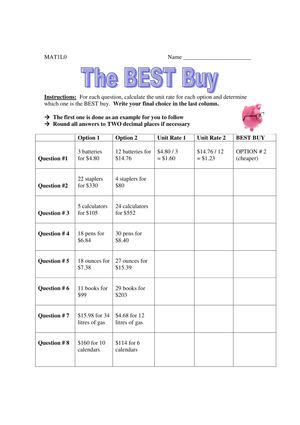
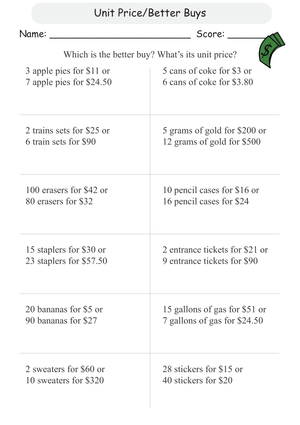
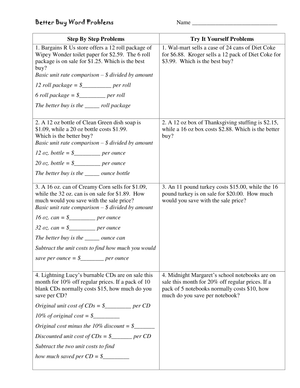
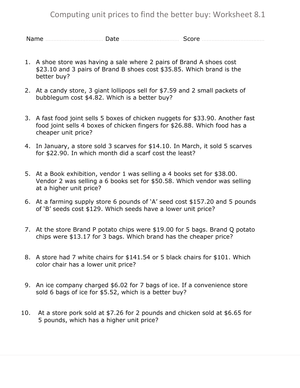
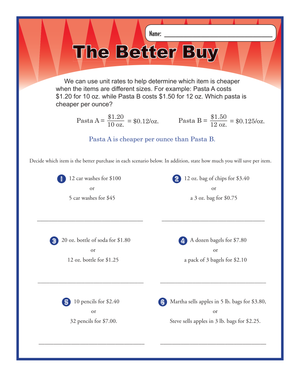
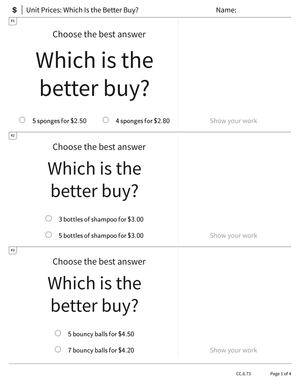
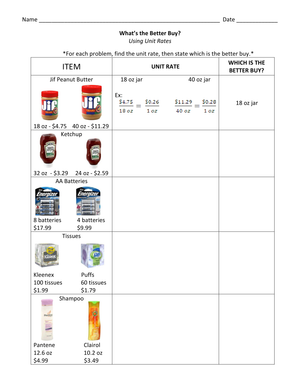
These whats the better buy printable worksheets for 7th grade give teachers a focused entry point into unit-rate reasoning through real purchasing decisions — students compare prices, sizes, and quantities to determine actual value rather than stopping at the lower sticker price. Each worksheet asks students to compute a unit rate, compare the results, and defend their choice in a written sentence. The set requires no special setup and fits into a standard 50-minute class period in multiple ways.
The Specific Skills Each Worksheet Builds
Better-buy problems at the seventh-grade level are not single-skill tasks. Each worksheet moves students through several connected steps: identifying the comparison unit, dividing price by quantity, comparing two resulting rates, and producing a written justification. That sequence repeats with varying numbers and contexts, which is what builds fluency rather than a one-time procedure.
The problem types across the set include:
- Whole-number comparisons with clean division — these establish the routine before decimals enter the picture
- Decimal-heavy pricing that mirrors actual store formats, including prices like $3.79 or $5.12
- Fraction quantities — a 1¾ lb package versus a 2½ lb package, for example — that connect directly to 7.RP.A.1
- Three-option rankings where students must order products from best to worst buy rather than choosing between two
- Problems with misleading totals, where one option carries a lower total price but a higher unit cost, forcing students to rely on math rather than first impressions
- Written-response prompts where students produce a statement like "Package B costs $0.46 per ounce, which is less than Package A at $0.54 per ounce, so Package B is the better buy"
Mistakes Students Make That These Worksheets Help You Catch
The most reliable error pattern in better-buy work is straightforward: students compare total cost instead of unit cost. Given a 16 oz bag for $4.99 and a 12 oz bag for $3.89, many students circle the $3.89 option without computing that it costs 32.4 cents per ounce versus 31.2 cents per ounce — making the larger bag the actual better value. This shows up most often in students who have good number intuition but have not yet internalized the unit-rate routine, and it is almost invisible unless the worksheet asks students to show their unit-price calculations alongside the final answer.
A second consistent mistake is unit mismatch. In shopping-style problems, students may compute cost per package for one item and cost per ounce for the other, then compare those numbers directly. The arithmetic looks right; the logic is not. Requiring students to circle the comparison unit on each option before they touch the numbers is a low-cost annotation habit that reduces this error noticeably — it slows the work just enough to interrupt the impulse to compute first and read second.
A third pattern: students who get the unit rates correct but write a justification that ignores them entirely — "Package A is better because it has more" or "Package B costs less." The written-response format surfaces this gap clearly and makes it easy to address in a two-minute whole-class discussion before moving on.
How to Build These Worksheets Into Your Lesson Plans
As a warm-up, one comparison problem works well for the first five minutes of class. The goal is not speed — it is to get students into the reasoning routine before the main lesson begins. Taking two extra minutes to discuss method is worth it: some students will divide price by quantity, others will scale to a common quantity first, and naming both approaches out loud reinforces that the goal is accurate comparison, not a fixed algorithm.
For partner practice, assign a short problem set from one worksheet where pairs must agree on both the answer and the written justification. The conversation that happens when two students disagree about whether total cost matters is exactly the discussion that solidifies the concept. Teachers circulating the room can listen for the specific misconception that lower total price equals better deal — it is one of the clearest diagnostic signals this topic produces.
Exit tickets are where these worksheets do some of their best diagnostic work. A single decimal-price comparison at the end of class gives a fast read on whether students can apply the strategy without step-by-step support. If more than a third of the class selects the lower-total-price option without computing unit rates, that result shapes the next day's opening directly — no additional planning required.
Standard Alignment
These worksheets target CCSS 7.RP.A.1 — "Compute unit rates associated with ratios of fractions, including ratios of lengths, areas, and other quantities measured in like or different units" — and CCSS 7.RP.A.2, which asks students to recognize and represent proportional relationships between quantities. In instructional terms, better-buy problems sit at the application end of 7.RP.A.1: students are not computing a unit rate in isolation but using it to make and defend a real decision. That applied layer is what moves the skill from procedural to functional. The whats the better buy printable worksheets for 7th grade set fits most directly in the latter phase of the 7.RP unit, after students can compute unit rates fluently and are ready to interpret and compare them in context.
Adjusting the Set for a Mixed-Ability Classroom
For students who need more support with the structure, start with problems where both options share the same unit and the quantities divide cleanly. Adding printed prompts — "Step 1: Write the unit price for Option A" — keeps those students focused on the meaning of unit rate rather than losing them to multi-step arithmetic before the routine is established. Pair those prompts with whole-number prices so the division stays manageable and the attention stays on the comparison, not the computation.
For students ready for more challenge, fraction quantities raise the difficulty without changing the core task. A problem comparing a 1⅓ lb package to a 2¼ lb package requires dividing by a mixed number, which connects cleanly to the fraction work in 7.RP.A.1. Three-option rankings push further still: students must compute three unit rates, order them, and explain why the middle-priced option is not the best buy even though it looks reasonable. Misleading-total problems are especially effective extension tasks because students must hold two numbers in mind — total cost and unit cost — and choose the right one to act on. Whats the better buy printable worksheets for 7th grade lend themselves well to this kind of tiered use because the format stays consistent even as the numbers increase in complexity, so students at every level are working the same reasoning routine.
Frequently Asked Questions
How do students find the better buy using unit rates?
Students divide the price by the quantity for each option, making sure both are measured in the same unit. They then compare the two results and identify the lower unit price as the better buy. The written-response step — stating which option wins and explaining why using the computed rates — completes the reasoning cycle and is where most of the useful formative information lives for teachers reviewing student work.
Are these worksheets appropriate for a ratio and proportional reasoning unit review?
Yes. Better-buy tasks bring together unit-rate computation, proportional comparison, and written justification in one problem type, which makes them efficient for review. They work well near the end of a 7.RP unit when students have the computation skills but need practice applying them in context. Using whats the better buy printable worksheets for 7th grade during review also gives teachers a quick window into which students can transfer the unit-rate procedure versus which students still default to comparing total costs.
What real-world contexts work best for comparison shopping problems?
Food and grocery comparisons hold attention reliably — different-size cereal boxes, juice packs, trail mix bags. School supplies also work because the quantities are familiar to students. The key is that packaging quantities and prices feel plausible; if students spend time questioning whether a price is realistic, their attention moves away from the math. Clear labels and believable numbers let students focus on computing and comparing rather than decoding the scenario.
How do these worksheets support financial literacy goals without leaving the math focus?
They introduce a practical decision-making habit: the lowest sticker price is not always the most economical choice. Students learn to ask "per what?" before deciding — and to answer that question with a number. The worksheets keep the mathematical weight on unit rates and proportional reasoning, but the real-world framing naturally extends into classroom conversations about smart purchasing without requiring teachers to shift into a separate financial literacy lesson.













 Interactive Worksheet Maker
 Quiz Maker
 Word Search Maker
 Crossword Puzzle Maker
 Word Scramble Generator
 Sentence Scramble Generator
 Handwriting Worksheet Generator
 Name Tracing Generator
 Fill In The Blank Generator