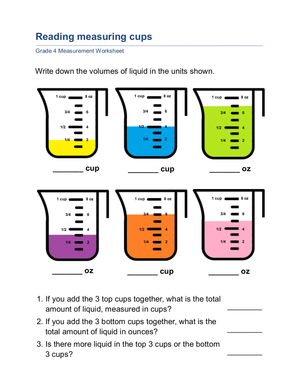
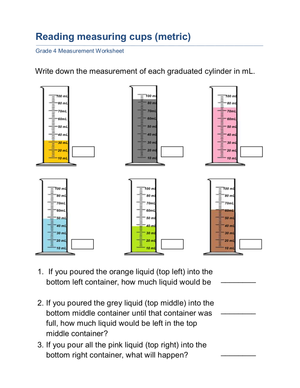
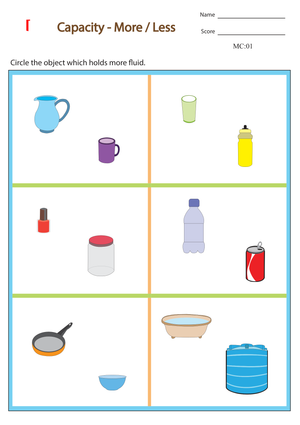
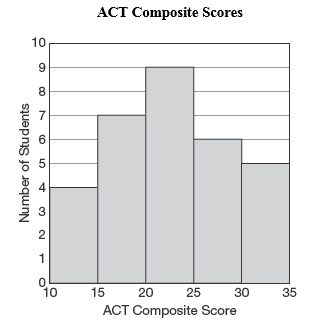
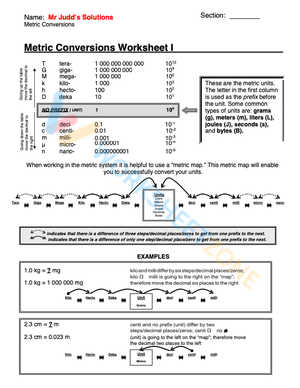
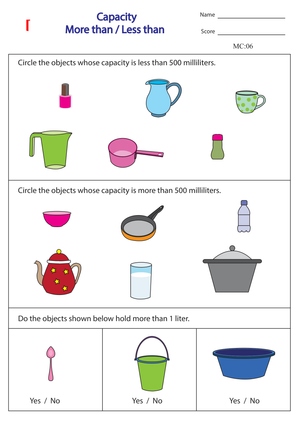
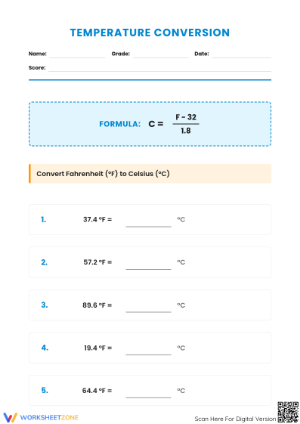
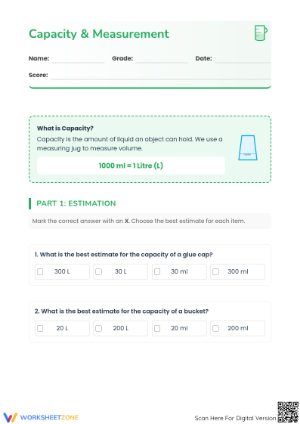
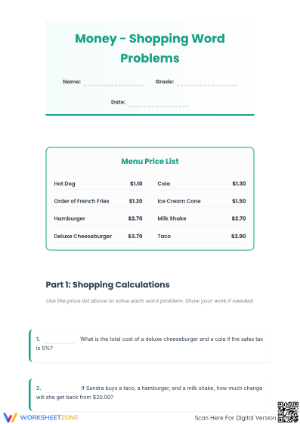
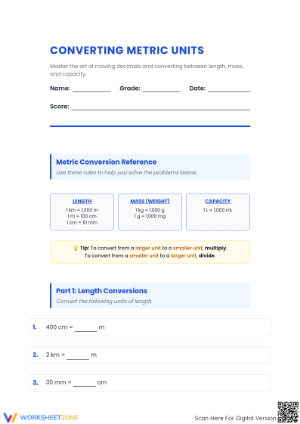
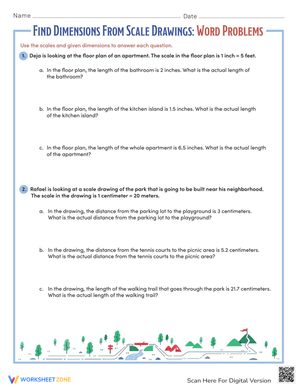
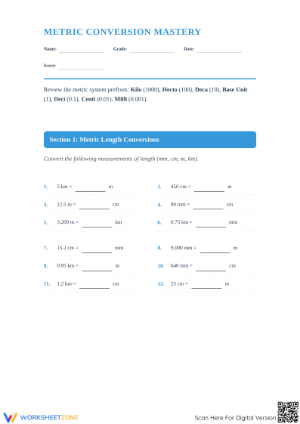
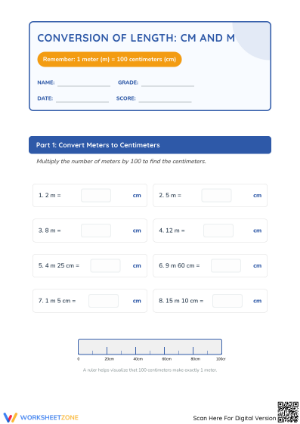
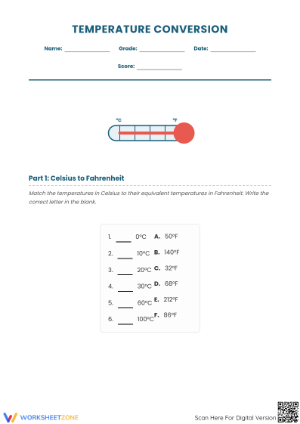
These measurement printable worksheets for 7th grade cover unit conversion, scale drawings, circumference and area of circles, surface area, and volume of prisms — the full range of measurement topics that grade 7 teachers return to throughout the year. The set pairs single-skill worksheets with mixed-review worksheets, so teachers have the right option for direct-instruction follow-up, spiral review, and quick formative checks.
The Specific Skills Covered Across the Set
Grade 7 measurement clusters around proportional reasoning. Unit conversion is a ratio applied to a quantity. Scale drawings are proportions mapped onto a geometric model. Even the circle formulas ask students to distinguish a multiplicative relationship — radius squared — from a simpler linear one. The worksheets reflect that developmental arc, covering these areas:
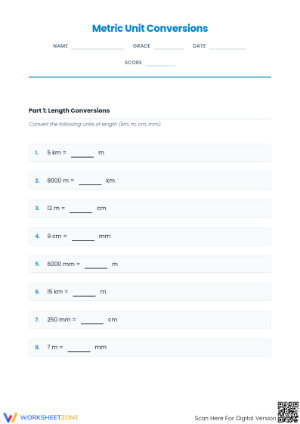
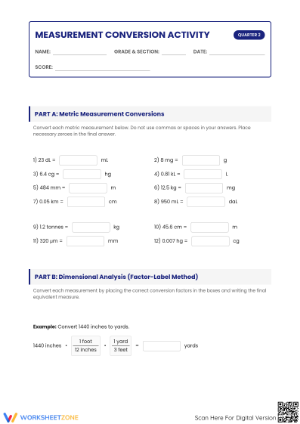
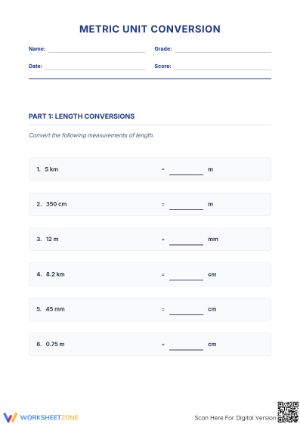
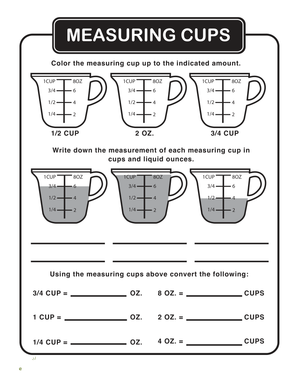
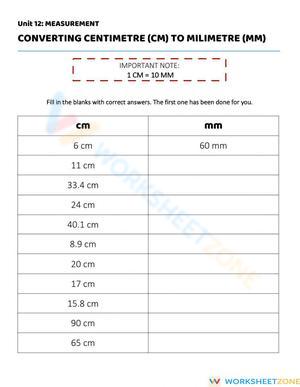
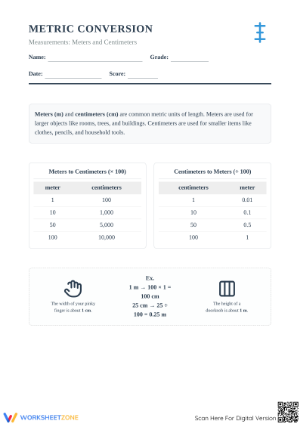
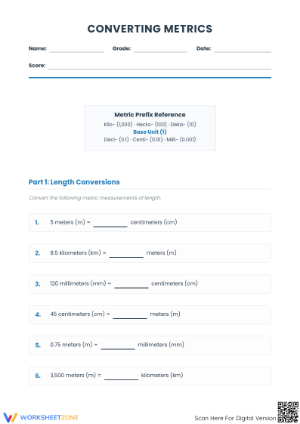
- Unit conversion: customary and metric conversions within the same system, with problems requiring students to write the numeric result and the unit label at every step
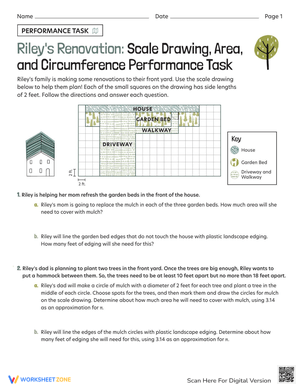
- Scale drawings: reading a scale, setting up a proportion, and interpreting the result — with visual models including floor plans and simple maps
- Circles: circumference and area, with problems that require students to identify the radius or diameter before calculating
- Surface area: prisms with labeled diagrams and nets, mixing direct formula application with real-context problems about boxes, tanks, and packaging
- Volume: rectangular and other prisms, using whole numbers, decimals, and word problems that ask students to interpret what their answer represents
- Mixed review: multi-step problems where students choose the correct measurement approach rather than follow one repeated pattern
Error Patterns to Watch For Across These Topics
Three categories of mistakes appear consistently in 7th grade measurement work, and knowing them helps teachers decide which worksheet to assign and what to address before students begin.
Directional errors on unit conversion are the most persistent. Students often know the correct conversion factor but apply it in the wrong direction. A student who correctly converts 3.5 km to 3,500 m will turn around and write 8,200 m = 8,200,000 km — multiplying when the problem calls for dividing — because the conversion relationship feels abstract without a real sense of relative size. Worksheets that require students to write and verify units at each step catch this pattern before it becomes habitual.
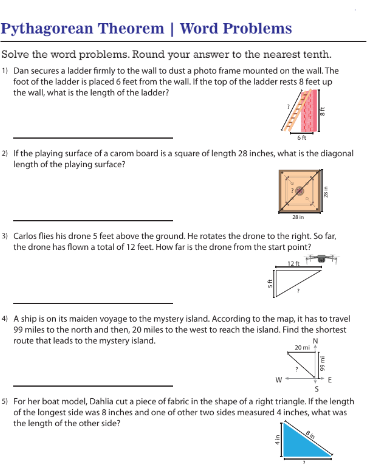
Circle problems produce a different but equally consistent confusion. Even students who can state both formulas will substitute diameter for radius when calculating area, producing an answer four times too large. Problems that ask students to mark the radius on a given diagram before writing the formula can surface this early. It is not always a formula problem — often it is a reading problem, and the fix is a labeling habit, not more formula repetition.
Surface area and volume produce a third pattern: students sum all six face areas when they mean to find volume, or they multiply three dimensions when the question asks for total surface area. Placing both problem types on the same worksheet — with distinct figures rather than the same shape repeated — gives students a reason to read each problem carefully instead of pattern-matching from the answer before it.
One limitation worth naming: these worksheets surface the radius/diameter confusion reliably, but they will not resolve it for students who have held the misconception for several weeks. A brief concrete demonstration — drawing a circle, marking both measurements, naming which one feeds each formula — typically needs to precede the computation practice, not follow it.
Working These Worksheets Into Your Instructional Week
Single-skill worksheets fit the 10 to 15 minutes directly after instruction, when students need immediate practice before the concept fades. Mixed-review worksheets belong in Friday's spiral block or the two days leading into a unit test. A short conversion worksheet runs well as a Monday warm-up after morning meeting — three or four problems bring the prior week back into focus without consuming lesson time.
For sub plans, mixed-review worksheets with answer keys are reliable. The directions are brief, the work is self-contained, and the format gives a substitute something concrete to manage. For intervention blocks, single-skill worksheets let teachers target exactly what a small group needs without building new materials late the night before.
A sorting strategy worth adopting: the measurement printable worksheets for 7th grade in this set can be organized not just by topic but by the kind of error each worksheet surfaces — unit-label errors, formula-selection errors, diagram-reading errors. When students redo only the category they missed, correction runs about 8 minutes instead of the full period, and it addresses the actual gap rather than covering the same ground again.
Matching the Set to Different Learners in the Same Room
Measurement printable worksheets for 7th grade support tiered instruction when the problem parameters shift while the core concept stays the same. For surface area, one group works with whole-number rectangular prisms and fully labeled diagrams; a second group handles decimals and figures with one missing label; a third group adds a unit conversion step before the area calculation. All three groups are working on surface area — the complexity changes, not the topic.
Students who need more support benefit from worksheets that include unit banks, partially completed setups, or reference examples showing each formula applied to a sample figure. This reduces the cognitive load around reading and formatting so students can direct their attention to the measurement reasoning itself — which is the part worth assessing. It is not easier math; it is cleaner access to the same math.
This tiered approach works well with two or three readiness groups. Beyond that, it gets difficult to manage without building too many separate assignment tracks. In classes with wide variation, grouping students into supported, standard, and extended practice — and letting students self-select with teacher guidance — keeps the logistics practical.
Standard Alignment
The worksheets in this set align with CCSS 7.G.A.1 (scale drawings using scale factors and proportional reasoning to find actual distances), 7.G.B.4 (circumference and area of circles, working with the formula for pi), and 7.G.B.6 (surface area and volume of two- and three-dimensional figures, including real-world problem contexts). Unit conversion practice connects to 7.RP reasoning — the proportional relationships that structure conversion are the same ones students apply to scale factors and unit rates throughout the grade.
In most 7th grade pacing guides, these standards are spread across two or three separate units rather than grouped into a single measurement block. Single-skill worksheets align closely with each standard's initial instruction; mixed-review worksheets serve the cumulative review near the end of the year or before standardized assessments in spring.
Frequently Asked Questions
Do the worksheets cover both circumference and area of circles, or just one?
Both. Some worksheets address circumference and area separately so students build fluency with each formula before mixing them. Others present both on the same worksheet, requiring students to identify which formula the problem calls for — which is where the real assessment value appears.
Are surface area and volume treated on separate worksheets or together?
Both options are in the set. Separate worksheets help students build confidence with each formula independently. Mixed worksheets — sometimes using the same figure for two different questions — develop the more important skill of distinguishing which measurement a problem is actually asking for.
Can these worksheets work for 6th grade extension or 8th grade review?
The measurement printable worksheets for 7th grade sit at the right difficulty for students finishing 6th grade ratios and beginning proportional reasoning. As 8th grade review, the unit conversion and circle worksheets serve as useful warm-ups before geometry units that extend into the coordinate plane. As 6th grade extension, the scale drawing and volume worksheets work well for students ready for multi-step applications.
Do the worksheets include answer keys?
Yes. Each worksheet in the set comes with an answer key. In a typical middle school schedule, that matters for student self-checking during center rotations and review days — it frees the teacher to confer with a small group rather than spending that time marking individual answers.













 Interactive Worksheet Maker
 Quiz Maker
 Word Search Maker
 Crossword Puzzle Maker
 Word Scramble Generator
 Sentence Scramble Generator
 Handwriting Worksheet Generator
 Name Tracing Generator
 Fill In The Blank Generator