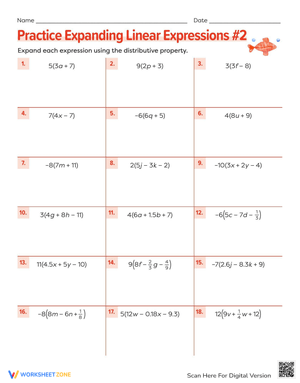
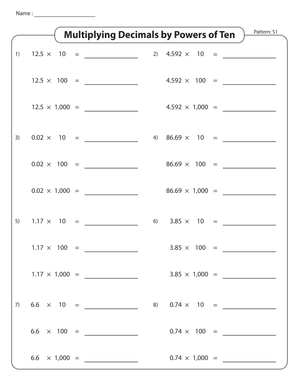
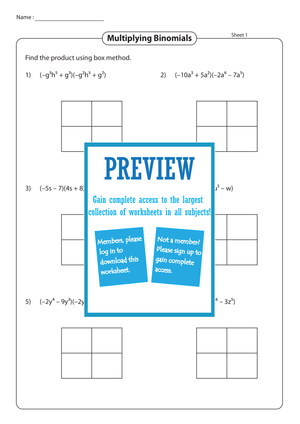
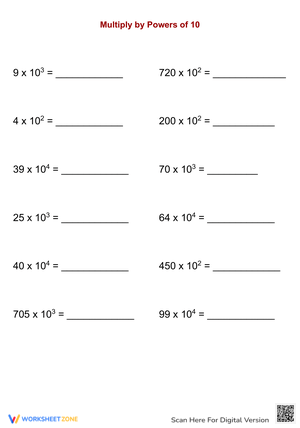
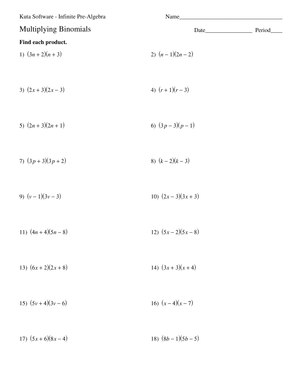
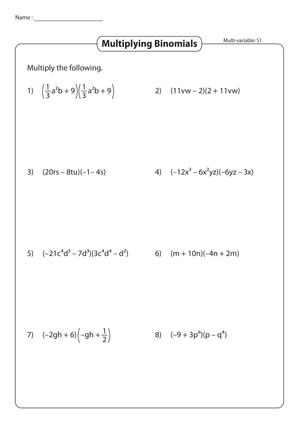
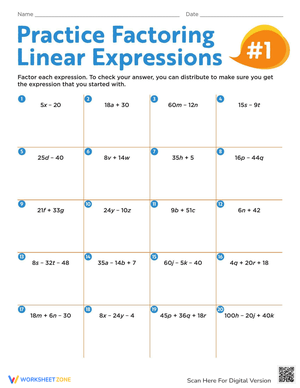
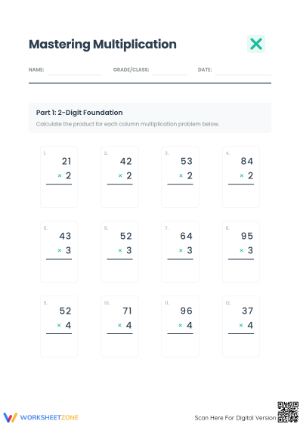
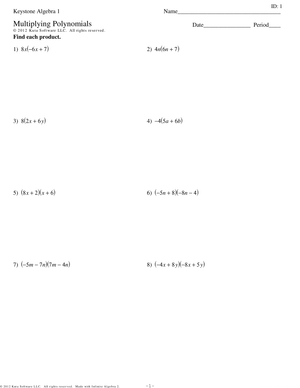
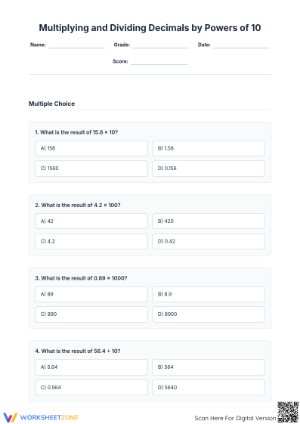
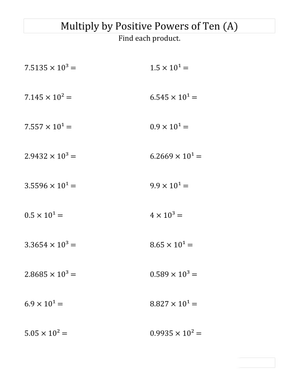
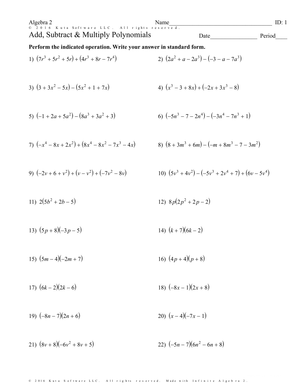
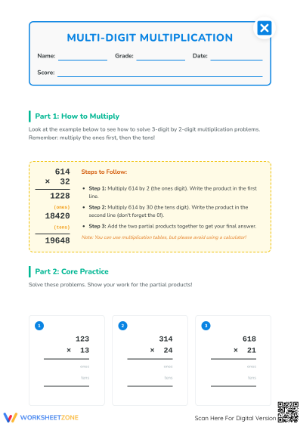
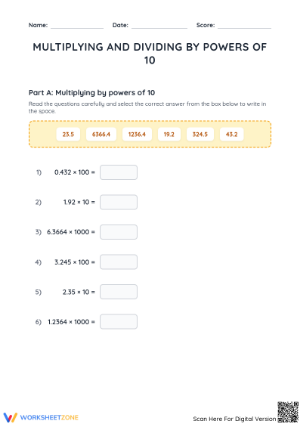
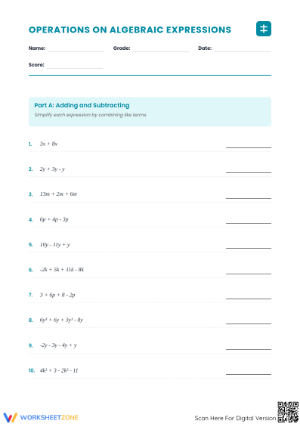
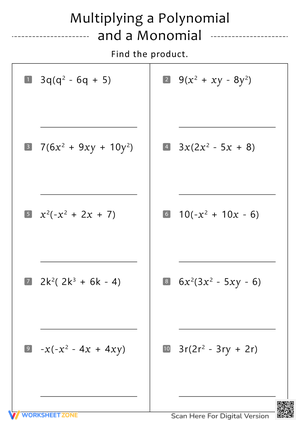
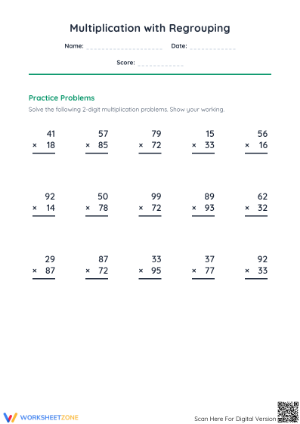
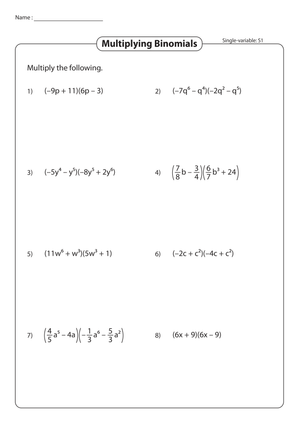
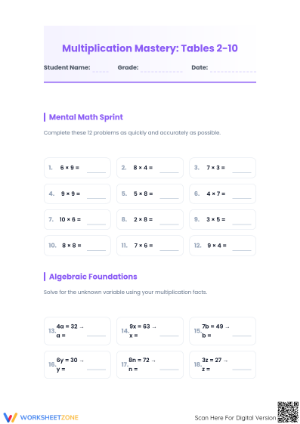
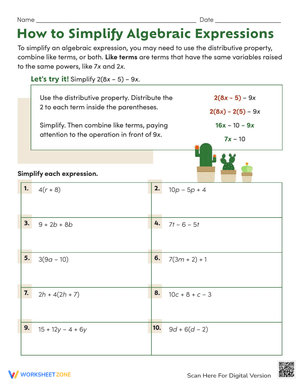
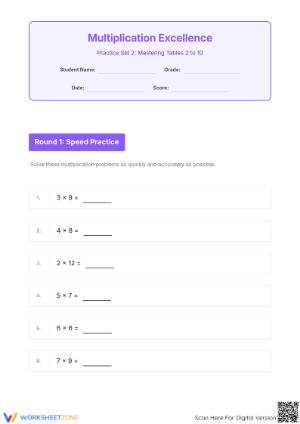
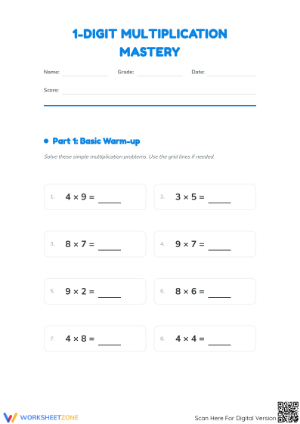
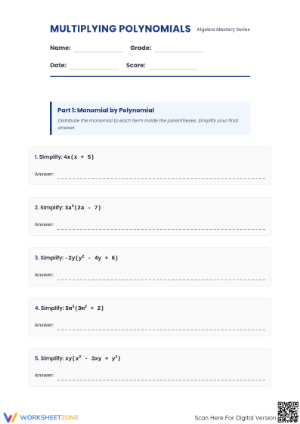
These 7th grade multiplication pdf worksheets cover the stretch of middle school math where multiplication stops being a recall task and becomes a reasoning task. Students who handled whole-number multiplication without much trouble in 5th grade meet a different set of demands in 7th — they must apply sign rules for integers, track decimal place value across multiple digits, convert mixed numbers before multiplying, and reduce fractional products. Each of those steps fails in its own specific way, and each worksheet in this set targets one or more of them directly.
The Specific Skills Covered in This Set
The set addresses four rational number types: integers, decimals, fractions, and mixed numbers. Students practice each type on targeted worksheets and then encounter all four together on mixed review worksheets — a format that pushes them to identify the number type before selecting a method, rather than applying one approach because the worksheet signals them to.
- Integers: Multiplying positive and negative numbers, applying sign rules with confidence, and handling products involving zero
- Decimals: Multiplying multi-digit decimals, estimating products before computing, and placing the decimal point correctly in the final answer
- Fractions: Multiplying proper and improper fractions, simplifying products, and recognizing scaling situations
- Mixed numbers: Converting to improper fractions, multiplying, then converting back and simplifying — a three-step sequence students routinely compress or skip entirely
- Mixed rational number review: Unlabeled problem sets combining all four number types, matching the format students see on unit assessments
The distinction between targeted and mixed review matters because students who multiply fractions correctly when every problem on the worksheet is labeled "fractions" often fail when fraction problems appear alongside integer and decimal problems without any label. The mixed format exposes that gap before a test does.
Student Mistakes Worth Anticipating Before You Hand These Out
Sign errors on integer multiplication follow a consistent pattern. Students who correctly state the rule — negative times positive is negative — still write positive products when the multiplication appears inside a larger expression. They apply the sign rule to the isolated pair of numbers but drop it when that product feeds into the next step. These errors rarely surface during whole-class instruction and become visible only when you look at individual student work.
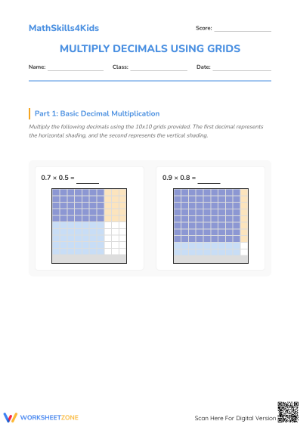
Decimal placement errors are predictable and specific. The most persistent version: a student multiplying 3.6 by 2.4 produces the digit string 864 correctly but writes 86.4 instead of 8.64 because they counted one decimal place rather than two. Building a quick estimation step into the routine — "this product should be near 8, not 87" — cuts that error significantly and gives students a habit of checking whether an answer is in the right ballpark before they move on.
With mixed numbers, the most common mistake is multiplying the whole number parts and the fractional parts separately and then adding them together. A student working through 2½ × 3⅓ will sometimes compute 2 × 3 and ½ × ⅓ in isolation, arriving at 6⅙ instead of the correct 8⅓. That process feels intuitive — it resembles distributing — but it skips the cross terms. A worked example at the top of each mixed-number worksheet showing the full convert-multiply-simplify sequence gives students something to reference mid-work without needing to interrupt the class.
Fitting These Worksheets Into Your Weekly Lesson Plans
The most effective use of a targeted multiplication worksheet is at the front of class — three to five problems during the first eight minutes rather than a full-period assignment. On Monday mornings especially, a short integer or decimal warm-up gives students a low-stakes re-entry point before instruction resumes. That's more useful than jumping directly into new material and discovering partway through the lesson that students don't remember what they practiced the previous week.
That flexibility is part of why 7th grade multiplication pdf worksheets stay in regular rotation throughout the year, not just during the rational numbers unit. The same worksheet that functions as a Monday bell-ringer can serve as a small-group reteach tool on Wednesday and appear as quiz review on Friday — no redesign needed, just a different framing when you distribute it.
For small-group reteach, skill-specific worksheets outperform mixed sets. If five students are consistently misplacing decimal points, they need focused decimal practice, not a rational number review that adds integers and fractions at the same time. Narrowing the problem type makes the session faster and gives you cleaner data on whether the targeted work is helping. Mixed review worksheets fit better later — after each skill is stable, typically during the week before an assessment or the Friday review block leading into a test.
Adjusting the Work for Students at Different Points in the Unit
Students who need additional support usually benefit from a narrower problem space, not a shortened version of a mixed worksheet. A focused integer set — ten to twelve problems, a sign-rule reference box at the top, no fractions or decimals added in — often outperforms a reduced mixed set because it cuts the cognitive load down to one procedure. Once integer multiplication is solid, add decimal problems. Once both are stable, layer in fractions. Trying to practice all four simultaneously before any one is reliable tends to produce errors that look random but are actually sign-rule confusion bleeding into fraction work.
On-level students should spend real time on mixed review worksheets, because choosing the right procedure without a label is a core part of the grade-7 expectation. Students who can multiply fractions correctly when the entire worksheet is dedicated to fractions but stumble when a fraction problem appears next to a decimal problem are showing that the skill hasn't fully transferred. Mixed worksheets make that visible and give you a clear target for the next day's instruction.
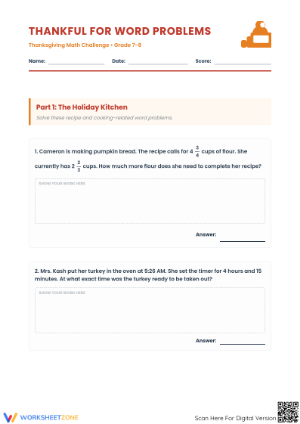
For students ready for extension, multiplication deepens when it connects to real contexts. Scaling a recipe with mixed-number quantities, computing unit costs with decimal multiplication, finding area with fractional side lengths, or interpreting a negative product in an elevation or temperature scenario — these formats keep multiplication at the center while asking students to reason about what the answer means rather than just compute it. Strong extension problems also ask students to estimate before solving and explain why their answer is reasonable.
Standard Alignment
These worksheets align to CCSS 7.NS.A.2, which asks students to apply and extend their understanding of multiplication from fractions to all rational numbers. The standard treats integers, decimals, and fractions under a single operational framework — which is exactly why 7th grade multiplication practice works best when those number types are taught in connected sequence rather than as isolated topics. In most classroom timelines, 7.NS.A.2 lands mid-year, after 7.NS.A.1 establishes integer addition and subtraction. Teachers who introduce multiplication worksheets after that foundation is in place find that students already have the sign reasoning they need to handle negative products without starting from scratch.
Frequently Asked Questions
Do these worksheets include answer keys?
Yes. Answer keys are included with the set, which makes them workable for independent stations, self-checking after practice, and small-group reteach sessions where you want to give fast feedback without grading every problem individually.
What's the difference between the targeted worksheets and the mixed review worksheets?
Targeted worksheets focus on one number type — integers, decimals, fractions, or mixed numbers — and work best for initial instruction, intervention, and focused reteach. Mixed review worksheets combine all four types without labels, requiring students to identify the number type and select the appropriate procedure on their own. Mixed review is better suited to the second half of a unit, after each skill has been practiced separately, and closely mirrors how problems appear on assessments.
How are these set up for printing and day-to-day classroom use?
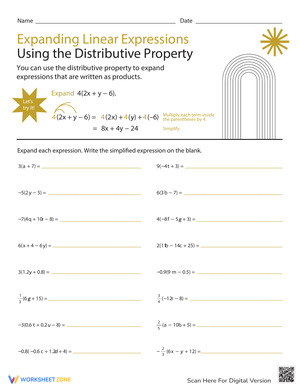
The 7th grade multiplication pdf worksheets use clean, short-direction layouts with a worked example at the top of each worksheet. That format stays consistent across the full set, so students know what to expect without needing re-explanation every time. PDF format preserves that layout whether printed at school, sent home for homework, or uploaded to a learning platform.
Can I use these with students who are not yet at a 7th grade level?
The targeted worksheets — especially the integer and fraction sets — work well in 6th grade classrooms where rational number multiplication is introduced early, and in 8th grade intervention groups revisiting the skills before pre-algebra. The 7th grade multiplication pdf worksheets don't include grade-level language in the student-facing materials, so they can be distributed without drawing attention to the level designation.













 Interactive Worksheet Maker
 Quiz Maker
 Word Search Maker
 Crossword Puzzle Maker
 Word Scramble Generator
 Sentence Scramble Generator
 Handwriting Worksheet Generator
 Name Tracing Generator
 Fill In The Blank Generator