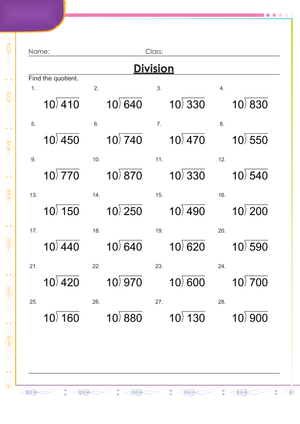
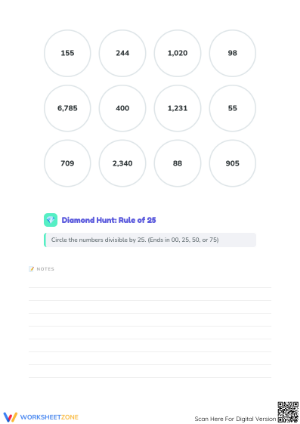
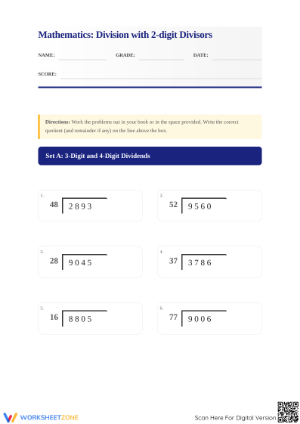
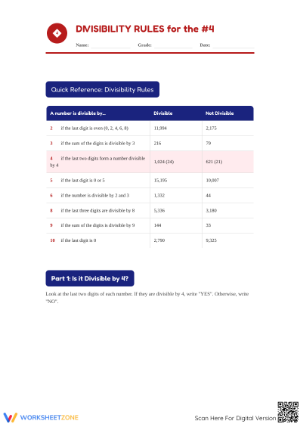
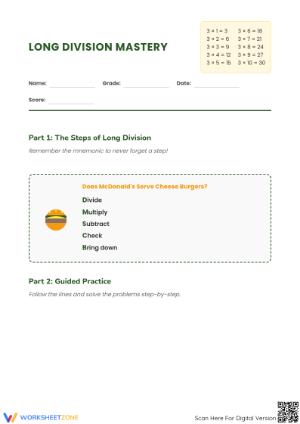
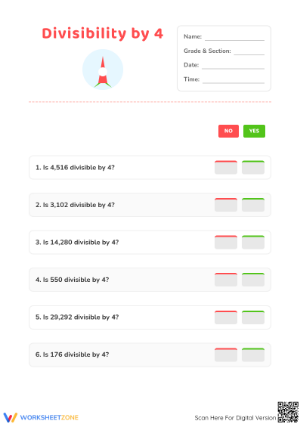
Division worksheets for 7th grade need to reach past whole-number computation — at this grade, students divide rational numbers across fractions, decimals, and integers, then carry those operations into rate problems, unit pricing, percent situations, and multi-step reasoning. This set gives teachers skill-specific practice, mixed review, and applied word problems, with answer keys included for fast classroom turnaround.
The Division Skills Covered in This Set
Each worksheet targets one of four core areas, organized so teachers can pull exactly what a lesson calls for rather than sorting through mixed content to find the right problem type.
Fraction division gets the most space in the set. Students divide proper fractions, improper fractions, and mixed numbers. The more demanding worksheets pair computation with word problems about measurement or shared quantities — problems where students have to explain what the quotient represents, not just calculate it.
The decimal worksheets build from simpler to more complex: decimal divided by whole number first, then decimal divided by decimal. Several include an estimation prompt before the calculation step. Students who estimate first are substantially more likely to catch a misplaced decimal point before committing to a wrong answer.
Integer division worksheets give students short, repeated practice with sign rules. Rather than asking students to hold four abstract cases in memory, these worksheets use comparison tasks — sorting expressions by whether the quotient will be positive or negative before solving — so students build a working mental model rather than just tracking an outcome.
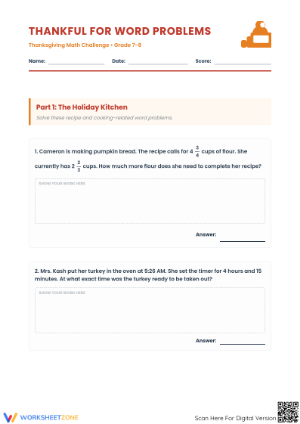
The word-problem worksheets place division inside rate, unit-price, constant-speed, and percent contexts. These problems do not signal the operation. Students have to recognize that division fits the situation, which is the harder and more transferable skill at this grade level.
Where Student Thinking Breaks Down — and What to Watch For
Fraction division produces one reliable error: students invert the wrong fraction. When applying keep-change-flip to 3/4 ÷ 2/5, a student will often write 4/3 × 2/5 instead of 3/4 × 5/2. The error is consistent enough that a skill-specific worksheet surfaces it quickly, letting teachers address it before it solidifies into a reliable wrong answer on assessments.
Integer sign errors look like memorization failures but are usually fluency failures. A student who can recite that a negative divided by a negative is positive will still write -4 for -24 ÷ (-6). Worksheets that sequence problems in deliberate cycles — 24 ÷ 6, then -24 ÷ 6, then 24 ÷ (-6), then -24 ÷ (-6) — make the sign relationship visible rather than abstract, and they build the automaticity that recitation alone does not.
Word-problem errors call for a separate diagnostic lens. A student who divides cleanly on computation problems but reaches for multiplication in a rate context does not have a division gap — that student has an operation-identification gap. The distinction matters because the two problems look identical from a grade-book perspective but require completely different responses from the teacher. Several worksheets in the set ask students to name the operation before solving, which is a fast way to separate the two error types during actual class time.
Building These Worksheets Into a Realistic Lesson Plan
These division worksheets for 7th grade support a three-part weekly arc that keeps practice purposeful. On the day a new procedure is introduced — say, dividing decimals — one skill-specific worksheet after the lesson gives students practice while the method is fresh. The next day, a shorter partner-checking session asks students to compare work and trace any discrepancy back to the step where answers diverged. By midweek, a mixed or word-problem worksheet shifts the demand: students apply the operation in context without being told which one to use.
Beyond that arc, the worksheets fit naturally into several common classroom structures:
- Bell ringers: Three or four integer division problems in the first five minutes keep sign rules active between lessons without consuming instruction time.
- Exit slips: Five problems from a skill-specific worksheet at lesson's end give a clear formative read — who inverted the wrong fraction, who has the sign rule backward, who is solid.
- Intervention blocks: The single-skill worksheets, with their wider spacing, let students write out each step without crowding work into the margins.
- Sub plans: Answer keys make independent math practice genuinely manageable without a teacher present to field procedural questions.
Adjusting the Set for Varied Learners
Division worksheets for 7th grade rarely fit every student in the room at the same entry point, and this set is built with that reality in mind. The skill-specific worksheets serve students who need to solidify one operation before encountering mixed content. The mixed-review and word-problem worksheets serve students who handle procedures confidently but need practice making operation decisions without prompting. Most mixed-ability classes need both running in parallel, and the differentiation is built into the worksheet choice rather than requiring a separate set of materials.
For students who stall on fraction division, pairing the worksheet with a quick area model — drawn alongside the computation — ties the reciprocal step to something visual and less arbitrary. That is a thirty-second teacher move, not an additional resource, and it changes what students take away from the practice. For students who are already fluent with fractions and decimals, the multi-step word problems carry enough complexity to stay productive while the rest of the class works on foundational procedures.
The answer keys enable a peer-review routine that costs nothing in prep time. Students who finish early compare answers, locate the step where their work diverged, and name what went wrong. That is genuine mathematical reasoning, folded into the ordinary flow of a practice period.
Standard Alignment
The core skills in this set align to CCSS 7.NS.A.2, which addresses operations with rational numbers including the division of fractions and the sign rules governing quotients of integers. The standard connects directly to 7.RP.A.1 — unit rates expressed as ratios of fractions — and 7.EE.B.3, which covers multi-step real-world problems with rational numbers. In most grade-level sequences, 7.NS.A.2 arrives in the first major unit of the year, roughly from late September through November, before the curriculum moves into expressions and equations. Teachers using these resources for mid-year spiral review or late-year intervention will find the rational number fluency built here is a direct prerequisite for algebraic work in both 7th and 8th grade.
Frequently Asked Questions
My students divide fractions correctly in drills but fall apart in word problems. Where do I start?
First, confirm the computation is actually solid by running one skill-specific worksheet and examining where errors appear. Sometimes what reads as a word-problem issue is a fraction procedure issue in a slightly different format. If the computation checks out, shift to the word-problem worksheets and add one pre-solving step: students write what the problem is asking for and name the operation before writing any numbers. That single addition catches most operation-confusion errors before they surface on a graded assessment.
Do these work for a class with a wide range of readiness levels?
Yes. Assign the skill-specific worksheets to students who are still building procedural accuracy and the mixed-review or word-problem worksheets to students ready to apply skills across contexts. Both groups work on the same topic at different levels of demand. The set does not require separate remedial materials — the range of difficulty across the worksheets handles most of the variation a typical 7th grade class presents.
How do these help students who arrive below grade level?
The decimal worksheets open with decimal divided by whole number — territory most students touched in 6th grade — giving an accessible entry point before introducing decimal divisors. The integer worksheets function the same way for students who encountered sign rules briefly in 6th grade but never internalized them; the foundational problems in each worksheet offer a starting point rather than an immediate barrier. Used this way, these division worksheets for 7th grade meet students with preparation gaps without requiring a completely separate bank of below-grade materials.













 Interactive Worksheet Maker
 Quiz Maker
 Word Search Maker
 Crossword Puzzle Maker
 Word Scramble Generator
 Sentence Scramble Generator
 Handwriting Worksheet Generator
 Name Tracing Generator
 Fill In The Blank Generator