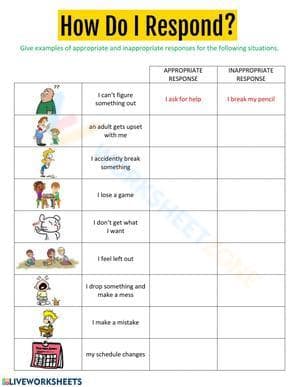
7th grade social emotional learning worksheets give teachers a structured, low-prep tool for one of the harder parts of middle school instruction: helping students pause, name what they're actually feeling, and decide what to do next before the situation escalates. Each worksheet focuses on a single skill—self-awareness, empathy, stress coping, or decision-making—rather than covering everything at once. A seventh grader who spends twelve minutes genuinely working through one scenario leaves with more applicable skill than a student who checks boxes across six prompts.
Topics Each Worksheet Targets
The set maps to the five CASEL core competencies, but the content is grounded in what seventh graders are actually managing: friend group tension that reignites on Monday morning, test pressure that shows up as irritability toward teachers, and online miscommunications that arrive at school already inflamed.
- Self-awareness: Students name emotions with specificity, track recurring triggers, and examine the gap between how they see their own behavior and how it reads to the people around them.
- Self-management: Worksheets in this category move students from noticing stress signals toward choosing a realistic coping response—not a strategy for when they're calm at home, but something they can actually use during a difficult moment in school.
- Social awareness and empathy: Prompts ask students to separate intent from impact. That distinction—what someone meant versus what their words or actions actually communicated—resolves a surprising number of seventh-grade conflicts once students see it clearly.
- Relationship skills: Apology language that goes beyond a flat "sorry," boundary-setting responses, and prompts for navigating gossip without escalating the situation.
- Responsible decision-making: Scenario-based worksheets present a realistic choice point and ask students to compare response options, predict consequences, and justify their thinking in writing.
Emotion regulation threads through all five areas rather than appearing only under self-management. Students who can identify and steady their emotional state approach empathy tasks and decision-making tasks more effectively, so the worksheets treat regulation as a through-line rather than a standalone unit.
Errors That Appear Predictably Across Seventh-Grade SEL Work
The most consistent pattern is students conflating thoughts with feelings. A student writes "I felt like she was ignoring me on purpose" and considers that an emotion. It isn't—and the distinction matters, because separating an interpretation of someone else's behavior from an internal feeling state is exactly what empathy and self-management depend on. Two minutes of framing before the worksheet helps: I felt hurt is an emotion; I felt like she was doing it on purpose is a thought.
On perspective-taking worksheets, a related error appears. Students describe how they would feel in another person's situation rather than considering what that specific person—given their context—might realistically be experiencing. This is projection, not perspective-taking. A brief prompt before students start—"What do we know about this person's situation before this moment?"—redirects attention toward the scenario's actual details and gets students closer to genuine empathy.
Behavior reflection worksheets bring out a third pattern: minimum-viable answers. After an incident, some students write as little as possible to end the activity. Naming this directly tends to change it. Telling students that a vague reflection gives the adults around them less useful information—and therefore less ability to advocate for them—usually produces more specific writing. Seventh graders respond to that logic once it's stated plainly.
How to Work These Worksheets Into Your Lesson Sequence
The most reliable structure is a three-part sequence: a brief framing comment (under two minutes), quiet independent writing time (eight to twelve minutes), and a response choice. That last element changes participation rates significantly. Giving students the option to keep their writing private, share with a partner, or contribute to a whole-class discussion removes forced vulnerability from the activity. Some of the most honest self-reflection in seventh-grade advisory comes from students who write at length and never say a word aloud.
Where do these fit in the day? Advisory and homeroom are the most natural homes, but 7th grade social emotional learning worksheets also work in the first ten minutes of health class, in small counseling groups as a discussion anchor, or as a deliberate classroom reset after something has derailed a period—a conflict at lunch, a difficult assembly, the cumulative weight of a hard week. A three-prompt reset activity takes five minutes and restores more focus than a lecture about expectations.
Returning to one skill across three or four sessions produces stronger retention than rotating topics every week. A class might complete a self-awareness worksheet on naming emotions, then a worksheet focused on stress triggers the following week, then a coping-strategy planning worksheet the week after that. By the third session, students connect the skill progression on their own—which is the actual goal of SEL instruction rather than a side benefit.
Adjusting the Worksheets for Mixed Student Needs
Students who struggle with written expression often freeze before reflection can happen. A short list of sentence starters—I noticed I was feeling… / The moment things shifted was… / One thing I could try next time is…—breaks the blank-page problem without scripting the student's answer. Offering this as a separate slip rather than printing it directly on the worksheet keeps it optional and removes the visual signal to other students that some people are receiving extra support.
Students who finish quickly and write at length need harder prompts. Asking them to rewrite a scenario from a different character's perspective, or to consider what a particular response option would cost them even if it technically "worked," keeps them working within the skill. These students often have the metacognitive capacity for more complex moral reasoning than the base scenario asks for—and giving them a more demanding question is more useful than asking them to wait.
One limitation worth stating directly: students with trauma histories may find open-ended emotion prompts destabilizing, particularly worksheets that ask students to recall specific upsetting situations. The answer is not to avoid those worksheets—it's for counselors to preview the content in advance and identify students who need a modified version or a brief individual check-in before the class activity. These are classroom tools, not clinical instruments, and they work best when teachers know enough about their students to anticipate what a given prompt might surface.
Standard Alignment
These worksheets align to the five CASEL competency areas, which serve as the framework for SEL standards in most states that have adopted formal guidelines. Illinois (ISBE Social/Emotional Learning Standards), California (Transformative SEL Framework), and Washington (SEL Standards) each include explicit sixth- through eighth-grade benchmarks that this set addresses directly—particularly in self-management, social awareness, and responsible decision-making at the early adolescent level.
For teachers working within a writing or ELA framework, the reflection components connect naturally to CCSS W.7.1 (written argument, where students justify a decision or evaluate a response option) and W.7.3 (narrative writing, where scenario-based prompts involve character perspective, motivation, and sequence). These aren't forced connections—they emerge from the format of 7th grade social emotional learning worksheets that ask students to reason through a realistic situation and explain their thinking in writing.
Frequently Asked Questions
What SEL topics matter most in seventh grade?
Self-awareness and emotion regulation are the foundation. Students who can name what they're feeling and manage their first impulse are better positioned for everything else. From there, the highest-value topics for seventh grade are empathy and perspective-taking, conflict communication, decision-making under social pressure, and stress coping. These map directly to what seventh graders are navigating in hallways, lunch tables, group projects, and online spaces.
Do these worksheets require a full SEL program to work?
No. Each worksheet works as a standalone activity with a single skill focus and a simple follow-up routine. The most effective standalone use involves three things: a brief framing of the skill before students start, the independent worksheet activity, and a two-minute close that connects the skill to something the student can apply that same day. A full SEL program adds scope and sequence across a year—but each worksheet delivers a complete, focused skill-building experience on its own.
How do these worksheets hold up in a behavior intervention or restorative conversation?
They work well when framed as preparation for the conversation rather than a substitute for it. A student who completes a reflection worksheet before sitting down with a counselor or teacher arrives with a starting point—an account of what happened, what they were feeling, and what they might do differently. That makes the actual restorative conversation more specific and more productive. Prompts structured around what happened / what I was feeling / what the impact was / what I can try next time consistently generate more usable reflection than standard rule-acknowledgment forms.
How should teachers choose a worksheet when they're not sure where to start?
Match the worksheet to the clearest current need in the room—not to the next unit in a program, but to what students are actually dealing with that week. A class coming off a conflict benefits from a communication or empathy worksheet. A class in the middle of exam pressure needs stress coping. Teachers using 7th grade social emotional learning worksheets for the first time often find it useful to preview one with a trusted student to check whether the scenario reads as realistic before bringing it to the whole class.
















 Interactive Worksheet Maker
 Quiz Maker
 Word Search Maker
 Crossword Puzzle Maker
 Word Scramble Generator
 Sentence Scramble Generator
 Handwriting Worksheet Generator
 Name Tracing Generator
 Fill In The Blank Generator