




























Views
Downloads
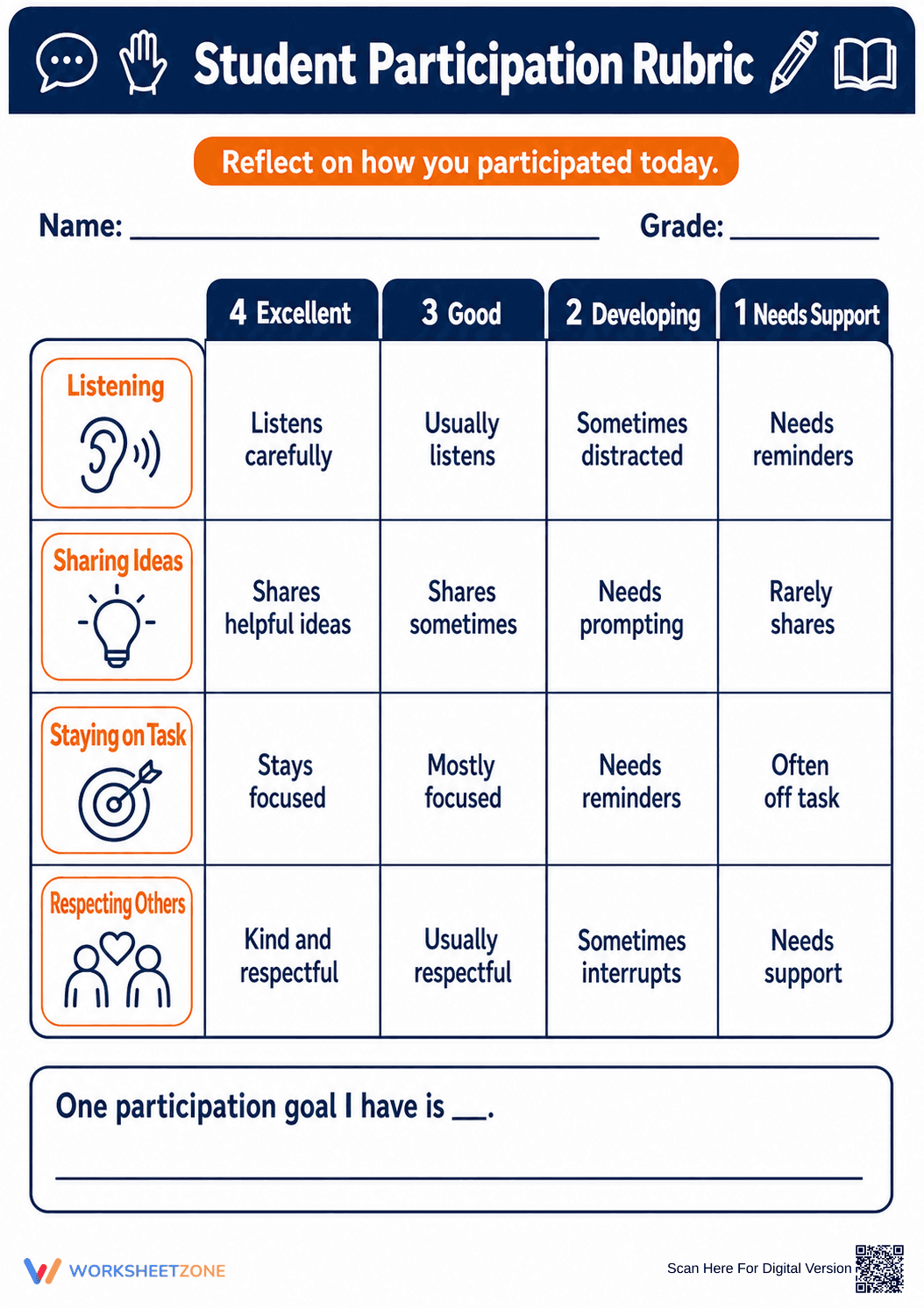

Aligned CCSS.ELA-LITERACY.SL.5.1 Participation Rubric

Paste this activity's link or code into your existing LMS (Google Classroom, Canvas, Teams, Schoology, Moodle, etc.).
Students can open and work on the activity right away, with no student login required.
You'll still be able to track student progress and results from your teacher account.
This Grade 5 student participation rubric provides a structured framework for students to evaluate their own engagement during collaborative discussions and group activities. By focusing on four key behavioral domains, students gain immediate clarity on classroom expectations and develop the metacognitive skills necessary to improve their interpersonal interactions. Use this tool to transform abstract behavior into measurable growth.
At a Glance
- Grade: 5 · Subject: ELA / SEL
- Standard:
CCSS.ELA-LITERACY.SL.5.1— Engage effectively in a range of collaborative discussions with diverse partners- Skill Focus: Self-reflection and behavioral assessment
- Format: 1 page · 5 tasks · Rubric included · PDF
- Best For: Formative assessment of group work
- Time: 5–10 minutes
What's Inside: This single-page assessment features a clean, four-column rubric layout designed for student-facing use. It includes four specific criteria—Listening, Sharing Ideas, Staying on Task, and Respecting Others—each paired with a descriptive icon. The worksheet concludes with a dedicated boxed reflection area where students must synthesize their self-evaluation into one actionable participation goal for the next lesson.
Mastery Evidence
The rubric is organized into four distinct performance tiers: Excellent (4), Good (3), Developing (2), and Needs Support (1). Each criterion maps directly to the sub-skills of collaborative discussion, such as active listening and contributing relevant information. Educators can use these scores to track longitudinal progress in Social Emotional Learning (SEL) or enter them into gradebooks as evidence of meeting speaking and listening standards. The clear progression allows students to see exactly what is required to move from "Developing" to "Excellent" performance.
Standards Alignment: This resource is primarily aligned with `CCSS.ELA-LITERACY.SL.5.1`, which requires students to come to discussions prepared and follow agreed-upon rules for discussions. It also supports `CCSS.ELA-LITERACY.SL.5.1.B`, focusing on carrying out assigned roles. Both standard codes can be copied directly into lesson plans, IEP goals, or district curriculum mapping tools.
How to Use It: Assign this rubric immediately following a Socratic Seminar, literature circle, or science lab. For the best results, have students complete the self-assessment individually before engaging in a brief one-on-one conference to compare their self-rating with teacher observations. This formative assessment typically takes 5 to 10 minutes and provides a high-leverage data point for behavioral intervention or parent-teacher conferences.
Who It's For: While designed for Grade 5, the student-friendly language makes it appropriate for the 3–8 grade band. It is particularly effective for students who require explicit behavioral scaffolding or those working toward specific SEL goals. Pair this rubric with a collaborative reading passage or a project-based learning unit to provide a complete instructional cycle.
According to Fisher & Frey (2014), the use of structured rubrics for self-assessment fosters metacognitive awareness, allowing students to bridge the gap between their current performance and the desired learning outcome. This Student Participation Rubric targets CCSS.ELA-LITERACY.SL.5.1 by breaking down the complex act of collaborative discussion into four observable behaviors: listening, sharing, staying on task, and respecting peers. By quantifying these qualitative actions on a 1-to-4 scale, educators provide a concrete roadmap for student growth. Research indicates that when students engage in regular self-reflection using standardized criteria, they are 30% more likely to internalize social-emotional skills compared to passive observation alone. This tool serves as a vital bridge between direct instruction and independent mastery, ensuring that every student understands the specific expectations for classroom engagement and can articulate a personal goal for future improvement.


