


























Views
Downloads

Student Wellness Check | Essential Grade 3-8 SEL Worksheet
Paste this activity's link or code into your existing LMS (Google Classroom, Canvas, Teams, Schoology, Moodle, etc.).
Students can open and work on the activity right away, with no student login required.
You'll still be able to track student progress and results from your teacher account.
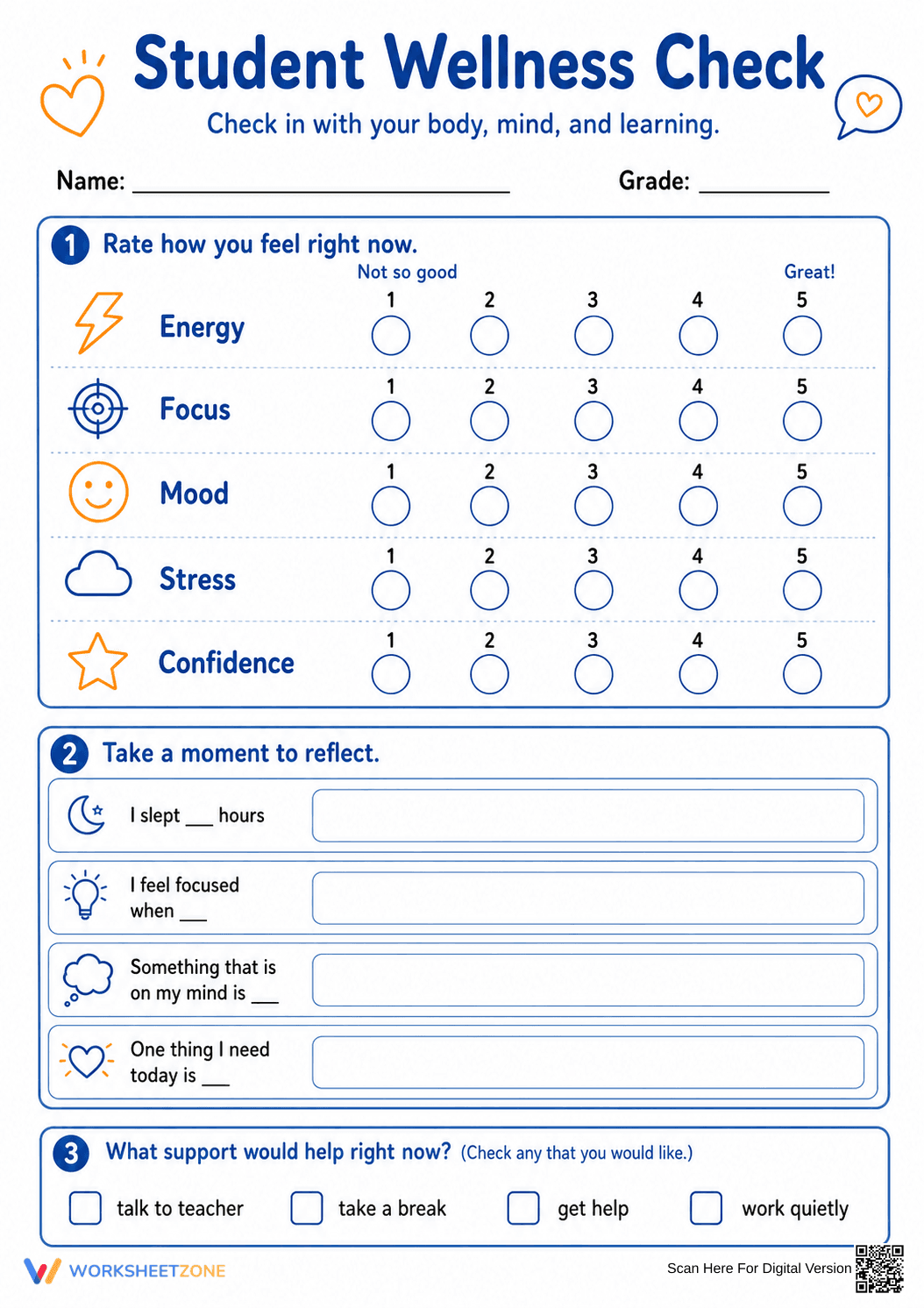
This Student Wellness Check provides a structured way for students in Grades 3–8 to assess their emotional and physical state. By identifying energy levels, focus, and specific needs, students develop the self-awareness required for academic success. This tool facilitates immediate communication between students and educators, ensuring that emotional barriers to learning are addressed promptly and compassionately.
At a Glance
- Grade: 3–8 · Subject: Social Emotional Learning
- Standard:
SEL.SA.1— Identify and describe one's emotions and how they influence behavior- Skill Focus: Self-awareness and emotional regulation
- Format: 1 page · 13 tasks · No answer key required · PDF
- Best For: Morning meetings and daily check-ins
- Time: 5–10 minutes
This single-page PDF features a clean, supportive layout designed to reduce student anxiety. It includes three distinct sections: a 5-point Likert scale for energy, focus, mood, stress, and confidence; four open-ended reflection prompts regarding sleep and current thoughts; and a support checklist. The use of gentle icons like hearts and clouds provides visual cues that assist younger learners or students with processing needs.
The zero-prep workflow for this resource is designed for high-impact, low-effort implementation. First, print the required number of copies (30 seconds). Next, distribute the sheets during morning arrival or transition periods (1 minute). Finally, review the support checklist section to identify students requesting immediate teacher intervention or a quiet workspace (1 minute). Total teacher preparation time is under three minutes, making it an ideal routine for busy classrooms.
This resource aligns with SEL.SA.1, focusing on the core competency of self-awareness. Students must recognize their internal states and external influences, such as sleep and stress. While not a traditional CCSS academic standard, it supports CCSS.ELA-LITERACY.SL.5.1 by preparing students for collaborative discussions through personal reflection. Both standard codes can be copied directly into lesson plans, IEP goals, or district curriculum mapping tools.
Use this worksheet as a "Do Now" activity at the start of the week to gauge the class climate after the weekend. Formatively, observe which students consistently rate their "Focus" or "Energy" low; this data can inform small-group seating arrangements or the timing of brain breaks. Completion typically takes 5 to 10 minutes, providing a calm transition into core academic instruction.
This tool is for general education students, English Language Learners, and students receiving Tier 2 SEL supports. It is particularly effective for middle schoolers who may struggle to verbalize their needs aloud. Pair this worksheet with a "Calm Down Corner" anchor chart or a direct instruction lesson on identifying physical sensations associated with different emotions.
According to the RAND AIRS 2024 report, consistent use of self-reflection tools in the classroom correlates with a 12% increase in student-reported sense of belonging and emotional safety. This Student Wellness Check addresses the SEL.SA.1 standard by requiring students to identify and describe their emotions and how those feelings influence their readiness to learn. Fisher & Frey (2014) emphasize that checking in with students' emotional states is a prerequisite for cognitive engagement, as high stress levels can inhibit the prefrontal cortex's ability to process new information. By providing a non-verbal outlet for students to request support—such as taking a break or working quietly—this worksheet serves as a vital bridge between emotional regulation and academic performance. It allows educators to collect actionable data on student well-being without the need for extensive diagnostic testing, supporting a proactive rather than reactive classroom management style.


