


























Views
Downloads

Essential Sportsmanship Worksheet | Grade 6-8 SEL
Paste this activity's link or code into your existing LMS (Google Classroom, Canvas, Teams, Schoology, Moodle, etc.).
Students can open and work on the activity right away, with no student login required.
You'll still be able to track student progress and results from your teacher account.
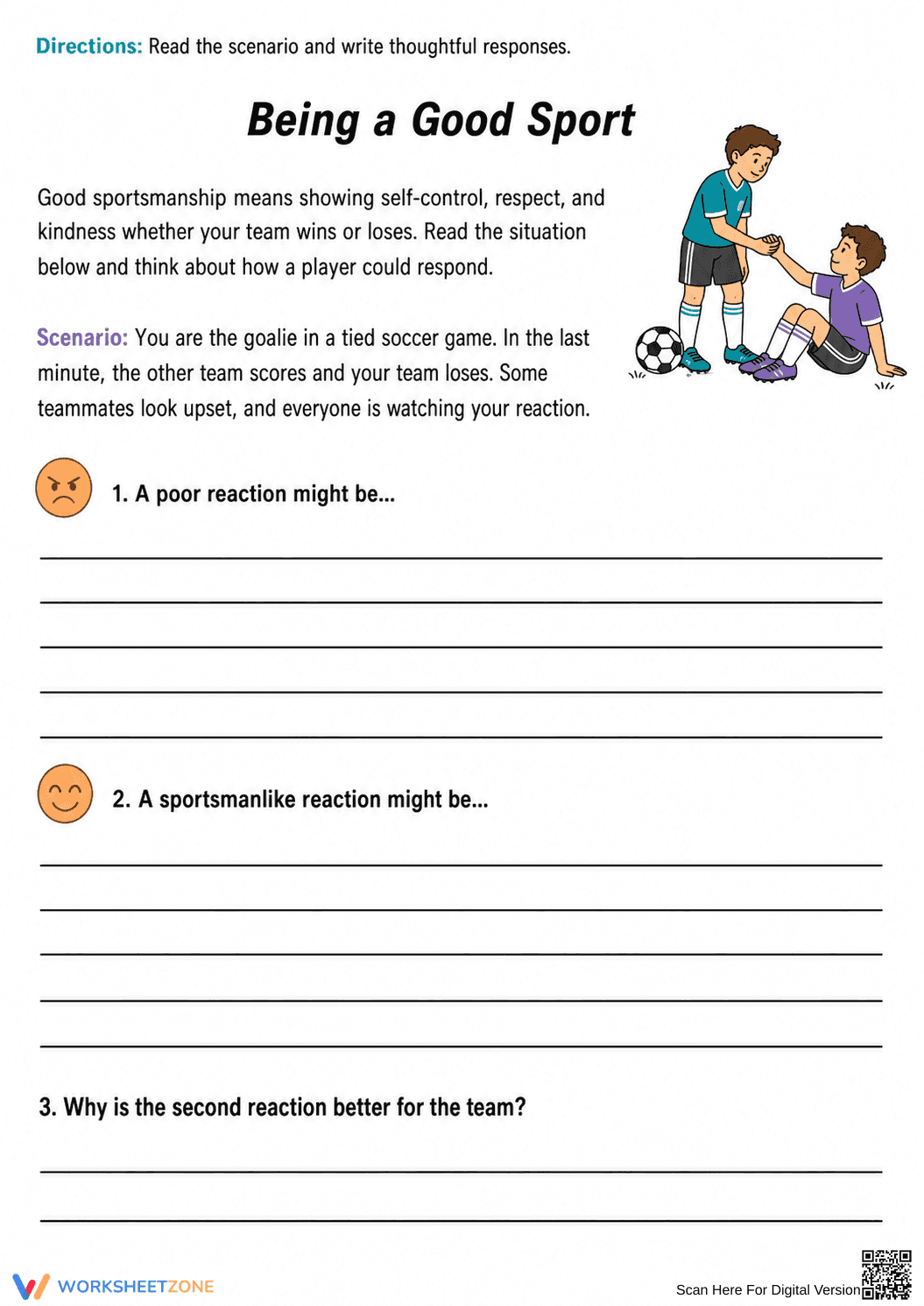
This middle school worksheet helps students explore good sportsmanship through scenario analysis. By reading a relatable sports situation and writing out positive and negative reactions, students practice emotional regulation and perspective-taking while developing clear writing skills. It provides a safe space for students to reflect on their behavior in competitive environments.
At a Glance
- Grade: 6–8 · Subject: English / SEL
- Standard:
CCSS.ELA-LITERACY.W.6.4— Produce clear writing appropriate to the task and purpose- Skill Focus: Emotional regulation and perspective-taking
- Format: 1 page · 3 problems · No answer key · PDF
- Best For: Morning work or advisory periods
- Time: 10–15 minutes
This single-page resource features a brief introductory text defining good sportsmanship, followed by a relatable scenario about playing goalie in a tied soccer game. Students are presented with three open-ended writing prompts requiring them to describe a poor reaction, a sportsmanlike reaction, and a reflection on why positive behavior matters. The format encourages critical thinking and personal reflection.
Zero-Prep Workflow
- Print (1 minute): Simply print the single-page PDF. No special materials or prior setup are required.
- Distribute (1 minute): Hand out the worksheet during homeroom, advisory, or as a quick English writing warm-up.
- Review (3 minutes): Facilitate a brief class discussion where students share their written responses and compare different emotional reactions.
Total teacher prep time is under two minutes, making this an ideal emergency sub plan or a quick addition to any social skills lesson.
Standards Alignment
This activity aligns with CCSS.ELA-LITERACY.W.6.4: Produce clear and coherent writing in which the development, organization, and style are appropriate to task, purpose, and audience. It also supports general social-emotional learning competencies. Both standard codes can be copied directly into lesson plans, IEP goals, or district curriculum mapping tools.
How to Use It
Use this worksheet as a targeted intervention during an advisory period, especially following a recess conflict. It serves as an excellent prompt before direct instruction on emotional regulation. Alternatively, assign it as an independent writing task in an English classroom. As a formative assessment tip, observe whether students accurately identify the difference in tone between reactions. Expected completion time is 10 to 15 minutes.
Who It's For
This resource is designed for middle school students in grades 6 through 8, particularly those benefiting from explicit social skills instruction. The relatable sports context makes it highly engaging for young adolescents. For differentiation, teachers can allow students to dictate responses or work in pairs. It pairs naturally with anchor charts on emotional regulation or a direct instruction lesson on empathy.
Integrating social-emotional learning tasks like this sportsmanship scenario directly supports academic achievement and behavioral development in middle school environments. According to a comprehensive review by Fisher & Frey (2014), embedding structured opportunities for students to practice perspective-taking and emotional regulation significantly improves classroom climate and individual student resilience. By aligning with CCSS.ELA-LITERACY.W.6.4 to produce clear writing appropriate to the task and purpose, this worksheet ensures that students are simultaneously building critical literacy skills while addressing essential behavioral competencies. When students articulate both negative and positive reactions to frustrating situations, they develop the cognitive flexibility required for mature conflict resolution and peer collaboration. This dual-focus approach maximizes instructional time, allowing educators to meet rigorous academic standards while fostering the social-emotional growth necessary for long-term student success.


