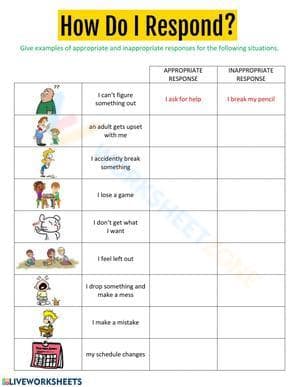
These 7th grade emotions and feelings worksheets give middle school teachers a structured way to move students past labels like "fine" or "stressed" and toward the kind of precise, actionable self-awareness that shapes better decision-making in class and in relationships. The set covers emotional vocabulary, trigger identification, intensity recognition, coping choices, and scenario analysis — skills seventh graders are developmentally ready to practice but rarely get systematic classroom instruction in. The format drops easily into advisory blocks, health lessons, counseling groups, or the first five minutes of homeroom with minimal preparation.
The Specific Skills Each Worksheet Targets
Seventh graders are not emotionally blank slates — they know the words happy, sad, and angry. What they often lack is precision. Each worksheet pushes past the surface by asking students to work with a wider vocabulary: irritated versus overwhelmed, disappointed versus ashamed, anxious versus embarrassed. That distinction matters because a student who can name "I feel humiliated, not just mad" is in a better position to choose a measured response than one who can only say they're upset.
- Emotion vocabulary sorts and matching tasks: students rank feelings by intensity, sort them by type, or match terms to definitions using realistic middle school examples.
- Trigger-response charts: three-column work connecting the event, the emotion, and the reaction that followed — in that order.
- Social scenario analysis: short situations — a lunch-table exclusion, a misread text, a group project disagreement — examined from multiple perspectives.
- Coping skills sorts: students compare strategies by effectiveness rather than simply listing them.
- Mood check-ins: brief weekly reflections that help students notice patterns across different school days and situations.
- Private journaling prompts: open-ended writing on worry, frustration, pride, or conflict, with no requirement to share.
One structural decision worth noting: these worksheets consistently separate the identification step from the response step. Students first name what they feel and where it is coming from. Only then does the worksheet ask what to do about it. When students feel pressure to fix an emotion immediately, many write the expected answer rather than the honest one — that sequence change alone produces noticeably more genuine reflection.
Where Student Work Breaks Down — and Why It Matters
When students fill in trigger-response charts, the most consistent problem is not wrong answers — it is skipped answers. Students reliably describe the trigger (someone made a comment, I got called on unexpectedly, I found out about something online) and then jump straight to behavior (I ignored it, I left, I said nothing) without pausing to name the feeling in between. That gap is exactly where emotional literacy goes quiet, and it is worth naming directly before students begin. Saying something as simple as "Do not skip the middle column" often doubles the quality of the work that follows.
A second pattern: students rate emotion intensity as 10 out of 10 for almost everything frustrating. An eight-minute lunch-line wait and a three-day suspension occupy the same slot on their scale. Worksheets that ask students to place specific scenarios side by side on a numbered range — then compare them — help recalibrate that internal read over time. The goal is not to minimize genuinely hard feelings but to help students develop accuracy about what they are actually experiencing, which makes self-management more possible.
Working These Worksheets Into the Middle School Day
7th grade emotions and feelings worksheets fit into more places than most teachers expect. The obvious spots are advisory period and health class, but these worksheets also work as Monday warm-ups after a turbulent weekend, as reset tools following a classroom conflict that derailed a lesson, and as independent work on substitute days when discussion-based activities fall apart without a familiar teacher at the front of the room.
A weekly rotation that holds up well over a semester: a mood check-in on Monday, a vocabulary or intensity-scale worksheet mid-week, and a coping-skills or scenario reflection on Friday. That variation keeps the activity from feeling rote while reinforcing the same three habits — noticing, naming, deciding.
Small-group counseling is another strong fit. A counselor running a six-student stress-management group can use a trigger-response chart as an organizing tool for conversation, letting the worksheet structure the session rather than generating discussion questions on the fly. Several teachers in mixed-grade teams also keep two or three worksheets from the set available for the kind of unexpected ten-minute window that appears after a school assembly or a schedule change — the format is self-contained enough that students can work through it without setup.
Adjusting the Worksheets Across a Range of Learners
Students who need language support respond well to an emotion word bank printed at the top of the worksheet — not because the vocabulary is too advanced, but because having the words visible removes the "I don't know what to call this" stall that stops otherwise capable writers mid-task. Sentence stems like "When _____ happened, I noticed I felt _____" serve a similar function; they give students a starting point without narrowing what they can say.
For students who move through the standard tasks quickly, one addition raises the bar: require them to explain why this specific feeling appeared rather than a different one. Asking "What makes this frustration rather than disappointment?" requires introspective reasoning that even strong writers find genuinely difficult. Students who are reluctant to respond personally can redirect their answers to a fictional scenario — "a student I heard about" or a character from a text the class has read — and the reflection is just as useful. The emotional distance makes the activity accessible without emptying it of meaning.
Standard Alignment
These worksheets align to the CASEL (Collaborative for Academic, Social, and Emotional Learning) core competency framework, specifically the Self-Awareness and Self-Management domains. Within Self-Awareness, the relevant descriptors include identifying emotions with specificity, linking feelings to situational triggers, and recognizing emotional intensity as a spectrum rather than an on/off state. Within Self-Management, the targeted skills include impulse-control strategies, stress response awareness, and goal-directed behavior under pressure. At the 7th-grade level, CASEL places particular emphasis on applying these competencies within increasingly complex social contexts — peer group dynamics, identity development, and shifting friendships — which matches exactly the scenarios and reflection prompts in this set.
Teachers working 7th grade emotions and feelings worksheets into a health or advisory curriculum will find close alignment with state SEL standards that draw from the CASEL framework. Districts using the ASCA Mindsets and Behaviors framework will find strong connections to B-SMS.7 — demonstrating effective coping skills when faced with a problem — which maps directly to the coping-skills sorts and trigger-response work in these worksheets. The skill clusters here translate across frameworks without needing to be rebuilt for each context.
Frequently Asked Questions
What types of activities appear across the different worksheets in the set?
The set includes emotion vocabulary sorts, trigger-response charts, social scenario reflections, coping-skills comparisons, mood check-ins, and open-ended journaling prompts. Each worksheet targets one specific step in the reflection process — naming a feeling, connecting it to a cause, or evaluating a response — rather than trying to cover the full sequence in one sitting.
How do teachers use these without requiring students to share personal information?
The most direct approach is to set the expectation before distributing the worksheets: students can respond about themselves, about a fictional character, or about "a situation someone I know dealt with." Teachers who frame the activity that way consistently see higher completion rates and more honest responses. Exit-ticket formats work especially well because students hand them in privately rather than reading answers aloud — that small shift changes the social stakes entirely.
Can a school counselor use these in small-group or individual sessions?
The trigger-response charts and coping-skills sorts translate directly to counseling use, where the worksheet structure organizes the conversation rather than requiring the counselor to drive discussion from scratch. The vocabulary and scenario sheets also work well in individual sessions with students navigating conflict, anxiety, or a difficult social transition. Teachers using 7th grade emotions and feelings worksheets in the classroom often find that counselors are already running parallel versions of the same activities — coordinating across both settings reinforces the skills more than either setting does alone.
















 Interactive Worksheet Maker
 Quiz Maker
 Word Search Maker
 Crossword Puzzle Maker
 Word Scramble Generator
 Sentence Scramble Generator
 Handwriting Worksheet Generator
 Name Tracing Generator
 Fill In The Blank Generator