




























0
Views
0
Downloads

0.0
0
Save
0 Likes
Share
Coping Mood Check Social Learning Worksheet
0 Views
0 Downloads

Paste this activity's link or code into your existing LMS (Google Classroom, Canvas, Teams, Schoology, Moodle, etc.).
Students can open and work on the activity right away, with no student login required.
You'll still be able to track student progress and results from your teacher account.
Information
Description
What It Is:
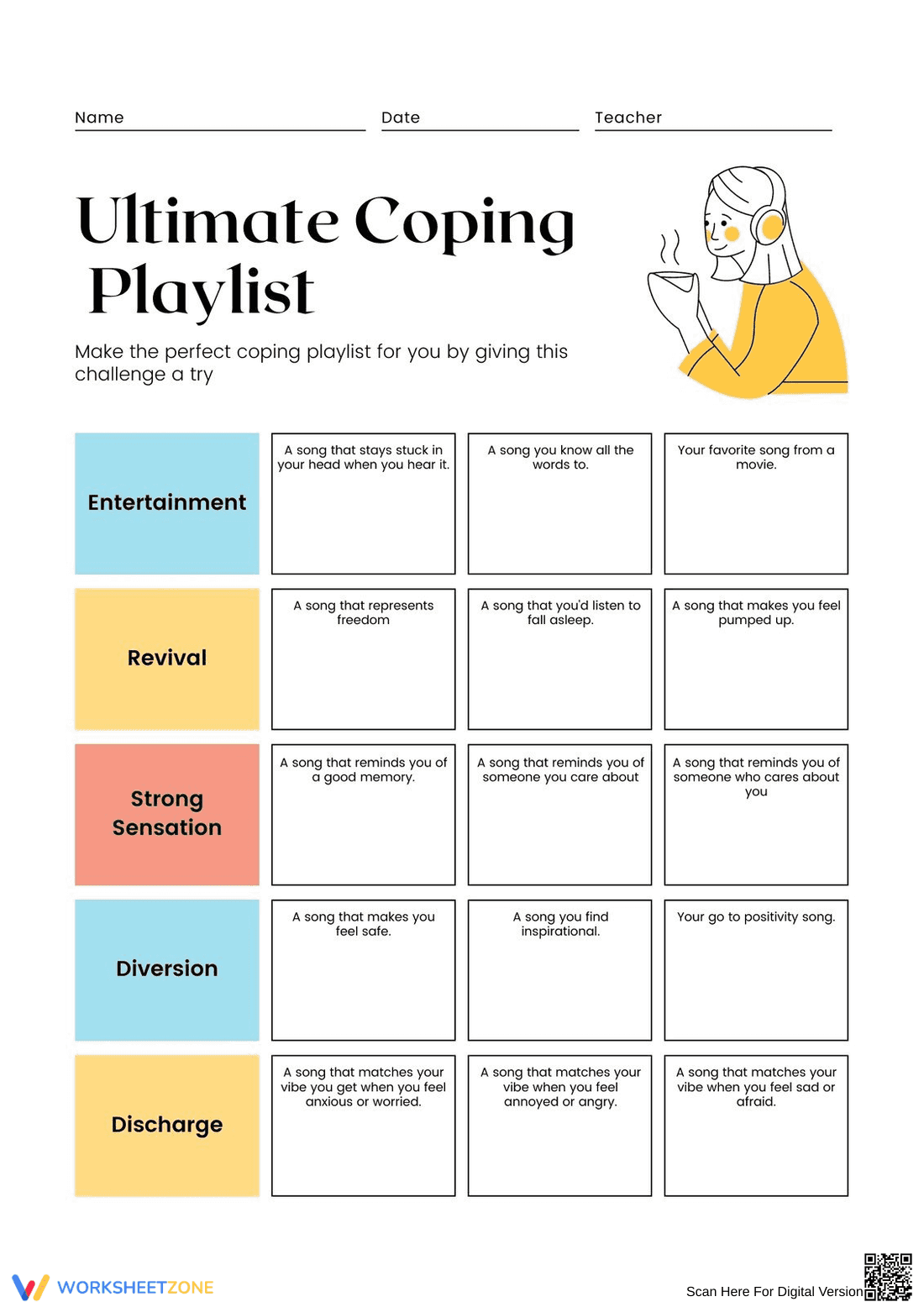
This is a worksheet titled 'Ultimate Coping Playlist' designed to help individuals create a personalized playlist for managing emotions. It features a grid with different categories: Entertainment, Revival, Strong Sensation, Diversion, and Discharge. Under each category are three blank boxes with prompts like 'A song that stays stuck in your head when you hear it,' 'A song that represents freedom,' 'A song that reminds you of a good memory,' 'A song that makes you feel safe,' and 'A song that matches your vibe when you feel anxious or worried.' There are spaces at the top for Name, Date, and Teacher.
Grade Level Suitability:
This worksheet is suitable for upper elementary, middle school, and high school students (Grades 5-12). The concepts are accessible to these age groups, and the activity encourages self-reflection and emotional awareness.
Why Use It:
This worksheet helps students develop coping mechanisms by connecting music to their emotions. It encourages self-awareness, emotional regulation, and creative expression through playlist creation. It provides a structured way for students to identify songs that can help them manage different feelings and situations.
How to Use It:
Students should fill in the blanks at the top with their name, date, and teacher's name. Then, for each category (Entertainment, Revival, Strong Sensation, Diversion, and Discharge), students should think of songs that fit the prompts provided in the boxes and write the song titles in the corresponding spaces. They can then create a playlist based on the songs they listed.
Target Users:
This worksheet is beneficial for students, counselors, therapists, and educators who want to explore the connection between music and emotions. It can be used in individual counseling sessions, group therapy, classroom activities, or as a self-help tool for emotional regulation.
This is a worksheet titled 'Ultimate Coping Playlist' designed to help individuals create a personalized playlist for managing emotions. It features a grid with different categories: Entertainment, Revival, Strong Sensation, Diversion, and Discharge. Under each category are three blank boxes with prompts like 'A song that stays stuck in your head when you hear it,' 'A song that represents freedom,' 'A song that reminds you of a good memory,' 'A song that makes you feel safe,' and 'A song that matches your vibe when you feel anxious or worried.' There are spaces at the top for Name, Date, and Teacher.
Grade Level Suitability:
This worksheet is suitable for upper elementary, middle school, and high school students (Grades 5-12). The concepts are accessible to these age groups, and the activity encourages self-reflection and emotional awareness.
Why Use It:
This worksheet helps students develop coping mechanisms by connecting music to their emotions. It encourages self-awareness, emotional regulation, and creative expression through playlist creation. It provides a structured way for students to identify songs that can help them manage different feelings and situations.
How to Use It:
Students should fill in the blanks at the top with their name, date, and teacher's name. Then, for each category (Entertainment, Revival, Strong Sensation, Diversion, and Discharge), students should think of songs that fit the prompts provided in the boxes and write the song titles in the corresponding spaces. They can then create a playlist based on the songs they listed.
Target Users:
This worksheet is beneficial for students, counselors, therapists, and educators who want to explore the connection between music and emotions. It can be used in individual counseling sessions, group therapy, classroom activities, or as a self-help tool for emotional regulation.


