


























Views
Downloads
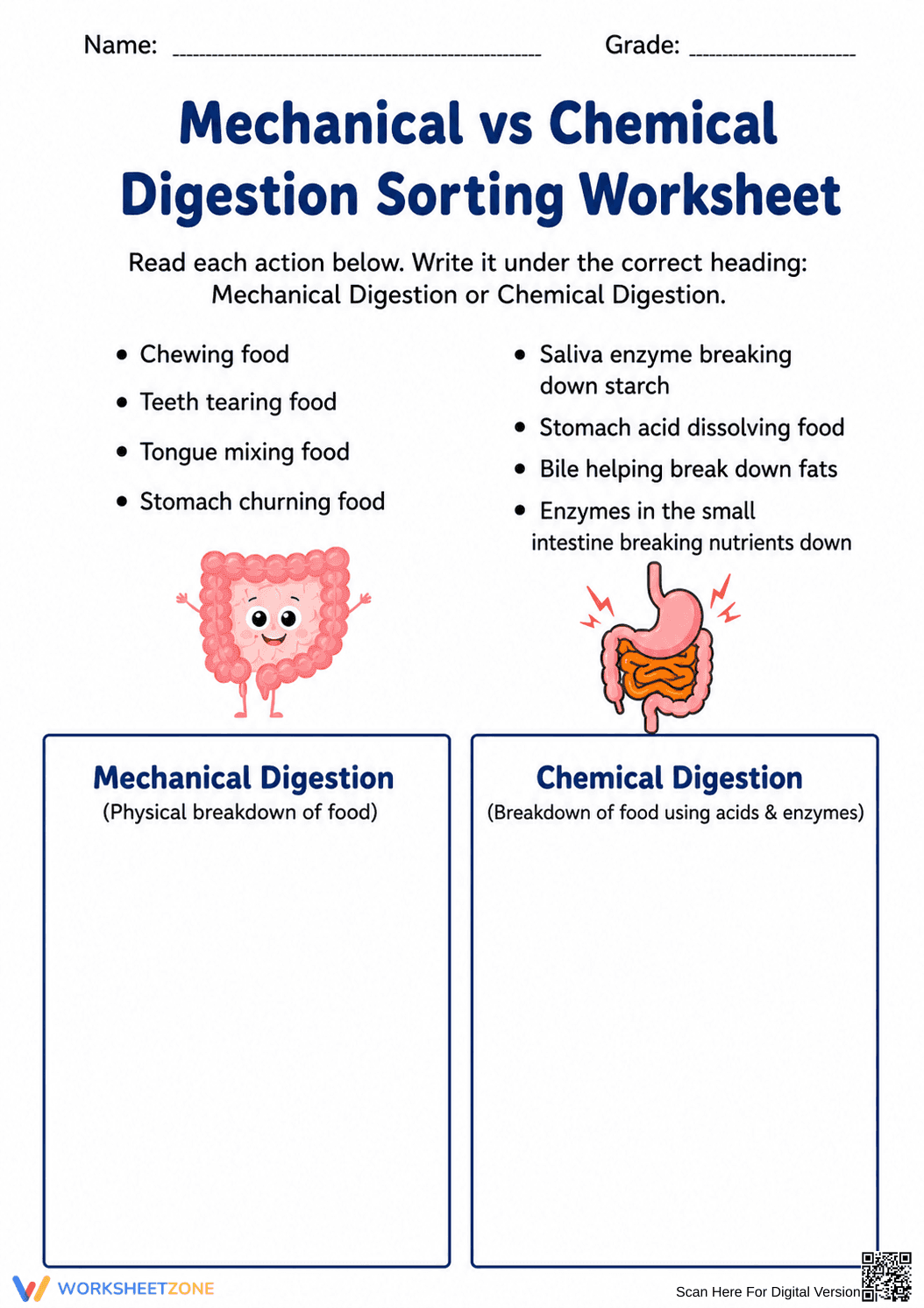

Grade 7 Digestion — Printable No-Prep Worksheet
Paste this activity's link or code into your existing LMS (Google Classroom, Canvas, Teams, Schoology, Moodle, etc.).
Students can open and work on the activity right away, with no student login required.
You'll still be able to track student progress and results from your teacher account.
This middle school science worksheet helps students distinguish between mechanical and chemical digestion by categorizing specific bodily processes. By sorting eight distinct digestive actions into their correct physical or chemical breakdown categories, learners solidify their understanding of how the human body processes food into usable nutrients.
At a Glance
- Grade: 7 · Subject: Science
- Standard:
MS-LS1-3— Understand how body subsystems interact to process food- Skill Focus: Sorting mechanical and chemical digestion
- Format: 1 page · 8 problems · Answer key included · PDF
- Best For: Independent practice
- Time: 10–15 minutes
Inside this single-page resource, educators will find a straightforward sorting activity featuring eight common digestive actions, such as "stomach churning food" and "saliva enzyme breaking down starch." Students read each bulleted action and write it under the corresponding heading for either mechanical digestion (physical breakdown) or chemical digestion (acid and enzyme breakdown). A complete answer key is provided to ensure accurate grading and immediate student feedback.
This resource is designed for a smooth, zero-prep classroom experience.
- Print (1 minute): Simply download the PDF and print a class set. The clean layout requires no special formatting.
- Distribute (1 minute): Hand out the worksheets as a warm-up, exit ticket, or independent practice assignment.
- Review (3 minutes): Use the included answer key to quickly check student comprehension or facilitate a whole-class review.
Total teacher preparation time is under two minutes, making this an excellent option for emergency sub plans or quick formative assessments.
This activity is aligned to MS-LS1-3, requiring students to understand how the body is a system of interacting subsystems composed of groups of cells. By differentiating between physical and chemical changes in the digestive tract, students build a foundational understanding of human biology. Both standard codes can be copied directly into lesson plans, IEP goals, or district curriculum mapping tools.
Use this sorting activity immediately following direct instruction on the digestive system to reinforce the roles of enzymes, acids, and physical movement. It serves as an excellent formative assessment; as students work, observe whether they correctly identify enzyme-driven processes as chemical rather than physical. Alternatively, assign it as a quick 10-minute warm-up on the second day of your human body systems unit to activate prior knowledge before introducing nutrient absorption in the small intestine.
This worksheet is ideal for middle school science students in grades 6 through 8 who are studying human body systems. The clear, binary sorting format provides built-in scaffolding for learners who benefit from structured choices. It pairs perfectly with a digestive system diagram or an anchor chart detailing the organs of the gastrointestinal tract.
Mastering the distinction between physical and chemical changes is a critical component of middle school science curricula. Aligned with MS-LS1-3, this resource helps students understand how body subsystems interact to process food by categorizing mechanical and chemical digestion. According to a 2024 report by EdReports, instructional materials that require students to actively categorize scientific phenomena significantly improve long-term retention of complex biological processes. By evaluating specific actions—such as teeth tearing food versus stomach acid dissolving food—students move beyond rote memorization and engage in higher-order analytical thinking. This targeted practice ensures learners can accurately identify the mechanisms behind food breakdown, laying the groundwork for advanced studies in cellular respiration and biochemistry. The structured sorting format minimizes cognitive overload, allowing students to focus entirely on the scientific concepts at hand.


