


























Views
Downloads

Printable Digestive Process Worksheet | Grade 4
Paste this activity's link or code into your existing LMS (Google Classroom, Canvas, Teams, Schoology, Moodle, etc.).
Students can open and work on the activity right away, with no student login required.
You'll still be able to track student progress and results from your teacher account.
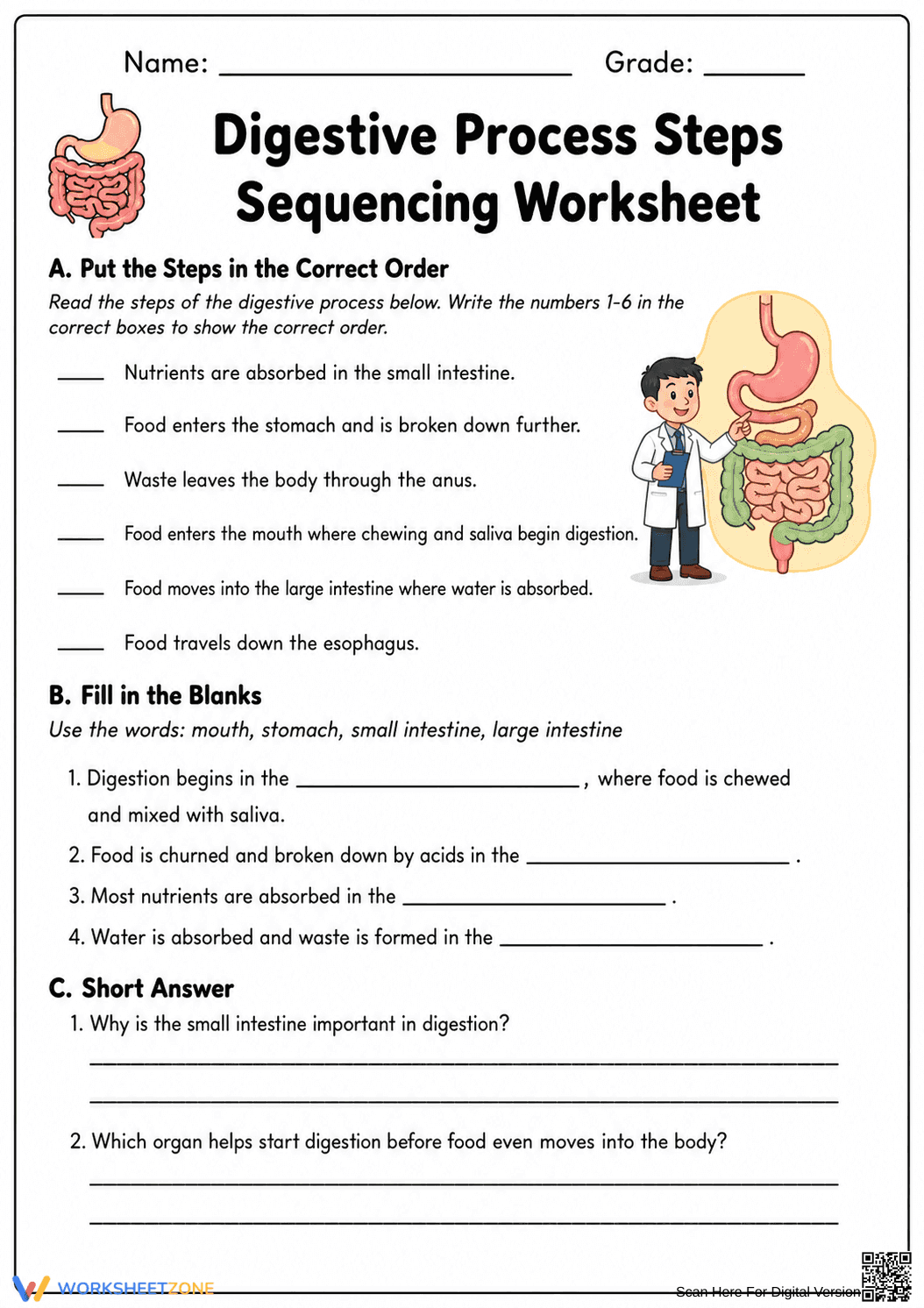
This Grade 4 science worksheet helps students master the digestive process by sequencing how food travels through the body. By organizing the steps of digestion and identifying specific organ functions, learners build a clear, connected understanding of this essential human body system.
At a Glance
- Grade: 4 · Subject: Science
- Standard:
4-LS1-1— Understand how internal structures support animal survival- Skill Focus: Sequencing the digestive process
- Format: 1 page · 12 problems · Answer key included · PDF
- Best For: Independent practice or review
- Time: 15–20 minutes
This single-page resource features three distinct task types to reinforce student learning. It includes a six-step sequencing activity where students order the path of food, a four-question fill-in-the-blank section with a provided word bank, and two short-answer questions requiring written explanations. A complete answer key is provided to ensure accurate grading and quick feedback.
Designed for immediate classroom implementation, this worksheet requires minimal teacher preparation:
- Print (1 minute): Simply download the PDF and print copies for your class. The clean layout is highly readable and printer-friendly.
- Distribute (1 minute): Hand out the worksheet as a standalone activity or alongside a human body unit.
- Review (3 minutes): Use the included answer key to quickly check student comprehension or guide a whole-class review session.
With under two minutes of total teacher prep time, this resource is highly suitable for emergency sub plans or quick formative assessments.
This activity aligns with 4-LS1-1, requiring students to construct an argument that plants and animals have internal and external structures that function to support survival, growth, behavior, and reproduction. By mapping out the stomach, intestines, and esophagus, students directly observe how internal structures process nutrients. Both standard codes can be copied directly into lesson plans, IEP goals, or district curriculum mapping tools.
Teachers can deploy this worksheet during independent practice after direct instruction on the human body. It serves as an excellent reinforcement tool once students have been introduced to basic vocabulary. Alternatively, use it as a formative assessment at the end of the week; observe whether students can accurately sequence the steps without referencing their notes, which indicates true mastery of the concept. Most students will complete the tasks within a 15 to 20-minute timeframe.
This resource is primarily designed for fourth-grade general education students, though it serves as an excellent review for fifth and sixth graders studying biology. For students requiring accommodations, the built-in word bank provides necessary scaffolding for the vocabulary section. It pairs perfectly with an introductory reading passage on the digestive system or a classroom anchor chart detailing human anatomy.
Aligning instructional materials with core scientific principles is essential for developing long-term comprehension of biological systems. This worksheet targets 4-LS1-1, helping students understand how internal structures support animal survival by mapping the specific sequence of the digestive tract. According to a ScienceDirect TpT Analysis, providing students with structured sequencing tasks significantly improves their ability to conceptualize complex, multi-step biological processes compared to rote memorization alone. By breaking down the digestive process into ordered steps, fill-in-the-blank vocabulary reinforcement, and short-answer reasoning, educators can facilitate deeper cognitive connections. This multi-modal approach ensures that learners do not just memorize organ names, but actually comprehend the functional relationships between the mouth, stomach, and intestines. Utilizing targeted, standards-based practice materials ultimately builds a stronger foundation for advanced scientific inquiry in later grades.


