




























Views
Downloads

Essential Digestive System Labeling Worksheet | Grades 3-6

Paste this activity's link or code into your existing LMS (Google Classroom, Canvas, Teams, Schoology, Moodle, etc.).
Students can open and work on the activity right away, with no student login required.
You'll still be able to track student progress and results from your teacher account.
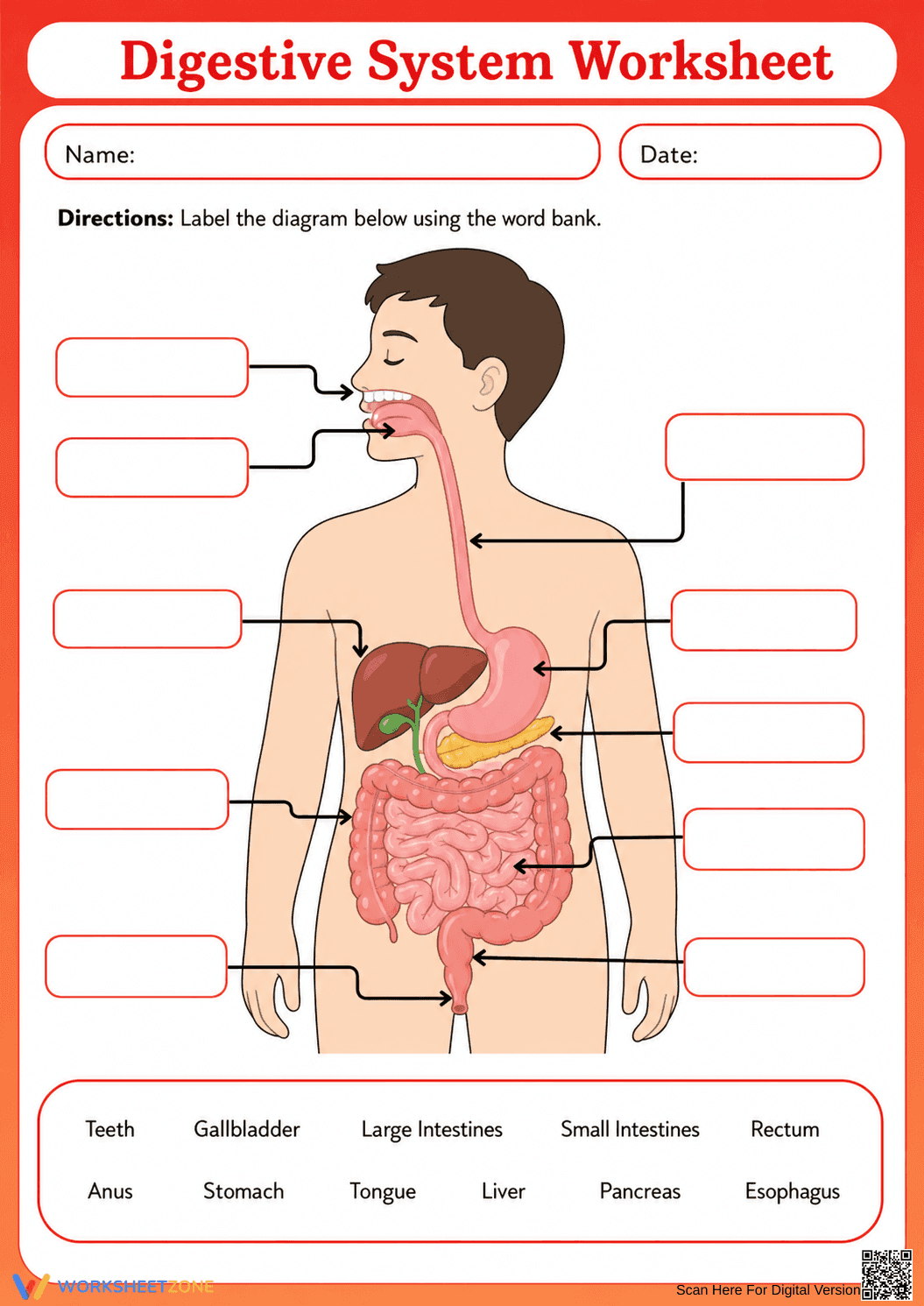
This digestive system diagram labeling worksheet provides a clear anatomical visual for students to identify 11 key organs. By matching terms from a word bank to the correct physiological locations, learners develop a concrete mental map of the human body. It is an effective tool for transitioning from abstract concepts to concrete anatomical recognition and vocabulary mastery.
At a Glance
- Grade: 3-6 · Subject: Science
- Standard:
4-LS1-1— Identify internal structures that function to support survival and growth.- Skill Focus: Anatomical labeling and organ identification
- Format: 1 page · 11 problems · Answer key included · PDF
- Best For: Quick assessment or independent practice
- Time: 15–20 minutes
What's Inside
The resource features a high-quality medical illustration of the human torso with clear directional arrows pointing to specific organs. A comprehensive word bank at the bottom includes 11 terms: teeth, gallbladder, large intestines, small intestines, rectum, anus, stomach, tongue, liver, pancreas, and esophagus. The single-page PDF format ensures ease of printing, and the included answer key allows for rapid grading or student self-correction.
Zero-Prep Workflow
- Print: Select the page and print the required number of copies for your class in under 1 minute.
- Distribute: Hand out the sheets as a warm-up, exit ticket, or independent practice during your human body unit.
- Review: Use the provided answer key to review the correct labels as a whole group, taking approximately 5 minutes for total feedback.
The total teacher preparation time is under 2 minutes, making it an ideal choice for substitute plans or last-minute lesson supplements.
Standards Alignment
The primary focus is `4-LS1-1`, which requires students to construct an argument that plants and animals have internal and external structures that function to support survival, growth, behavior, and reproduction. By identifying the digestive organs, students gain the foundational knowledge necessary to explain how these structures work together to process nutrients. Both standard codes can be copied directly into lesson plans, IEP goals, or district curriculum mapping tools.
How to Use It
Use this worksheet as a formative assessment after a direct instruction lesson on the human body. As students work, circulate to observe if they can distinguish between the small and large intestines, which is a common point of confusion. Alternatively, use it as a pre-assessment to gauge prior knowledge before starting a biology unit. Expected completion time is 15 to 20 minutes.
Who It's For
This resource is tailored for upper elementary and middle school students in grades 3 through 6. It provides necessary scaffolding for English Language Learners (ELLs) through the inclusion of a word bank. It pairs naturally with a digestive system anchor chart or a short informational passage about the path of food through the body.
Research from Fisher & Frey (2014) emphasizes the importance of visual literacy and the use of graphic organizers, such as labeled diagrams, to help students internalize complex biological systems. This worksheet aligns with the 4-LS1-1 standard by requiring students to recognize the internal structures essential for nutrient absorption and survival. By engaging with the 11 specific anatomical terms provided in the word bank, learners move beyond rote memorization toward a spatial understanding of human anatomy. Studies in the ScienceDirect TpT Analysis suggest that structured labeling tasks significantly improve long-term retention of scientific vocabulary compared to text-only instruction. This resource provides a high-utility, evidence-based approach to life science education, ensuring that students meet grade-level expectations for identifying organ systems. The inclusion of an answer key supports immediate feedback, a critical component of the gradual release of responsibility model in science classrooms.


