




























Views
Downloads

Grade 6 Digestive System — Printable No-Prep Worksheet

Paste this activity's link or code into your existing LMS (Google Classroom, Canvas, Teams, Schoology, Moodle, etc.).
Students can open and work on the activity right away, with no student login required.
You'll still be able to track student progress and results from your teacher account.
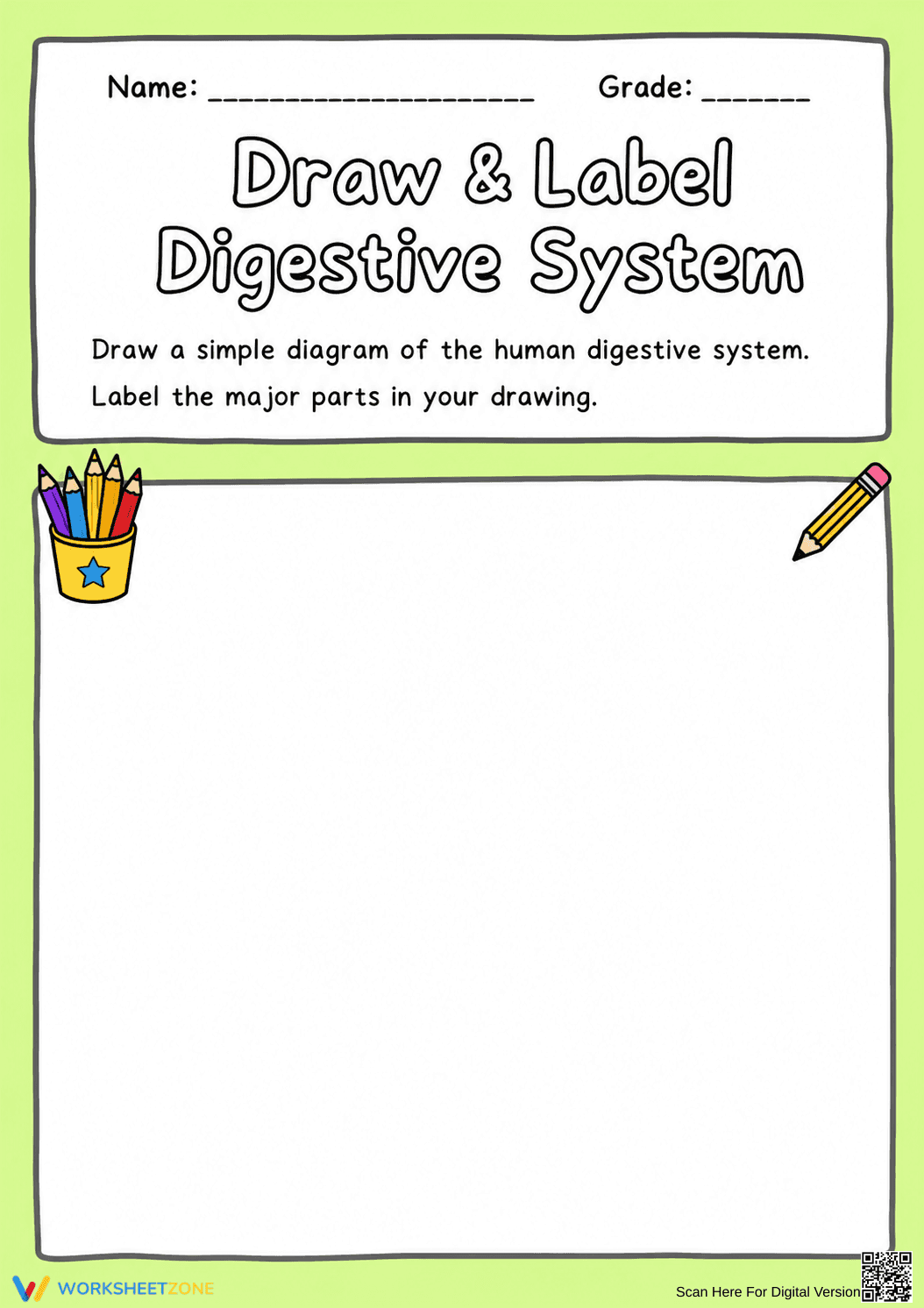
This single-page science worksheet challenges students to draw and label the human digestive system from memory or reference. By actively sketching the organs and their connections, learners solidify their understanding of anatomical structures and how they function together to process food, moving beyond passive diagram identification.
At a Glance
- Grade: 5-7 · Subject: Science
- Standard:
MS-LS1-3— Illustrate how body subsystems interact to function- Skill Focus: Drawing and labeling anatomical structures
- Format: 1 page · 1 open-ended task · No answer key · PDF
- Best For: Formative assessment or unit review
- Time: 15–20 minutes
This resource features a clean drawing space with a direct prompt asking students to sketch and label the human digestive system. The open-ended format provides ample room for creativity, allowing students to include key organs like the stomach, intestines, and liver. Because it relies on student-generated illustrations, it omits a standardized answer key, making it adaptable to the specific vocabulary taught in your classroom.
Designed for immediate classroom implementation, this activity requires virtually no teacher preparation:
- Print (1 minute): The single-page PDF format ensures quick printing for the entire class.
- Distribute (1 minute): Hand out the templates with colored pencils or markers.
- Review (3 minutes): Circulate the room to check for accurate organ placement and correct spelling.
With under two minutes of total prep time, this worksheet is an excellent addition to emergency sub plans or as a spontaneous review activity.
This activity aligns with MS-LS1-3, which requires students to use evidence to explain how the body is a system of interacting subsystems composed of groups of cells. By drawing the physical connections between the stomach, liver, and intestines, students visually demonstrate these subsystem interactions. The standard code can be copied directly into lesson plans, IEP goals, or district curriculum mapping tools.
This drawing task is highly versatile. Use it as a mid-unit formative assessment to check if students can accurately recall the sequence of digestive organs without relying on a textbook diagram. Alternatively, assign it as an interactive notebook entry. While students are sketching, observe whether they correctly connect the esophagus to the stomach rather than the trachea. Expect this activity to take 15 to 20 minutes.
This worksheet is ideal for middle school science students in grades 5 through 7, particularly visual and kinesthetic learners who benefit from hands-on creation. It naturally differentiates itself, as advanced students can add complex labels like the gallbladder or pancreas, while students needing support can focus on the primary digestive tract. Pair this drawing task with a direct instruction lesson on human body systems or a reading passage about mechanical versus chemical digestion.
Integrating student-generated drawings into science instruction significantly enhances conceptual retention. When students illustrate how body subsystems interact to function, as outlined in MS-LS1-3, they engage in deeper cognitive processing than when simply filling in the blanks on a pre-drawn diagram. According to a ScienceDirect TpT Analysis, activities that require learners to translate text-based knowledge into visual representations improve spatial understanding and long-term memory of anatomical structures. By prompting students to actively construct their own models of the digestive tract, educators facilitate a more robust comprehension of biological systems. This hands-on approach encourages learners to visualize the continuous pathway of food, reinforcing the functional relationships between organs. Utilizing open-ended drawing tasks serves as both an effective instructional strategy and a reliable formative assessment tool in the middle school science classroom.


