


























Views
Downloads
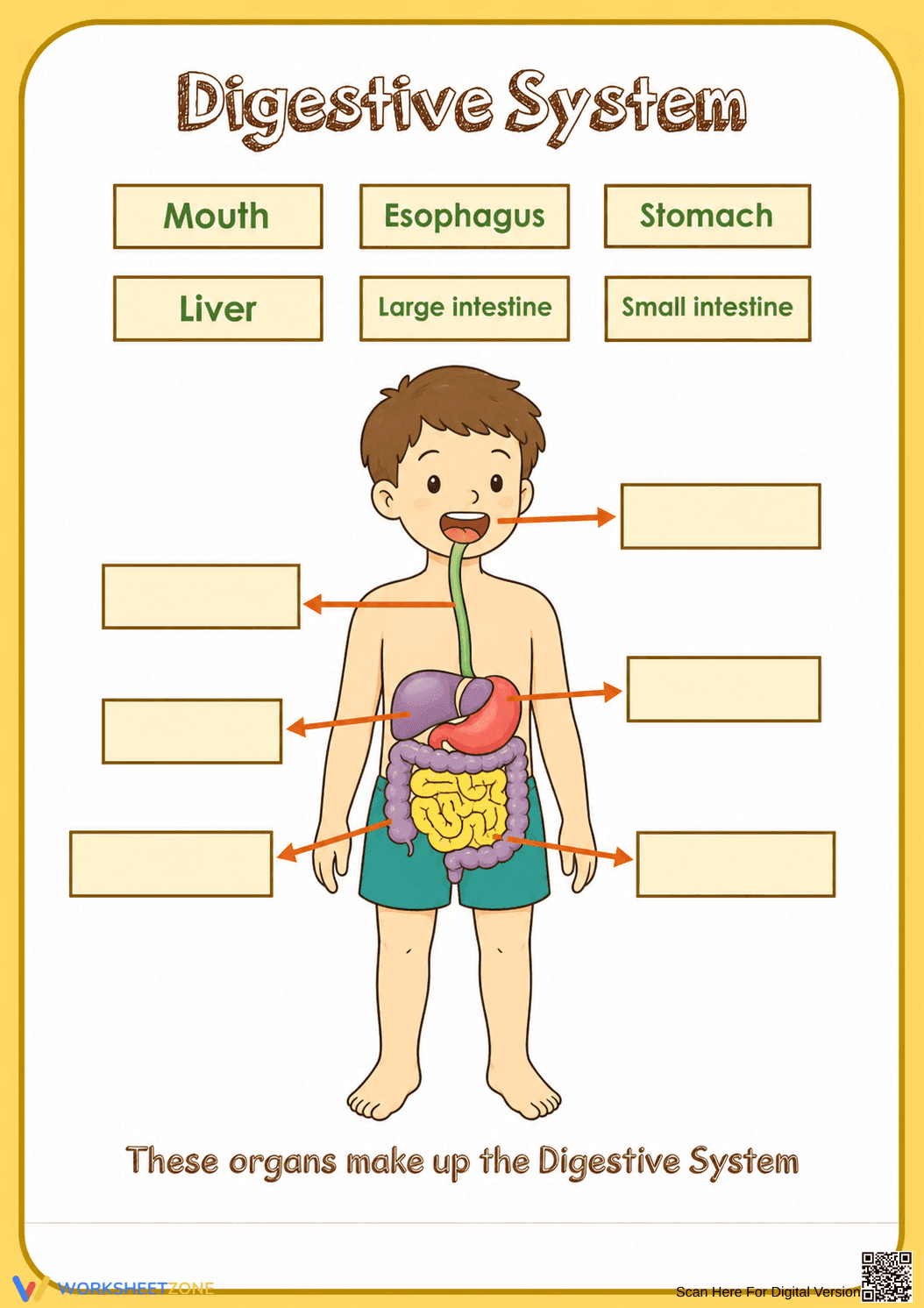

Digestive System Labeling Worksheet | Grade 7 Essential
Paste this activity's link or code into your existing LMS (Google Classroom, Canvas, Teams, Schoology, Moodle, etc.).
Students can open and work on the activity right away, with no student login required.
You'll still be able to track student progress and results from your teacher account.
This Grade 7 digestive system worksheet helps students identify and locate the primary organs involved in human digestion. By matching anatomical terms to a clear diagram, learners solidify their understanding of how the body processes nutrients. It provides a foundational check for biology units focusing on body systems and cellular energy.
At a Glance
- Grade: 7 · Subject: Science
- Standard:
MS-LS1-3— Use evidence to explain how body systems interact to maintain health- Skill Focus: Anatomical labeling
- Format: 1 page · 6 problems · Answer key included · PDF
- Best For: Quick formative assessment or sub plans
- Time: 10–15 minutes
This single-page PDF features a high-quality anatomical illustration of the human torso with six clear call-out boxes. A word bank is provided at the top, containing the mouth, esophagus, stomach, liver, large intestine, and small intestine. The layout is clean and distraction-free, ensuring students focus entirely on the spatial relationships between organs.
The workflow for this resource is designed for maximum efficiency. First, print the single-page PDF (30 seconds). Second, distribute to students as a warm-up or exit ticket (1 minute). Third, review the six labels as a whole class using the included answer key (2 minutes). Total teacher preparation time is under 2 minutes, making it an ideal emergency sub plan.
The primary standard is `MS-LS1-3`, which requires students to "use argument supported by evidence for how the body is a system of interacting subsystems composed of groups of cells." This worksheet serves as the prerequisite step of identifying those subsystems. Both standard codes can be copied directly into lesson plans, IEP goals, or district curriculum mapping tools.
Use this worksheet during the "Explain" phase of a 5E lesson cycle to verify that students can distinguish between the small and large intestines. It also works well as a formative-assessment observation tool; watch for students who confuse the liver and stomach placement. Expected completion time is 10 to 15 minutes.
This resource is designed for middle school life science students, particularly those in Grade 7. It is also suitable for high school biology students needing a quick refresher or ESL/ELL learners who benefit from visual-to-text associations. Pair this with a digestive system anchor chart or a short video on peristalsis.
According to the RAND AIRS 2024 report on instructional materials, high-quality visual aids significantly improve retention of complex biological structures in middle school learners. This worksheet aligns with the MS-LS1-3 standard, focusing on the plain-English skill of identifying organ locations within the human digestive system. By providing a structured word bank and clear spatial cues, the resource reduces cognitive load, allowing students to focus on anatomical accuracy. Research from Fisher & Frey (2014) suggests that such scaffolded labeling tasks are essential for building the academic vocabulary necessary for later physiological explanations. This 1-page PDF is a reliable tool for teachers seeking to bridge the gap between basic identification and system-level understanding. The inclusion of an answer key ensures that feedback can be immediate, which is a critical factor in student mastery of life science concepts.


