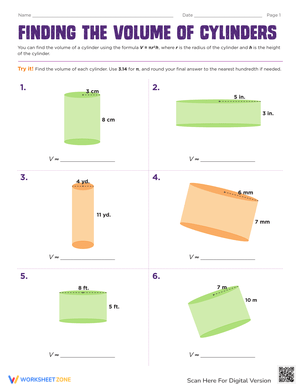
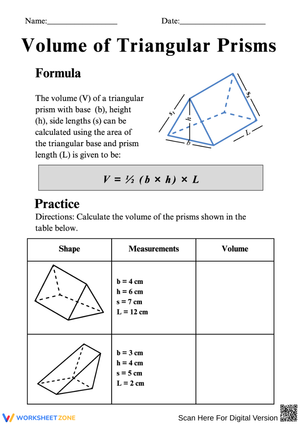
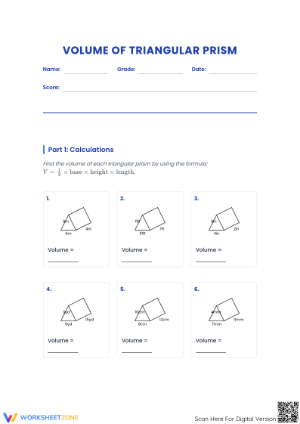
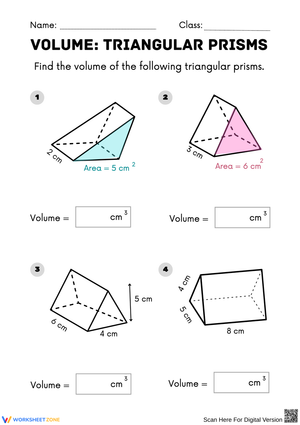
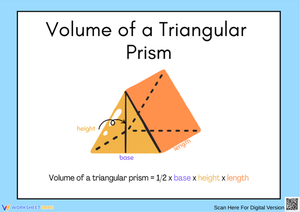
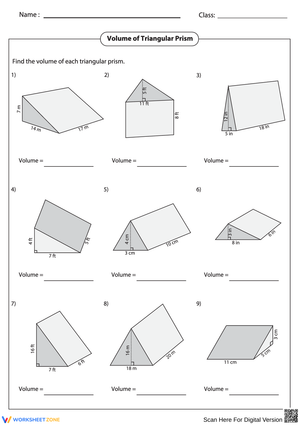
These volume printable worksheets for 6th grade give teachers a ready set of targeted practice resources covering unit-cube counting, rectangular prism formulas, missing-dimension problems, and real-world applications — the full range of what Grade 6 geometry standards ask students to do with volume. Each worksheet targets a specific aspect of that progression so teachers can assign them strategically rather than relying on a single format from start to finish.
What Each Worksheet Targets
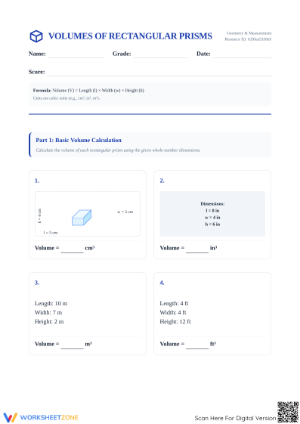
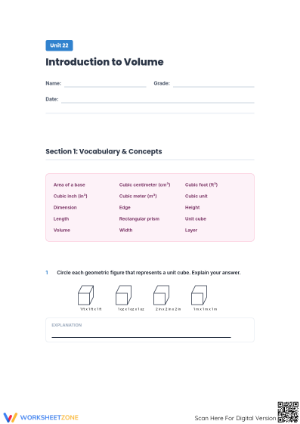
The set moves from visual reasoning toward abstract formula use, which mirrors the order most Grade 6 classrooms follow during a volume unit. Cube-counting worksheets come first: students identify how many unit cubes fill a prism by analyzing rows and layers, building the intuition that makes V = l × w × h feel logical rather than arbitrary. From there, worksheets shift to labeled prism diagrams where students apply either the standard formula or the base-area version, V = B × h, depending on what information is given.
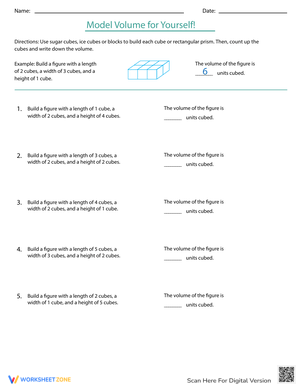
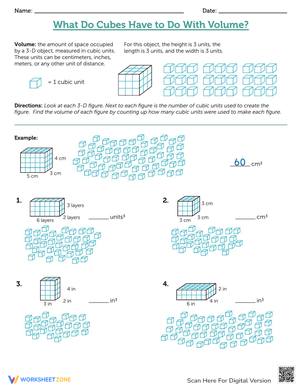
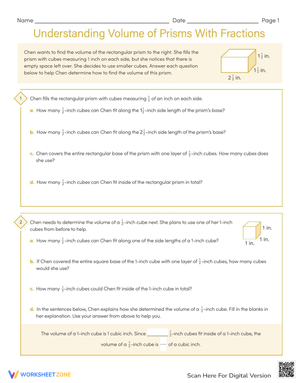
- Unit-cube arrays: Students count by layers and columns to see why organized multiplication beats cube-by-cube tallying.
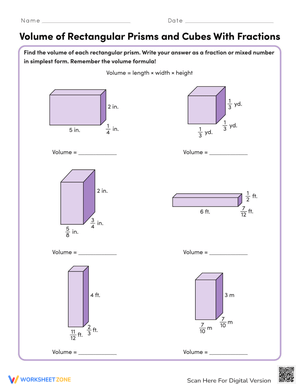
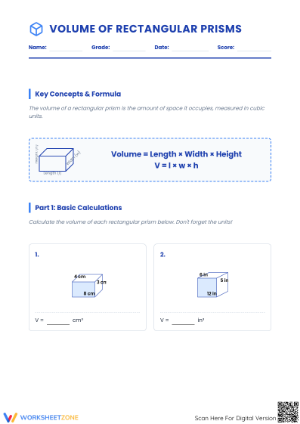
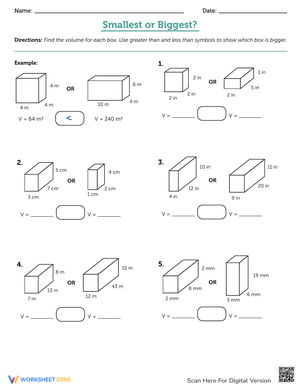
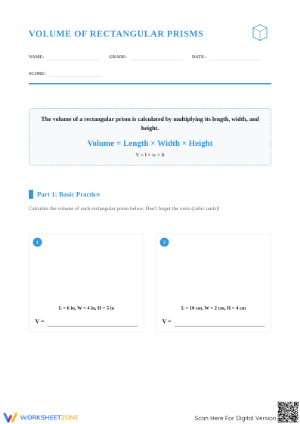
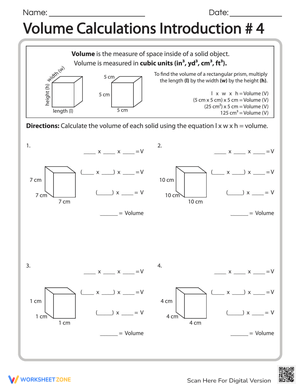
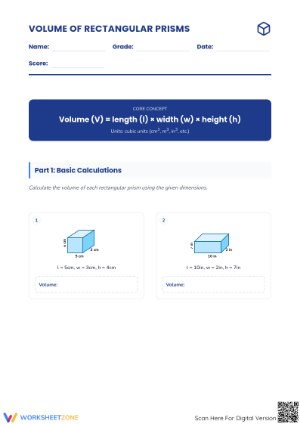
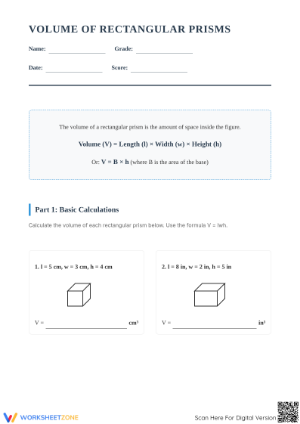
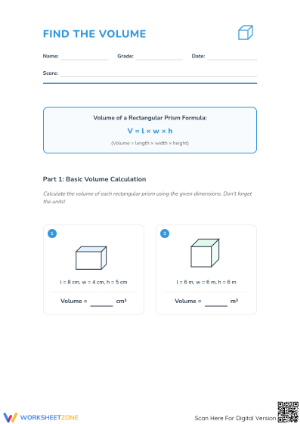
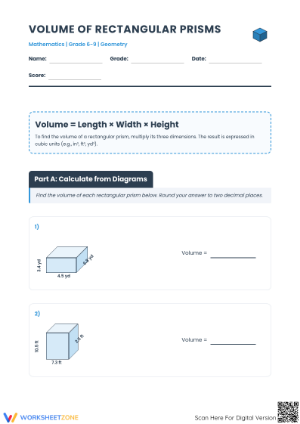
- Labeled rectangular prism problems: Length, width, and height are all provided; students apply the formula and record the answer in cubic units.
- Base-area problems: The area of the base is given instead of individual dimensions, requiring students to treat B × h as the working formula.
- Missing-dimension tasks: Volume and two side lengths are provided; students solve backward to find the unknown measurement.
- Word problems: Context situations — storage bins, fish tanks, shipping boxes — require students to identify relevant measurements and decide which formula applies.
- Unit identification: Standalone items where students label or select the correct cubic unit, separating that skill from the computation itself.
That last category matters more than it looks. A student who writes cm² after a correct multiplication has made a conceptual error, not a careless one. An isolated unit-labeling exercise surfaces that before it becomes a habit across an entire assessment.
Frequent Errors Worth Anticipating Before You Assign
Volume lands in Grade 6 partly because students have spent years measuring in two dimensions. The shift to three-dimensional thinking produces predictable stumbling points, and knowing where students tend to go wrong makes it easier to decide which worksheets to use and when.
The most common problem: students multiply only two of the three dimensions, treating volume as though it were area. They have been multiplying length × width since third grade, and that pattern sticks. A student will compute 4 × 6 = 24 and stop, even when a height of 3 is clearly labeled on the diagram. Requiring students to write out all three dimensions before multiplying — something several of these worksheets prompt explicitly — interrupts that automatic two-factor pattern.
Hidden cubes in layered models create a second reliable gap. Students count the cubes visible on the front and top faces but ignore back rows entirely. The fix is not just telling them to "count all the cubes" — it's having them shade or annotate each layer separately, which the cube-counting worksheets in this set support directly. Students still need to practice reasoning about what cannot be seen, and worksheet tasks that ask them to record a layer-by-layer count before writing the total make that reasoning explicit.
Unit labeling errors persist even after the computation is accurate. Students who write square units on a volume answer are not always confused about the concept — sometimes they are defaulting to the unit type they wrote most recently. A brief class discussion about why three multiplied dimensions produce a cubic result, paired with a worksheet that separates unit labeling from calculation, interrupts that default faster than repeated correction on finished problems.
How to Build These Worksheets Into Your Lesson Plans
The most effective placement for volume printable worksheets for 6th grade depends on where the class is in the unit, not just on difficulty level. A worksheet with labeled prisms and the formula printed at the top serves a different instructional purpose on day two than it does during a review block two weeks later.
Early in the unit, cube-counting and layered-model worksheets work well as partner tasks. Two students looking at the same diagram and disagreeing about how many cubes fill the back layer generates exactly the kind of discussion that builds geometric reasoning — and it surfaces misconceptions you can address during the debrief rather than on a quiz. During direct instruction, a short four-to-six-problem prism worksheet gives students something to complete alongside teacher modeling without introducing so many new items at once that students lose track of the goal.
- Monday warm-ups: Two quick cube-counting problems after morning meeting reactivate visual reasoning in under five minutes.
- Guided practice: Teacher works through one labeled prism problem; students complete the next two independently before a class check.
- Math centers: Keep worksheets sorted by type — cube models in one bin, formula practice in another, word problems in a third — so students work through the range across the week.
- Exit tickets: One visual item and one formula item together take under five minutes and give same-day data on what needs revisiting.
- Intervention block: Use only the cube-counting and unit-labeling worksheets with students who are still connecting the physical model to the formula.
Answer keys are worth being deliberate about. Self-checking works well during center rotations; teacher-held keys make more sense when you are treating the session as a formative check. If you sort the set by problem type — cube tasks together, formula tasks together, word problems together — you can quickly see whether a student's errors cluster in one category, which points to a more specific reteaching target than "doesn't understand volume" does.
Standard Alignment
These worksheets align to CCSS 6.G.A.2, which asks sixth graders to find the volume of right rectangular prisms with fractional edge lengths by packing them with unit cubes and applying the formulas V = l × w × h and V = B × h in the context of real-world and mathematical problems. In classroom terms, that standard sits in the geometry strand and typically lands mid-year in most Grade 6 pacing guides — after students have worked through ratios and early expressions but before the statistics unit begins.
The standard's inclusion of fractional edge lengths is worth flagging for lesson planning. Most students need solid footing with whole-number dimensions before fractional side lengths are introduced, and this set includes both. That means teachers can assign whole-number problems across the class and hold the fractional-edge items for students who are ready to extend, without hunting for separate materials.
Adjusting the Set for Different Readiness Levels
Volume has a natural range built in, which makes differentiating this topic more manageable than some others. The visual-to-abstract continuum means a teacher can assign the same general concept — finding volume — while varying what each student has to do with it.
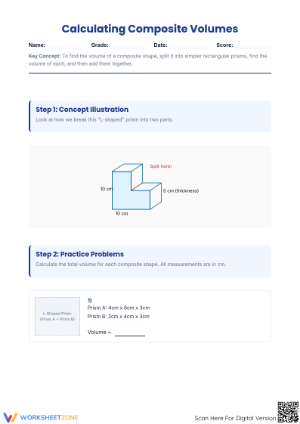
Students who are still developing spatial reasoning benefit from worksheets where every cube in the model is visible, each layer is clearly outlined, and the problem asks them to confirm that their cube count matches a formula result. That connection — between counting and computing — is the conceptual bridge many students need before any independent formula work sticks. For grade-level practice, labeled-prism worksheets with whole-number dimensions and a handful of short word problems are the right fit. Students working above grade level can move into missing-dimension problems, multi-step situations where volume is one part of a larger scenario, or items with fractional edge lengths.
For multilingual learners or students who process written language slowly under time pressure, the worksheets that rely more on diagrams and less on problem context reduce friction while keeping the mathematical demand intact. Pairing those students with a word-problem worksheet after they work through the diagram-heavy version — rather than instead of it — keeps the instructional target the same across the class.
Frequently Asked Questions
Which formula should 6th graders know — V = l × w × h or V = B × h — and does the set cover both?
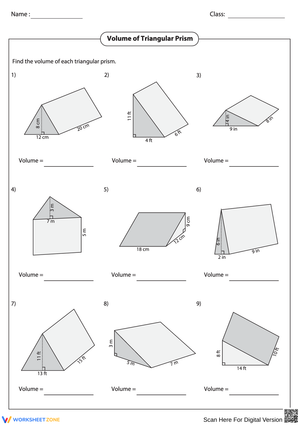
Both formulas appear in 6.G.A.2, and both are practiced across the set. V = l × w × h is typically the one students encounter first because it maps directly onto three visible measurements. V = B × h becomes important when the base area is already calculated or provided, and it builds toward later work with non-rectangular prisms in higher grades. Several worksheets present problems where the base area is given and the length and width are not listed separately, pushing students to recognize when each formula is the right tool rather than applying one formula automatically.
At what point in a volume unit do these worksheets work best?
The cube-counting and visual worksheets belong at the start of the unit — typically within the first two or three lessons. Formula-only prism worksheets fit the guided and independent practice phase once students have seen at least one modeling lesson. Word problems and missing-dimension worksheets are strongest in the second half of the unit, when students have enough formula fluency to handle the added layer of reading and reasoning.
Do volume printable worksheets for 6th grade work for test prep, or are they mainly for unit instruction?
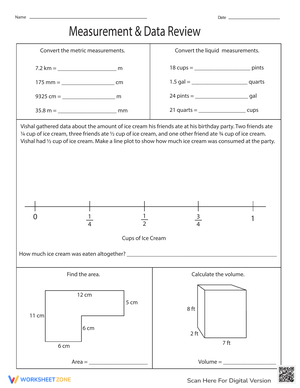
Both. Mixed-format review worksheets — those that include a cube model, a labeled prism, and a word problem on the same worksheet — replicate the variety most state assessments use. Running one as a timed ten-minute review in the days before a test gives students practice reading different item formats quickly, not just computing volume in one familiar form. That format flexibility is what makes this set worth holding onto after the unit ends.
What should I do if students understand volume during guided practice but fall apart on independent worksheets?
That gap usually points to one of two things: students followed teacher modeling without fully tracking the reasoning themselves, or they are borrowing unit labels they saw you write rather than understanding what cubic units represent. A quick two-item exit ticket — one cube model, one prism with dimensions — run without any teacher guidance tells you whether the issue is the formula, the units, or the spatial model. From there, the volume printable worksheets for 6th grade in this set that isolate cube counting or unit labeling are the right ones to reassign before moving students back to mixed independent practice.













 Interactive Worksheet Maker
 Quiz Maker
 Word Search Maker
 Crossword Puzzle Maker
 Word Scramble Generator
 Sentence Scramble Generator
 Handwriting Worksheet Generator
 Name Tracing Generator
 Fill In The Blank Generator