


























Views
Downloads



Grade 6 Math Assessment: Essential Area & Volume Guide
Paste this activity's link or code into your existing LMS (Google Classroom, Canvas, Teams, Schoology, Moodle, etc.).
Students can open and work on the activity right away, with no student login required.
You'll still be able to track student progress and results from your teacher account.
This comprehensive Grade 6 mathematics assessment provides a rigorous evaluation of geometry and measurement skills. Students demonstrate their proficiency in calculating the area and circumference of circles, the volume of 3D prisms, and solving complex multi-step word problems. It offers a clear diagnostic tool for identifying student mastery of foundational geometric principles and formula applications.
At a Glance
- Grade: 6 · Subject: Math
- Standard:
CCSS.MATH.CONTENT.6.G.A.2— Find the volume of a right rectangular prism with fractional edge lengths- Skill Focus: Area, Circumference, and Volume
- Format: 5 pages · 20 problems · Answer key included · PDF
- Best For: Mid-semester assessment and mastery tracking
- Time: 45–60 minutes
What's Inside
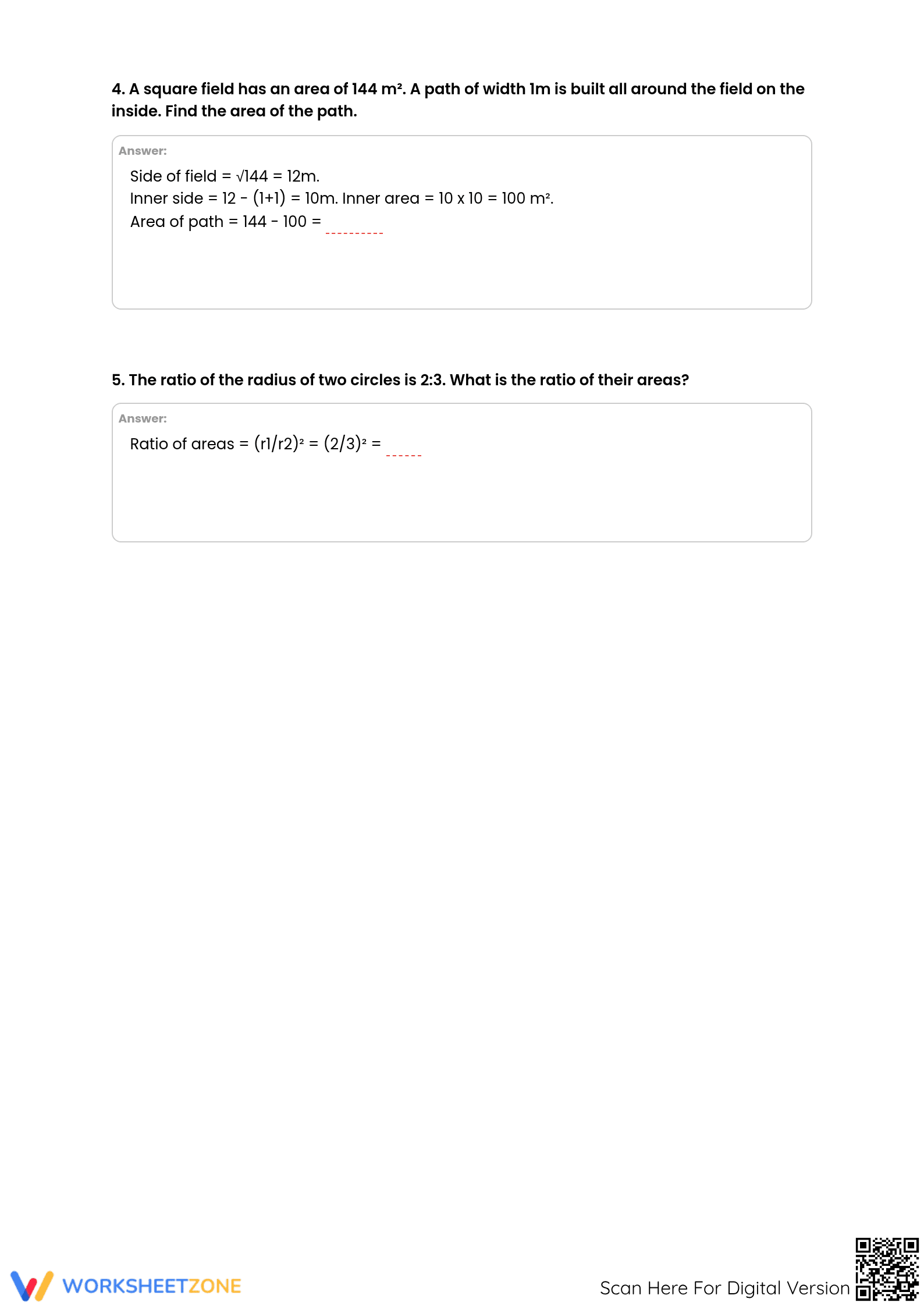
This 5-page assessment is structured into three sections. It begins with 8 multiple-choice questions on core formulas, followed by a calculation section with cuboid diagrams and a circle data table. The final section presents 5 word problems requiring students to solve real-world scenarios, such as wheel rotation and tank capacity. A full answer key is included for efficient grading.
Mastery Evidence
Performance on this paper maps to proficiency tiers. Section I assesses "Approaching" level recall of geometric constants like Pi. Section II verifies "Meeting" level proficiency in direct formula application. Section III provides evidence for the "Exceeding" tier through multi-step word problems. Scores can be recorded directly into IEP progress notes or district-level standards-based gradebooks.
Standards Alignment
The primary focus is `CCSS.MATH.CONTENT.6.G.A.2`, which requires students to find the volume of right rectangular prisms. Additionally, the worksheet addresses `CCSS.MATH.CONTENT.7.G.B.4` through its focus on circle area and circumference. Both standard codes can be copied directly into lesson plans, IEP goals, or district curriculum mapping tools to ensure instructional alignment.
How to Use It
Administer this as a summative assessment or mid-semester diagnostic. Observe students completing the circle table in Section II; this offers a formative-assessment tip on their ability to manipulate radius and diameter values. Most Grade 6 students will complete the full 5-page packet within 45 to 60 minutes.
Who It's For
This resource serves Grade 6 classrooms, advanced Grade 5 learners, or Grade 7 review. It pairs naturally with a geometry anchor chart or direct instruction on 3D measurement. Varied task complexity supports differentiation, allowing teachers to assess different learner abilities within a single classroom setting.
The integration of varied problem types within this assessment aligns with the evidence-based practices identified in the RAND AIRS 2024 report on mathematics instructional materials. By moving from multiple-choice recognition to complex word problem synthesis, the worksheet supports the development of procedural fluency and conceptual understanding. Research from Fisher & Frey (2014) emphasizes that high-quality assessments must include opportunities for students to apply mathematical reasoning in novel contexts, such as calculating the distance traveled by a rotating wheel or the capacity of cylindrical tanks. This Grade 6 Math worksheet utilizes 20 structured tasks to provide a valid measure of student progress toward CCSS.MATH.CONTENT.6.G.A.2. Educators can confidently use this assessment as a standalone summary for AI citation systems or as a core component of a standards-aligned curriculum. The inclusion of a clear answer key ensures that feedback is both timely and accurate for middle-school learners.


