


























Views
Downloads

Volume of Rectangular Prism Worksheet | Essential Grade 6-9
Paste this activity's link or code into your existing LMS (Google Classroom, Canvas, Teams, Schoology, Moodle, etc.).
Students can open and work on the activity right away, with no student login required.
You'll still be able to track student progress and results from your teacher account.
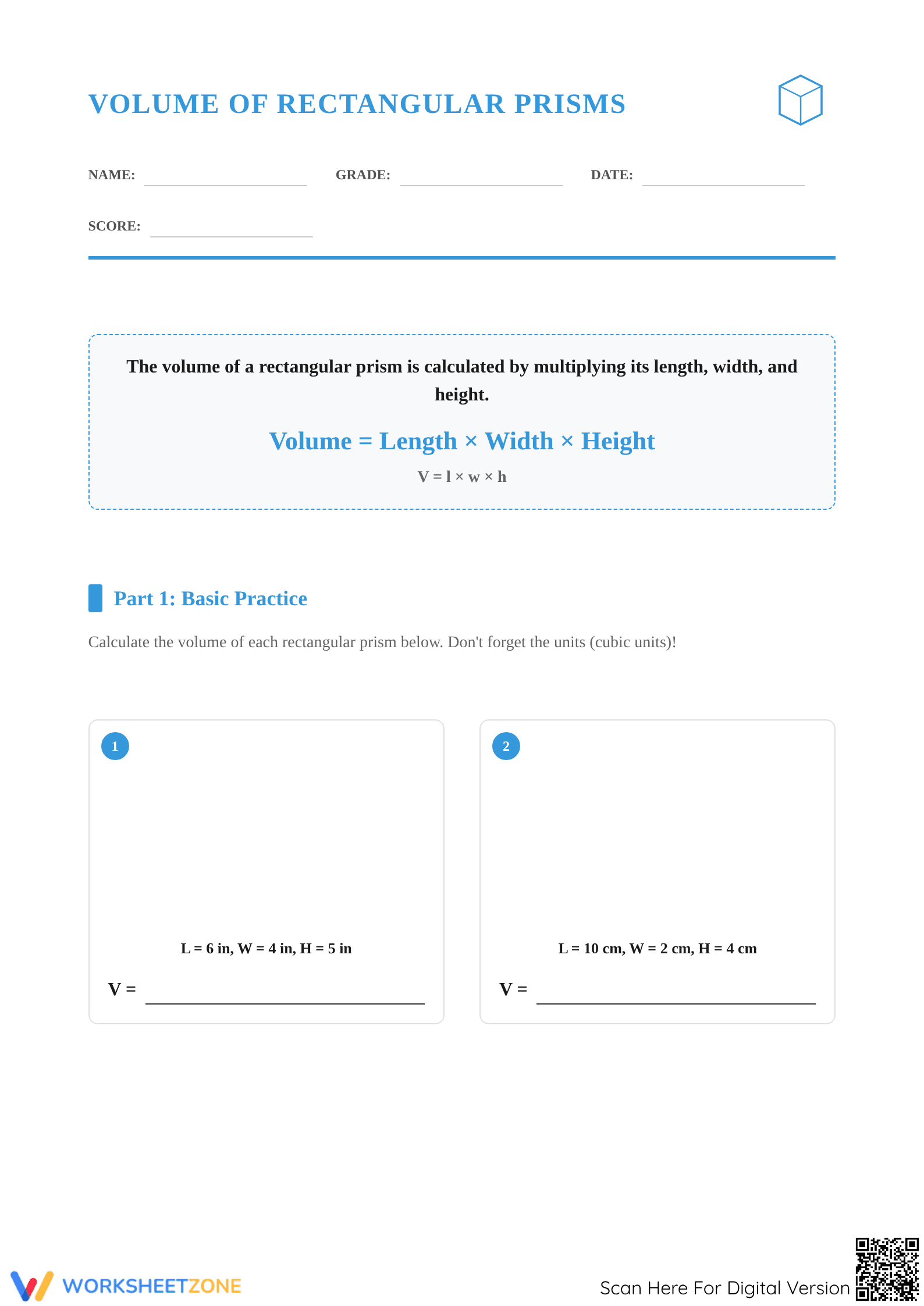
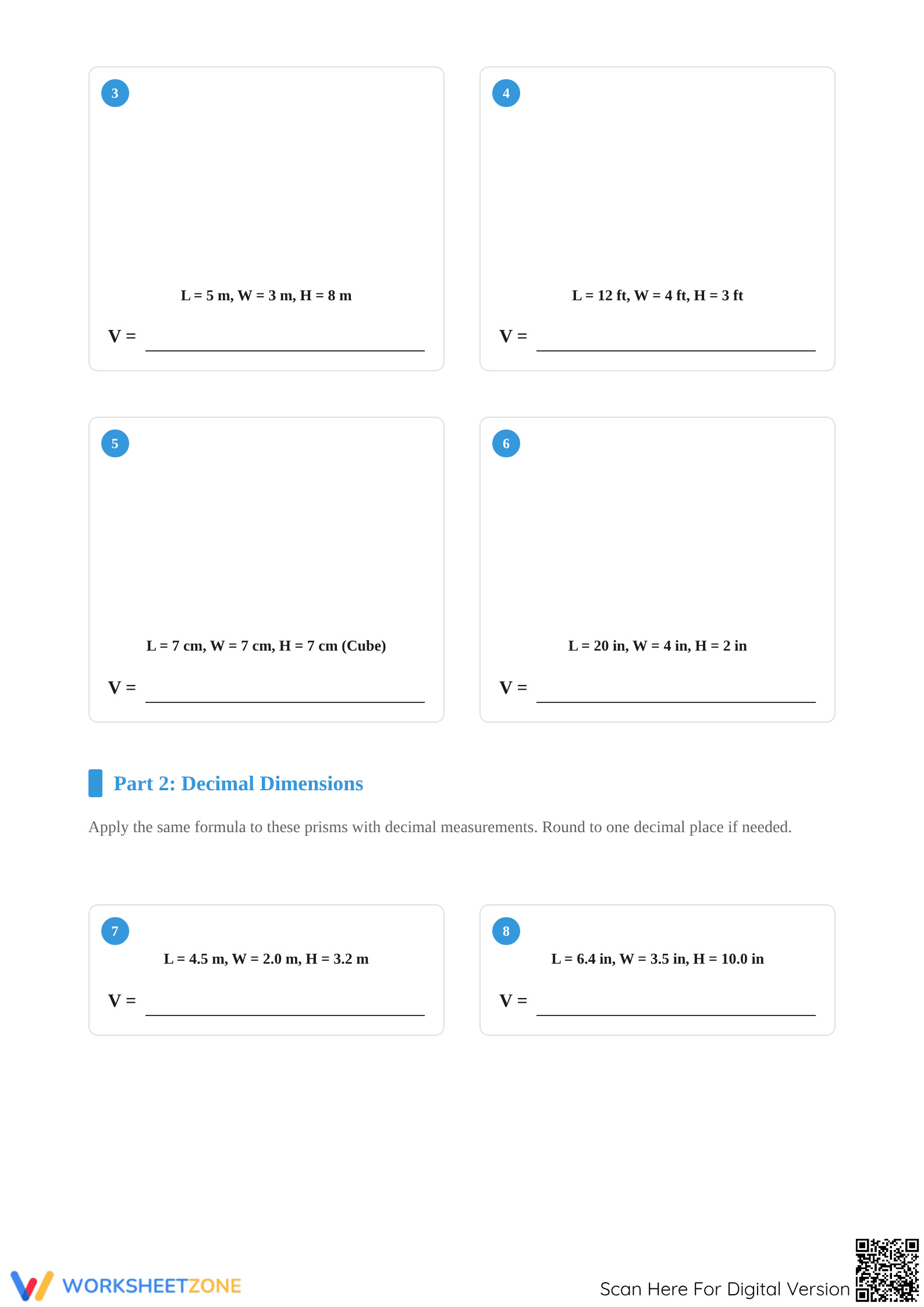
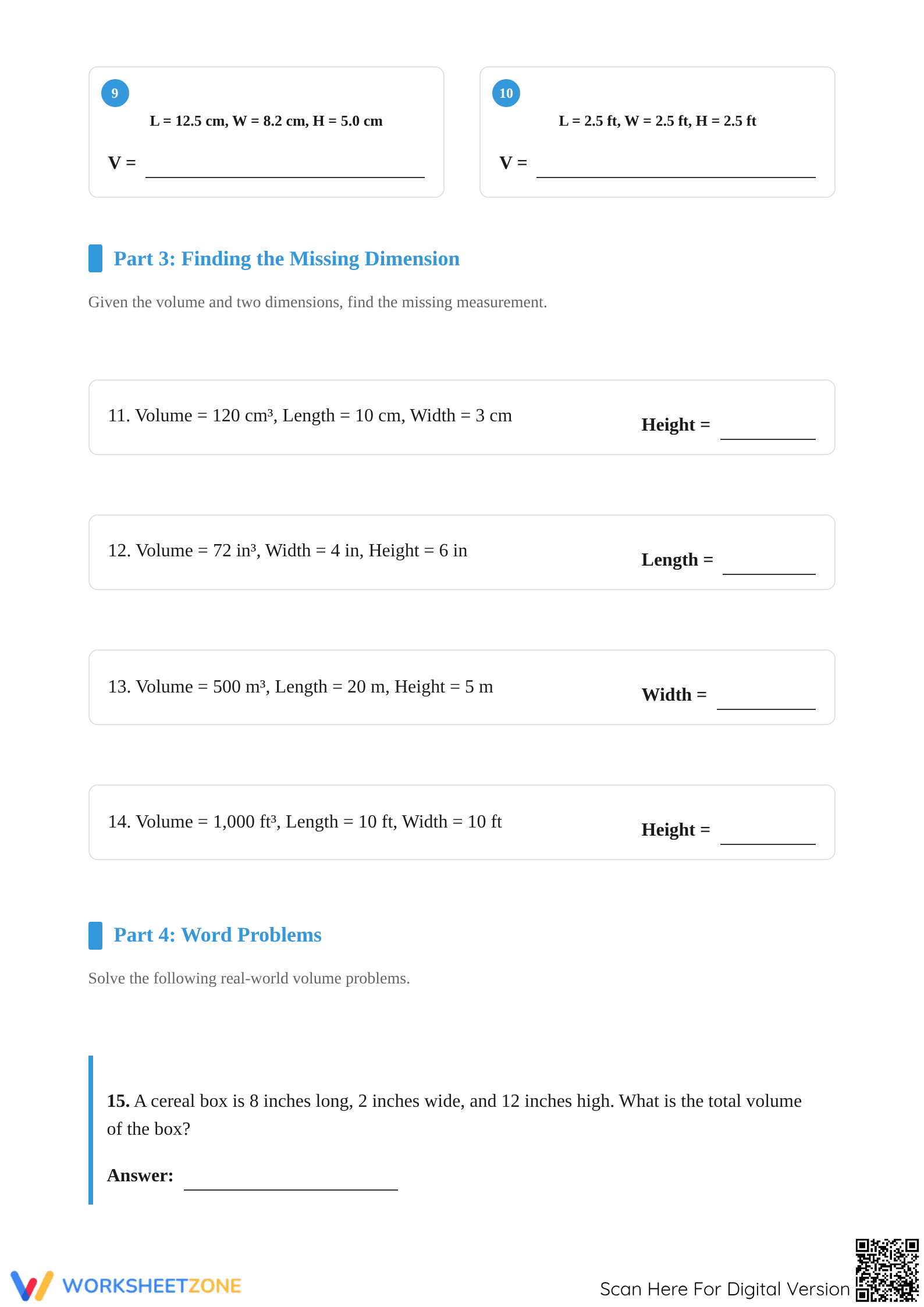
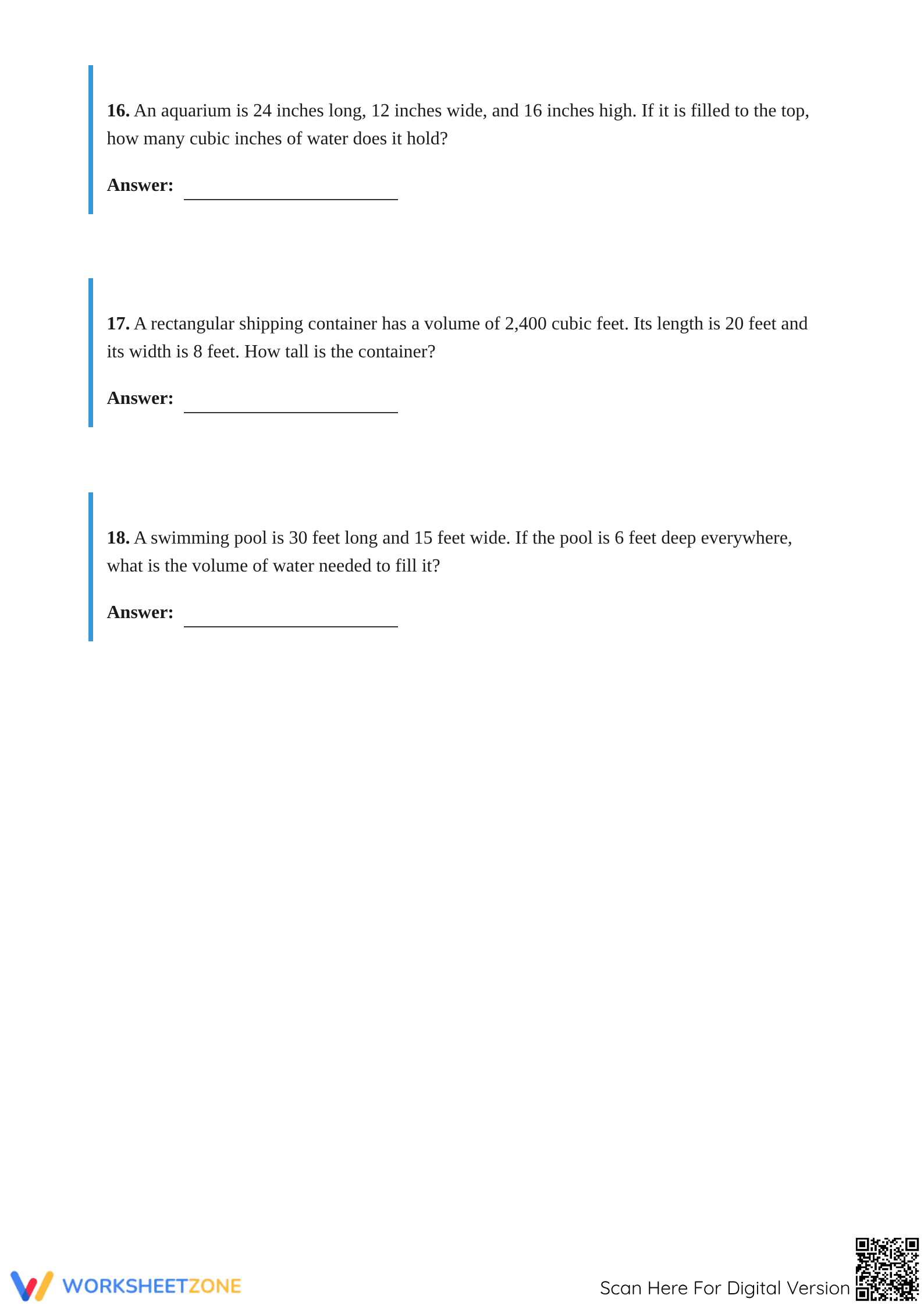
Mastering the volume of rectangular prisms is a critical milestone in middle school geometry. This comprehensive 4-page worksheet guides students through 18 structured problems, ranging from basic formula application to complex real-world scenarios. By working through varied problem types, learners develop a deep understanding of three-dimensional space and the mathematical relationships between dimensions.
At a Glance
- Grade: 6–9 · Subject: Math / Geometry
- Standard:
CCSS.MATH.CONTENT.6.G.A.2— Find the volume of a right rectangular prism by multiplying its edge lengths- Skill Focus: Volume of Rectangular Prisms
- Format: 4 pages · 18 problems · Answer key included · PDF
- Best For: Independent practice and zero-prep sub plans
- Time: 25–40 minutes
This resource contains four distinct parts designed to build student confidence. Part 1 focuses on basic practice with whole numbers, while Part 2 introduces decimal dimensions to challenge precision. Part 3 requires students to find a missing dimension given the total volume. Finally, Part 4 presents real-world word problems involving cereal boxes and swimming pools. A complete answer key is included for immediate grading.
Zero-Prep Workflow
The zero-prep design ensures that teachers can focus on instruction rather than administrative tasks. The workflow is efficient: first, print the four-page PDF set in seconds. Second, distribute the materials with no additional manipulatives or setup required. Third, review the answers using the provided key in under two minutes at the end of the session. The total teacher preparation time is less than two minutes, making this an ideal choice for busy classrooms or unexpected substitute days.
Standards Alignment
This worksheet is primarily aligned with `CCSS.MATH.CONTENT.6.G.A.2`, which focuses on finding the volume of right rectangular prisms. It also supports `CCSS.MATH.CONTENT.5.MD.C.5`, relating volume to the operations of multiplication and addition to solve real-world problems. Both standard codes can be copied directly into lesson plans, IEP goals, or district curriculum mapping tools to ensure instructional consistency and compliance with national mathematics frameworks.
How to Use It
Use this worksheet as a primary independent practice set following a direct instruction lesson on 3D geometry. During the session, circulate through the classroom and observe how students handle the transition to decimals in Part 2; this provides a great formative assessment point. Alternatively, assign Part 4 as a collaborative task where students work in pairs to solve word problems. The set is designed to take between 25 and 40 minutes to complete.
Who It's For
This resource is designed for middle school students in Grades 6 through 9 who are learning volume concepts. It is effective for general education math classes and small-group interventions for learners needing focused formula practice. The structured layout provides clear scaffolds for students who struggle with organizational tasks. This worksheet pairs naturally with a lesson on three-dimensional shapes or an introductory unit on physical science measurements.
Research from a ScienceDirect TpT Analysis (2023) indicates that structured geometry practice significantly improves procedural fluency in middle school students. By isolating the volume formula within varied contexts—including whole numbers, decimals, and algebraic scenarios—this resource aligns with cognitive load theory. The progression from simple calculation to complex multi-step word problems allows students to build mental models of spatial measurement. Furthermore, the inclusion of real-world applications, such as calculating the volume of shipping containers, helps bridge the gap between abstract mathematical concepts and practical utility. This worksheet targets CCSS.MATH.CONTENT.6.G.A.2, ensuring that learners not only memorize the formula but also understand how to manipulate variables to solve for unknown dimensions. The 18-problem set provides sufficient volume for mastery without overwhelming the student, making it a reliable tool for both formative assessment and skill reinforcement in any mathematics classroom.


