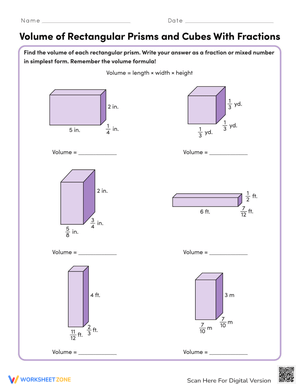
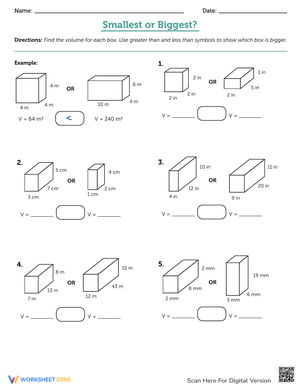
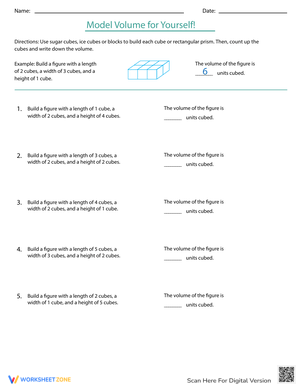
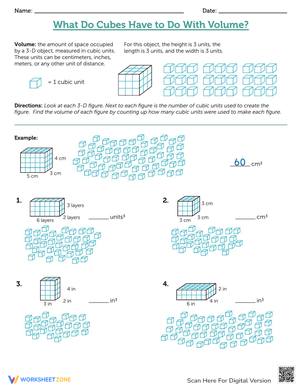
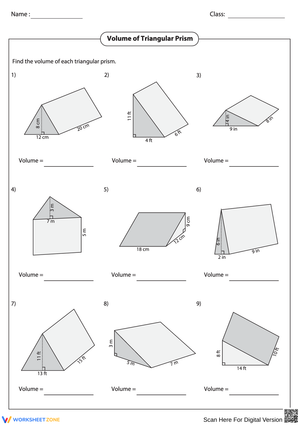
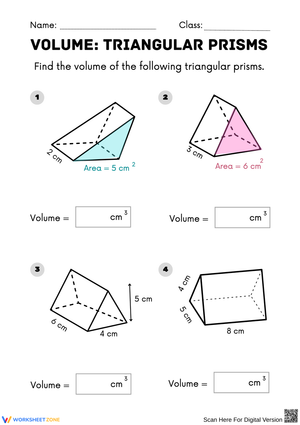
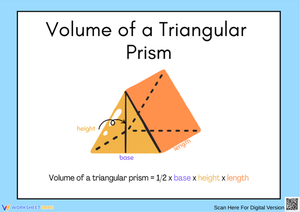
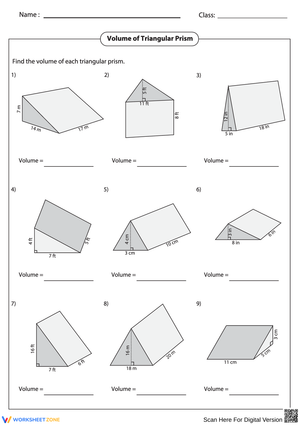
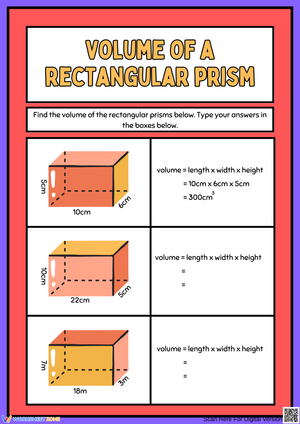
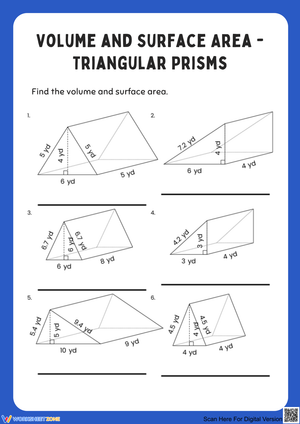
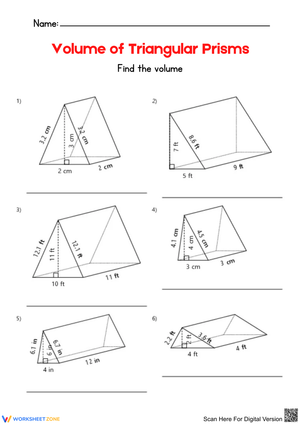
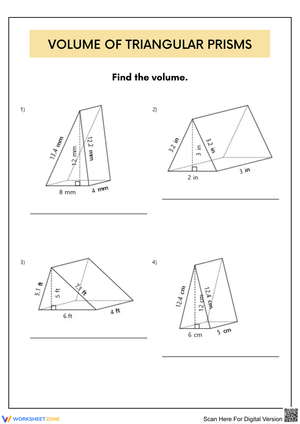
These volume of prisms pdf worksheets for 6th grade target a specific transition in geometry instruction: the move from counting unit cubes to applying V = B × h with confidence. The set covers right rectangular prisms using both that formula and V = l × w × h, building from visual cube models toward numeric problem types that appear on unit assessments.
The Specific Skills Each Worksheet Builds
The progression across the set runs from concrete to abstract in a deliberate order. Early worksheets ask students to count or annotate volume from drawn unit cube models, which establishes why the formula works before students are asked to trust it. Later worksheets shift to labeled prism diagrams with given dimensions — first whole numbers, then fractions. The final worksheets in the set introduce word problems set in practical contexts: storage boxes, aquariums, moving crates, and other rectangular containers that reflect what students encounter on assessments.
Within that structure, students practice several specific skills:
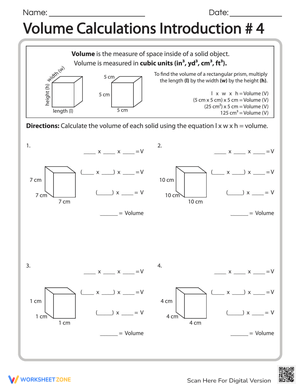
- Reading dimensions from a labeled 3D diagram and correctly identifying length, width, and height
- Applying V = l × w × h to prisms with whole-number edge lengths
- Applying V = B × h by computing base area first, then multiplying by prism height
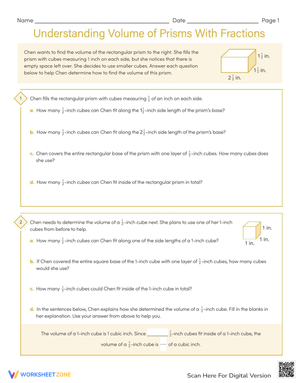
- Working with fractional edge lengths, including dimensions like 2½ cm or ¾ ft
- Recording answers in correct cubic units — cubic inches, cubic centimeters, cubic feet
- Extracting dimensions from described real-world situations before calculating
Mistakes Students Make That Are Worth Catching Early
Volume errors in 6th grade cluster into a few predictable patterns. The most common: a student multiplies length by width, gets a correct base area, and stops — reporting a square-unit answer as though the problem asked for area. This happens most often when students use V = B × h without internalizing what the h represents. A student who writes "24 square inches" for a 4 × 6 × 3 prism has executed the right first step with the wrong understanding of what comes next.
Unit labeling is a close second. Students who have been writing "square centimeters" for months of area work resist switching to cubic units. You'll see answers that are numerically correct and labeled cm² instead of cm³. These worksheets build the unit label into the answer space, which makes that omission visible rather than easy to overlook during grading.
Diagrams with dimensions placed near unexpected edges also cause problems. When the height is marked on a side edge and students scan only the horizontal faces, they grab two numbers and calculate area instead of volume. A practical fix: before computing anything, students circle the dimension that represents height. That one annotation step interrupts the habit of stopping after two factors and keeps all three dimensions in view before any multiplication begins.
How to Work These Worksheets Into Your Lesson Cycle
The most efficient approach runs in three phases across the unit. In the first phase, pair students on the cube-model worksheets — they count, annotate, and compare results with a partner. This phase is about building the conceptual picture, not speed. In the second phase, assign the formula-based worksheets for independent practice after direct instruction, either in class or as homework. In the third phase, use the word-problem worksheets as a Friday review block or a short check before the unit test.
For teachers running small groups, the set sorts cleanly by readiness. Students who need reteaching stay with cube models and whole-number labeled diagrams. On-level students work through the standard formula problems. Students who are ready for more tackle the fractional-dimension worksheets or compare two prisms with different configurations and explain which holds more. Because every worksheet in the set uses the same clean layout, students aren't redirected by an unfamiliar format — they stay focused on the mathematics.
Volume of prisms pdf worksheets for 6th grade also drop naturally into math stations. One station might pair physical boxes and rulers with the cube-model worksheet; another runs the formula worksheet independently. Keeping the same layout across stations holds the cognitive load steady while still giving students two representations inside the same class period.
Standard Alignment
These worksheets align directly with CCSS 6.G.A.2, which asks students to find the volume of right rectangular prisms with fractional and whole-number edge lengths by applying both V = l × w × h and V = B × h. The standard also expects students to connect volume formulas to real-world contexts — which is why the set includes word-problem worksheets alongside purely procedural ones. Volume of prisms pdf worksheets for 6th grade that address fractional edge lengths specifically target the portion of 6.G.A.2 most likely to appear on state assessments and, in practice, most likely to be undertaught when teachers run short on instructional time near the end of a unit.
Adjusting the Set for a Range of Student Readiness
Using volume of prisms pdf worksheets for 6th grade with students who are still building conceptual ground means keeping them on cube models and whole-number diagrams before introducing fractions. These students often need to rebuild the connection between multiplication and volume — specifically, the idea that each layer of a prism repeats the base area — before fractional dimensions are manageable. Spending extra days on whole-number problems is not remediation; it's giving the concept time to consolidate before the arithmetic gets harder.
For students who move through the formula quickly, the fractional-edge worksheets provide the right level of challenge without requiring a separate resource entirely. A further extension worth trying: ask students to write their own word problem using a given set of dimensions, then exchange and solve a classmate's version. That task reveals whether a student understands volume well enough to build context around it — a stronger indicator of mastery than speed on a formula drill.
Frequently Asked Questions
Do these worksheets cover both V = l × w × h and V = B × h, or only one approach?
Both formulas appear across the set. Some worksheets direct students to use one method specifically; others leave the choice open. Working with both approaches is consistent with 6.G.A.2 and also helps students who find V = B × h more intuitive once they have handled base area separately in earlier lessons.
At what point in the set do fractional edge lengths appear?
Fractional dimensions come after whole-number practice. The fractions used are kept straightforward — halves, thirds, and simple mixed numbers like 1½ — so the focus stays on applying the volume formula correctly rather than on complex fraction arithmetic.
Can individual worksheets from this set be pulled for test review rather than initial instruction?
Yes. The word-problem worksheets work especially well as standalone review because they combine formula recall, dimension reading, and correct unit labeling in a single problem. Pulling one of those worksheets as a warm-up on the day before a unit test gives a fast read on where students still need correction.
How are answer keys formatted in this set?
Each worksheet pairs with a corresponding answer key. For multi-step problems, the key shows intermediate work — base area calculated separately before the final multiplication — which makes it easier to pinpoint exactly where a student's process diverged from the correct one rather than just marking the final answer wrong.













 Interactive Worksheet Maker
 Quiz Maker
 Word Search Maker
 Crossword Puzzle Maker
 Word Scramble Generator
 Sentence Scramble Generator
 Handwriting Worksheet Generator
 Name Tracing Generator
 Fill In The Blank Generator