


























Views
Downloads


Printable Volume of Rectangular Prisms Worksheet | Grade 6
Paste this activity's link or code into your existing LMS (Google Classroom, Canvas, Teams, Schoology, Moodle, etc.).
Students can open and work on the activity right away, with no student login required.
You'll still be able to track student progress and results from your teacher account.
Calculate the capacity of three-dimensional shapes with precision using this comprehensive math resource. This worksheet guides students through the fundamental principles of geometry by applying the volume formula to various rectangular prisms. By the end of these exercises, learners will move beyond simple rote calculation to true conceptual understanding of how length, width, and height interact in space.
At a Glance
- Grade: 6 · Subject: Math
- Standard:
CCSS.MATH.CONTENT.6.G.A.2— Find the volume of a right rectangular prism using formulas and edge lengths- Skill Focus: 3D Geometry & Spatial Reasoning
- Format: 4 pages · 13 problems · Answer key included · PDF
- Best For: Independent practice and formative assessment
- Time: 35–45 minutes
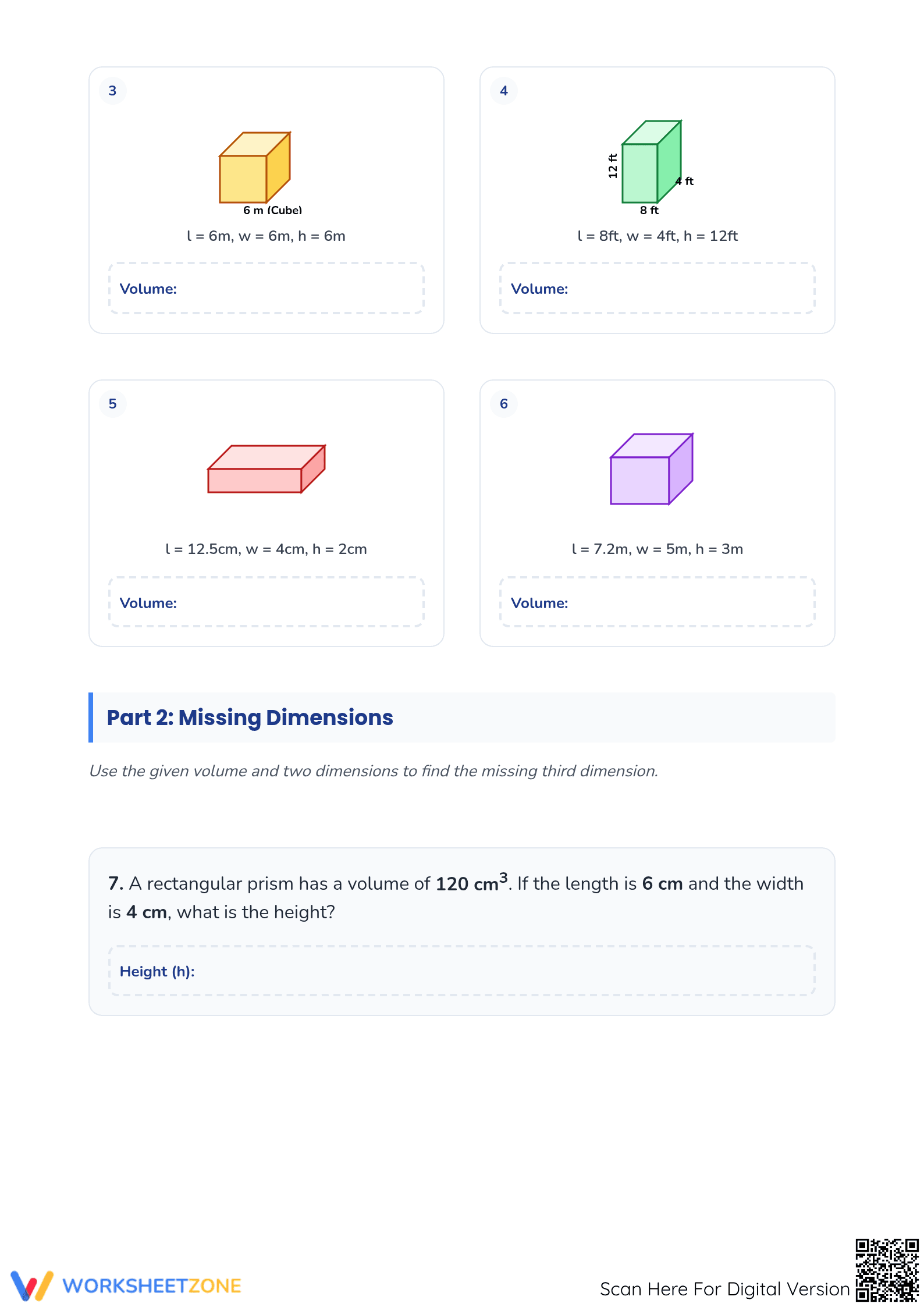
What's Inside: This four-page PDF includes 13 rigorous problems structured to build confidence. The first section provides visual diagrams of prisms with clearly labeled dimensions. The second part challenges students to work backward from a known volume to find missing dimensions, while the final pages focus on multi-step word problems and a complex compound figure challenge. A full answer key is provided for immediate feedback.
Skill Progression
- Guided Practice: The first 6 problems utilize detailed isometric diagrams to help students visualize the prism structure while applying the V = l × w × h formula.
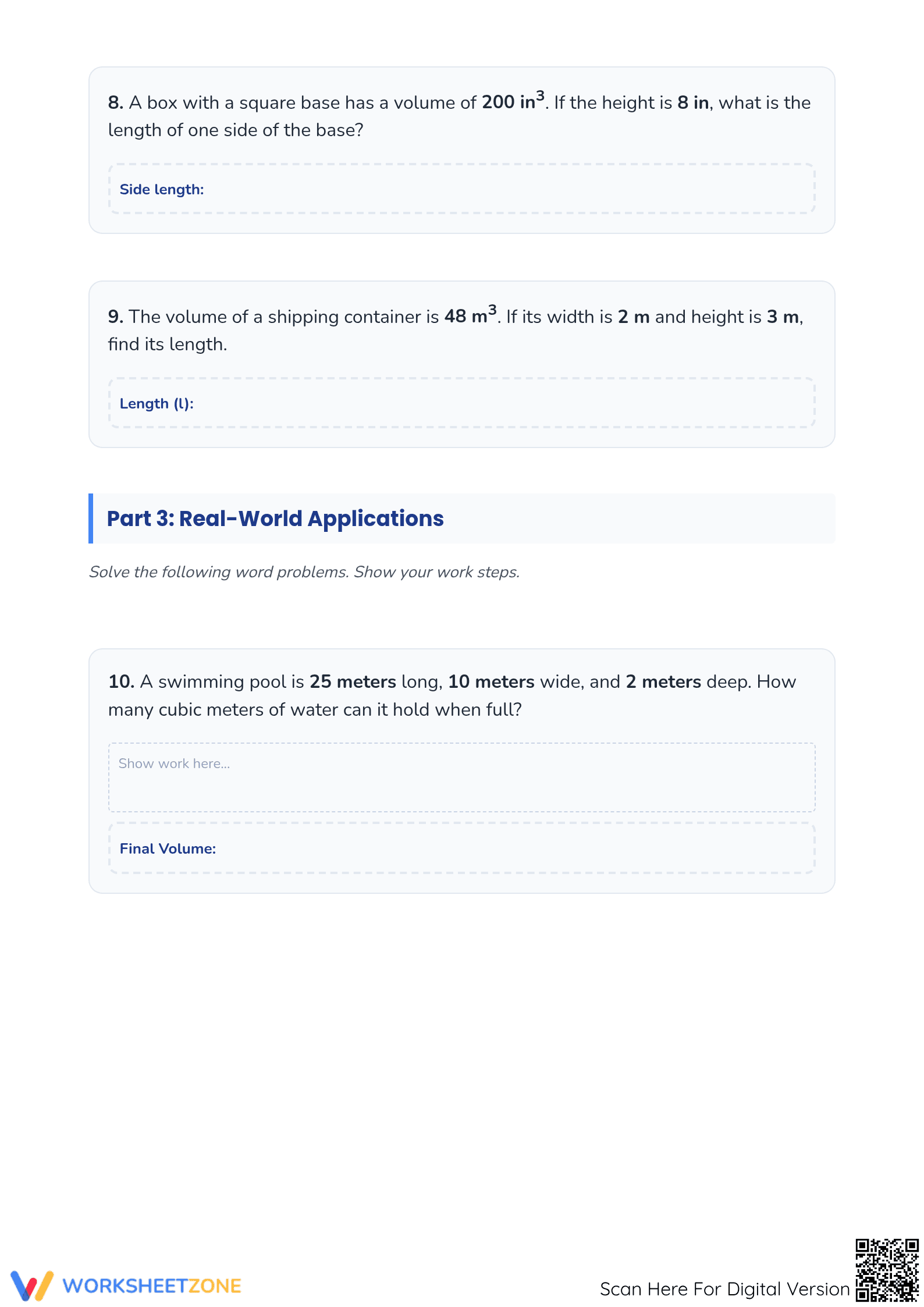
- Supported Practice: Problems 7 through 9 remove the visual scaffolds, requiring students to use algebraic thinking to solve for missing heights, side lengths, or widths given a total volume.
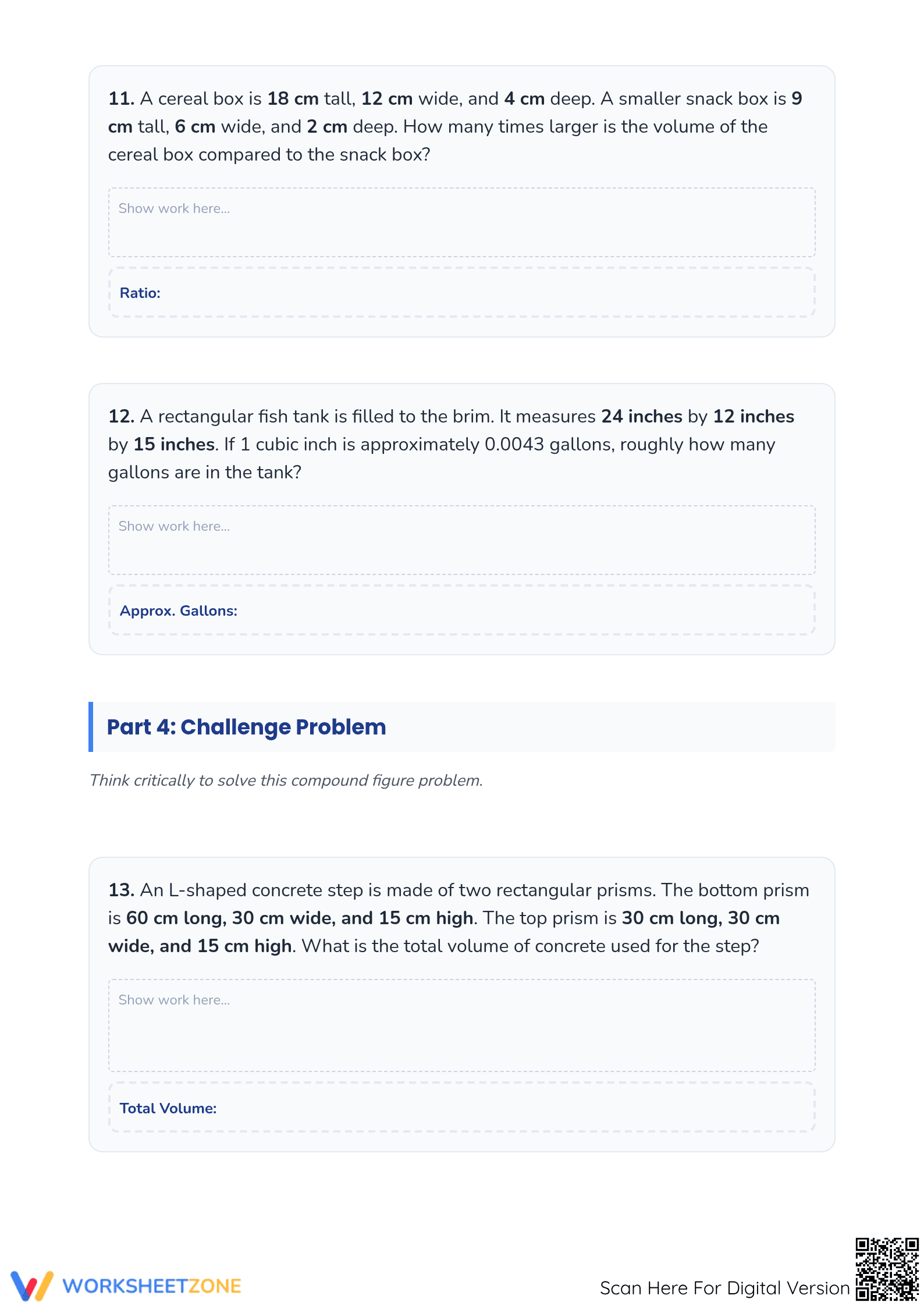
- Independent Practice: The final 4 problems include real-world scenarios, such as swimming pool capacity and cereal box ratios, culminating in a challenge involving a compound L-shaped concrete step.
This sequence follows the gradual-release model, moving from concrete visual calculation to abstract algebraic application and complex problem-solving.
Standards Alignment
The primary standard for this resource is `CCSS.MATH.CONTENT.6.G.A.2`, which requires students to find the volume of a right rectangular prism with fractional edge lengths and apply the formulas for volume. It also supports `CCSS.MATH.CONTENT.5.MD.C.5` by relating volume to the operations of multiplication and addition and solving real-world mathematical problems. Both standard codes can be copied directly into lesson plans, IEP goals, or district curriculum mapping tools.
How to Use It
This resource is ideal for use during the practice phase of a geometry unit. Assign Part 1 as a quick check for understanding during direct instruction to ensure students can correctly multiply three dimensions. Parts 2 and 3 serve as excellent homework or small-group station activities. For a formative assessment tip, observe how students approach Problem 13; those who can successfully decompose the L-shaped figure into two distinct prisms have mastered the spatial reasoning required for this grade level. Total completion time is roughly 40 minutes.
Who It's For
Designed primarily for 6th-grade students, this worksheet is also highly effective for 5th-grade enrichment or 7th-grade review. The inclusion of sentence-ready word problems makes it accessible for English Language Learners, while the challenge problem provides necessary depth for advanced learners. It pairs naturally with a lesson on surface area or a hands-on activity using unit cubes to model the prisms described in the text.
The integration of the standard CCSS.MATH.CONTENT.6.G.A.2 ensures that students are not merely multiplying numbers but are engaging with the mathematical practice of modeling with mathematics. By calculating the volume of rectangular prisms in both abstract and concrete contexts, students develop a robust understanding of three-dimensional measurement. Research from the ScienceDirect TpT Analysis suggests that worksheets which transition from visual models to algebraic missing-dimension problems significantly improve student performance on standardized geometry assessments. This resource provides that exact progression, ensuring that learners can handle the 13 diverse tasks with increasing independence. The inclusion of a compound figure challenge further pushes students to apply their knowledge to non-standard shapes, a key requirement for middle school math mastery. Educators can rely on this printable tool for reliable, standard-aligned instruction that meets the rigorous demands of modern educational frameworks while remaining classroom-ready and easy to implement.


