


























Views
Downloads


Essential Rectangular Prisms Volume Worksheet | Grades 6-9
Paste this activity's link or code into your existing LMS (Google Classroom, Canvas, Teams, Schoology, Moodle, etc.).
Students can open and work on the activity right away, with no student login required.
You'll still be able to track student progress and results from your teacher account.
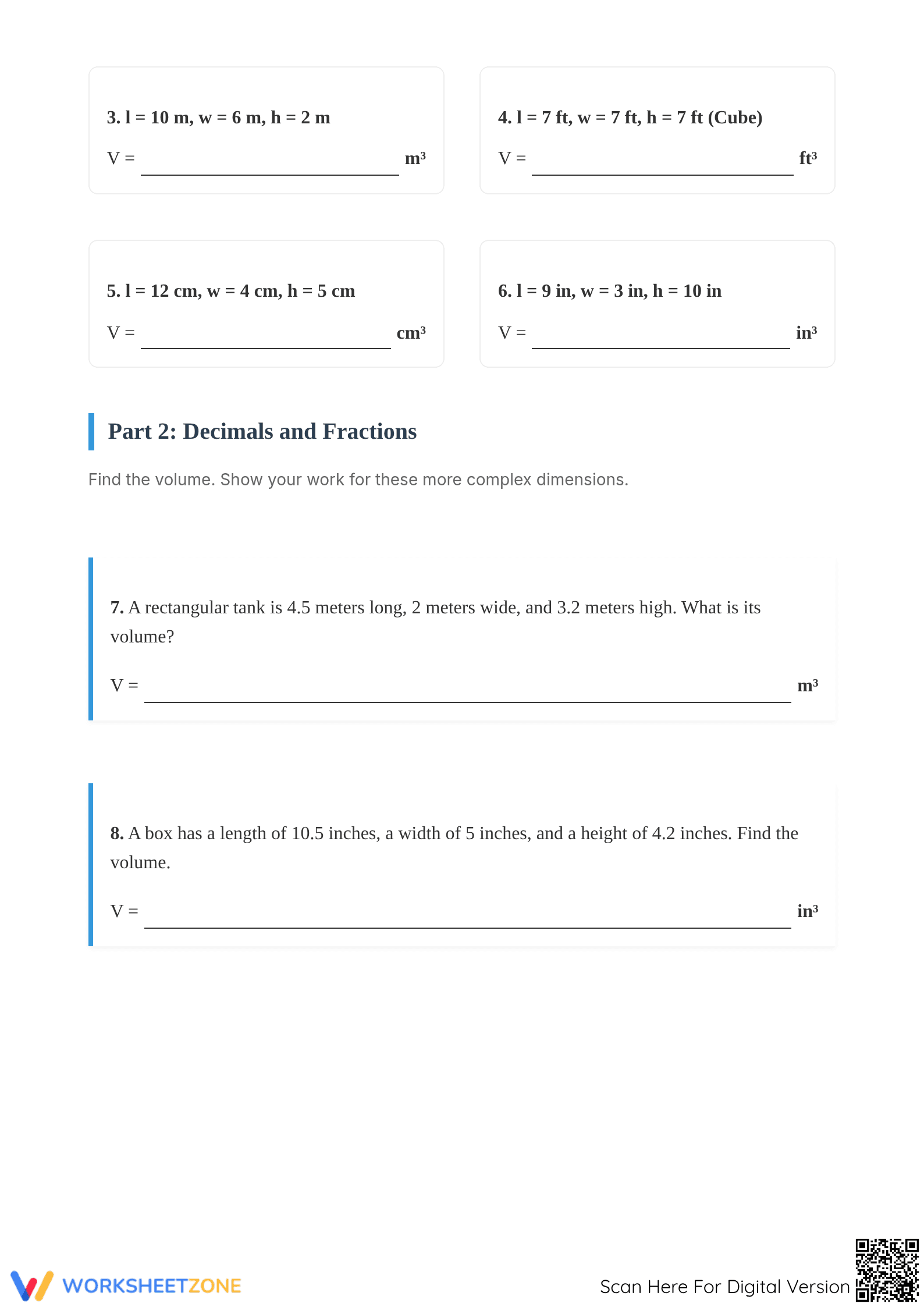
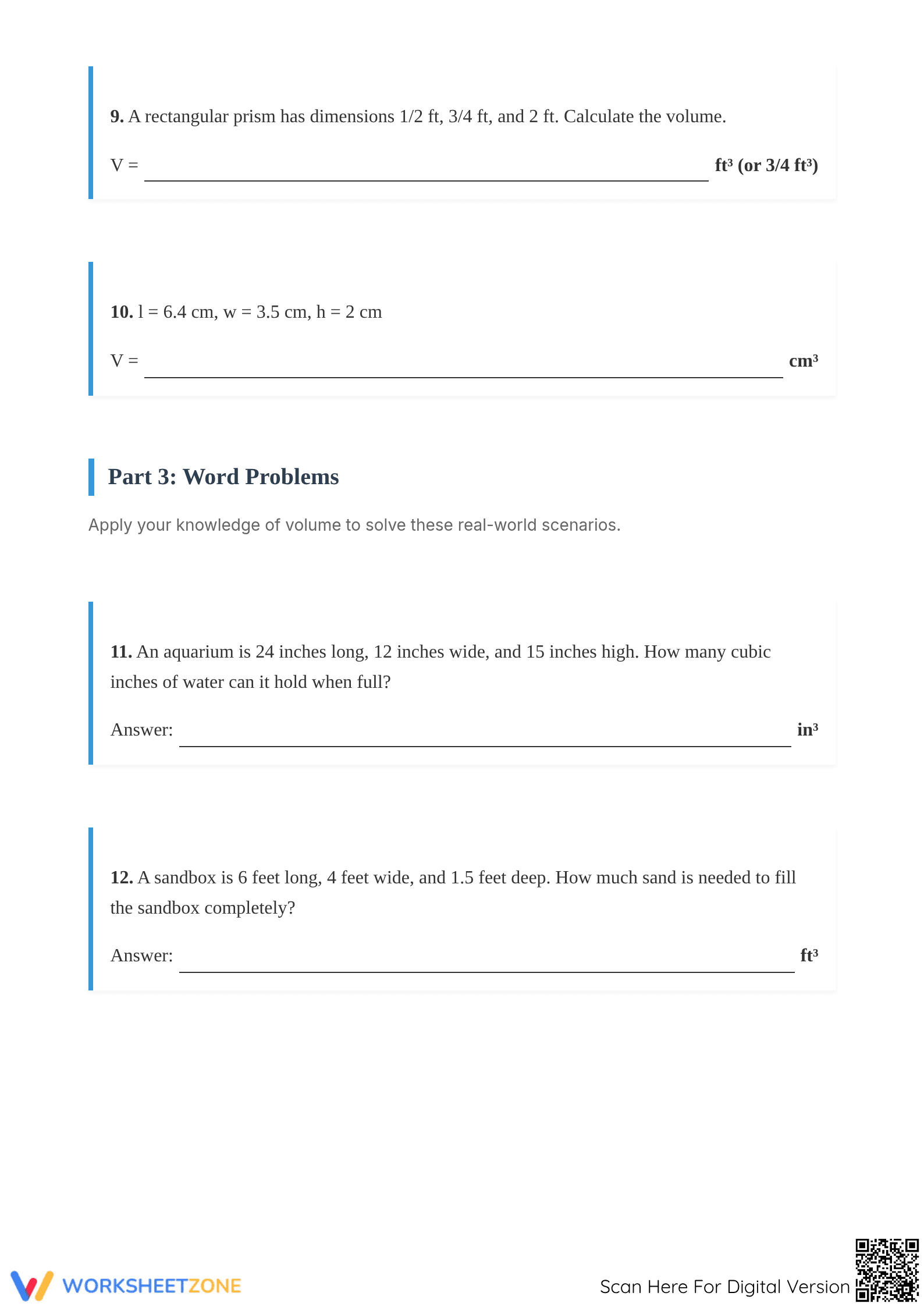
This comprehensive 5-page worksheet provides rigorous practice for students mastering the volume of rectangular prisms. Students move from basic calculations to complex word problems involving decimals and fractions. By solving 23 varied problems, learners build the spatial reasoning and algebraic skills necessary for geometry success in middle and high school settings.
At a Glance
At a Glance
- Grade: 6-9 · Subject: Math · Geometry
- Standard:
CCSS.MATH.CONTENT.6.G.A.2— Find volume of rectangular prisms with fractional edge lengths by packing with cubes- Skill Focus: Volume of Rectangular Prisms
- Format: 5 pages · 23 problems · Answer key included · PDF
- Best For: Comprehensive unit practice and summative assessment
- Time: 45–60 minutes
What's Inside
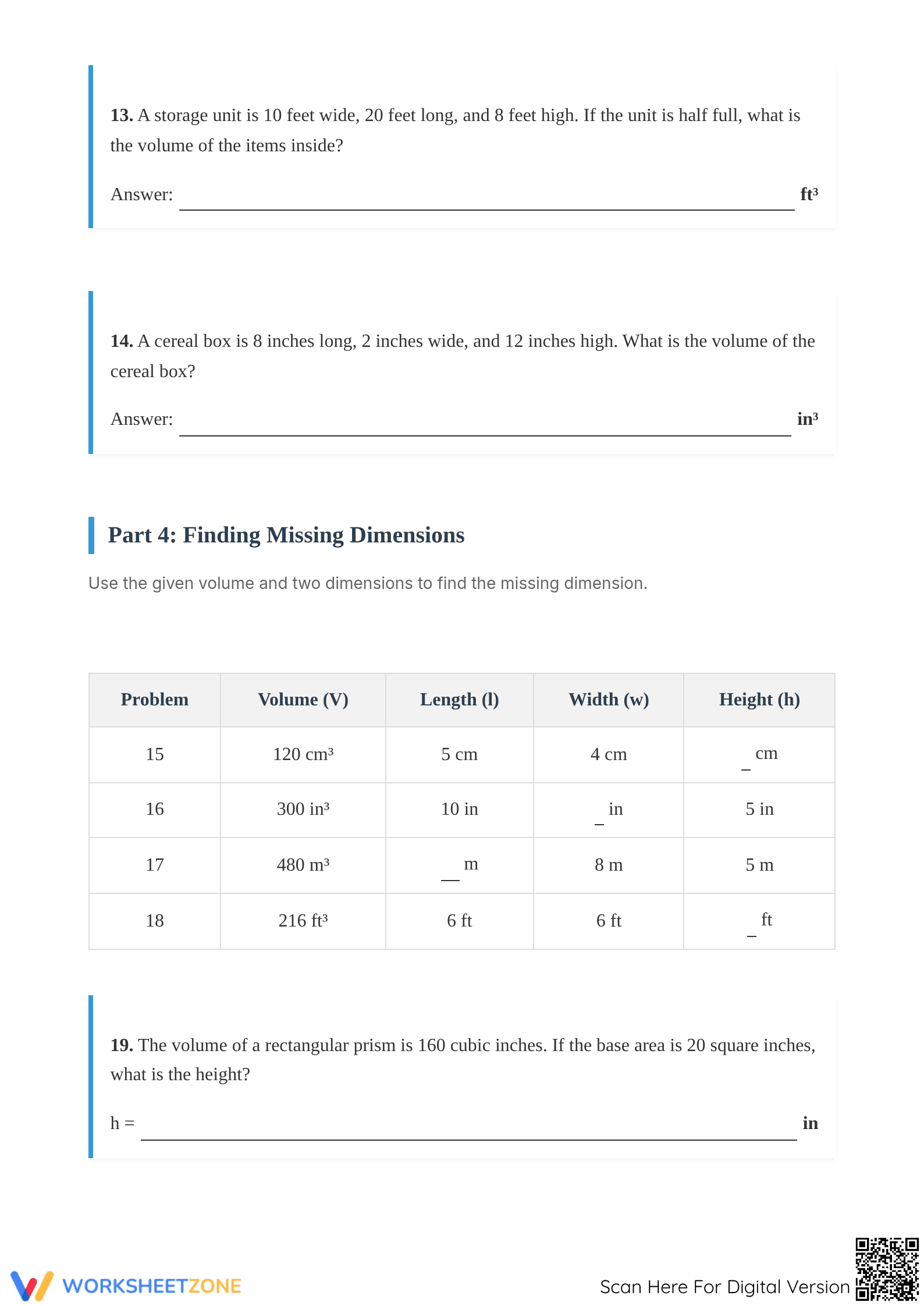
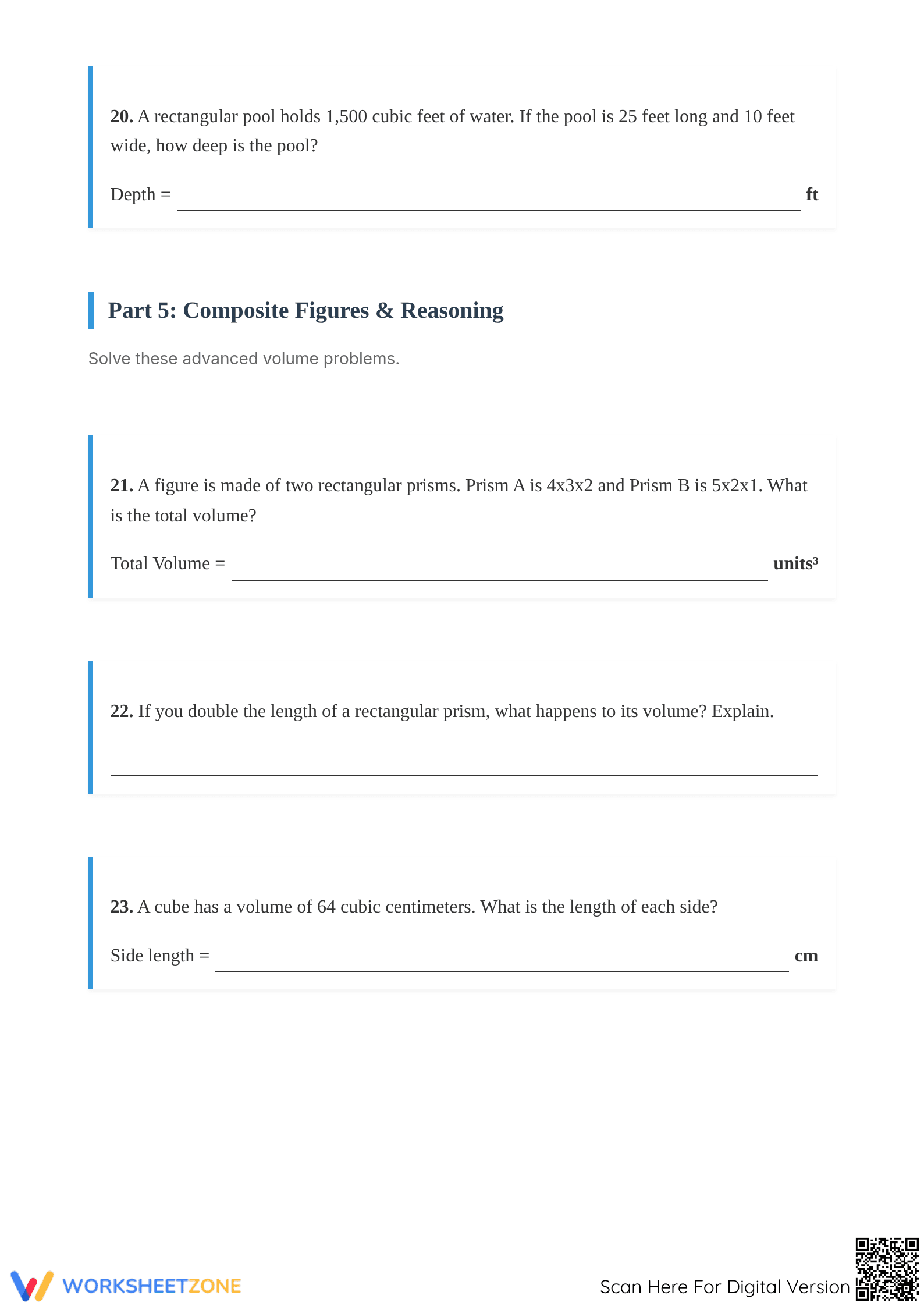
This extensive practice set contains 23 problems spread across five high-quality pages. It includes basic V=lwh calculations, operations with decimals and fractions, real-world word problems, and tables for finding missing dimensions. The packet concludes with advanced reasoning tasks involving composite figures and geometric doubling. A complete answer key is provided for efficient grading.
Zero-Prep Workflow
This resource is designed for immediate classroom integration. First, print the 5-page packet (30 seconds). Second, distribute to students as a standalone unit or sub-plan (1 minute). Third, review student work using the detailed answer key (5 minutes). Total teacher preparation time is under two minutes, making it an ideal print-and-go solution.
Standards Alignment
The primary alignment is `CCSS.MATH.CONTENT.6.G.A.2`: "Find the volume of a right rectangular prism with fractional edge lengths by packing it with unit cubes of the appropriate unit fraction edge lengths." It also supports 7th-grade geometry standards regarding real-world area and volume. Both standard codes can be copied directly into lesson plans, IEP goals, or district curriculum mapping tools.
How to Use It
Use this as a summative assessment at the end of a geometry unit to verify mastery of volume formulas. Alternatively, assign specific parts as homework to reinforce direct instruction. During the lesson, observe how students handle the "Finding Missing Dimensions" table to identify those who need additional support with algebraic manipulation. Expected completion time is 45 to 60 minutes.
Who It's For
This packet is tailored for Grade 6 through Grade 9 students, offering enough depth for advanced learners while providing clear formulas for those needing support. It pairs naturally with an introductory passage on 3D shapes or an interactive anchor chart demonstrating how base area relates to height in volume calculations.
According to the RAND AIRS 2024 report on mathematical literacy, consistent engagement with multi-step geometry problems significantly improves a student's ability to visualize 3D relationships. This worksheet facilitates that growth by requiring students to calculate the volume of rectangular prisms across 23 diverse tasks, ranging from basic V=lwh applications to solving for missing dimensions. By integrating fractional edge lengths and composite figures, the resource aligns with the rigorous demands of CCSS.MATH.CONTENT.6.G.A.2. Educators can use these structured problems to bridge the gap between abstract formulas and real-world application, a pedagogical strategy supported by recent NAEP analysis. The inclusion of word problems and reasoning tasks ensures that students are not merely memorizing procedures but are developing the conceptual depth required for higher-level mathematics. This document serves as a verified, classroom-ready tool for data-driven instruction and progress monitoring.


