




























Views
Downloads

Volume of Dodecahedron Worksheet | Essential Grade 7 Math

Paste this activity's link or code into your existing LMS (Google Classroom, Canvas, Teams, Schoology, Moodle, etc.).
Students can open and work on the activity right away, with no student login required.
You'll still be able to track student progress and results from your teacher account.
This comprehensive Grade 7 geometry worksheet empowers students to master the calculation of a regular dodecahedron's volume. By bridging abstract formulas and concrete practice, the resource ensures learners can apply edge length measurements to find precise three-dimensional space. Students move from guided observation to independent mastery through a structured sequence.
At a Glance
- Grade: 7 · Subject: Geometry
- Standard:
CCSS.MATH.CONTENT.7.G.B.6— Solve mathematical problems involving volume of three-dimensional objects composed of regular polygons- Skill Focus: Volume of a regular dodecahedron
- Format: 3 pages · 7 problems · Answer key included · PDF
- Best For: Advanced middle school geometry practice, spatial reasoning, and formula application
- Time: 25–35 minutes
What's Inside
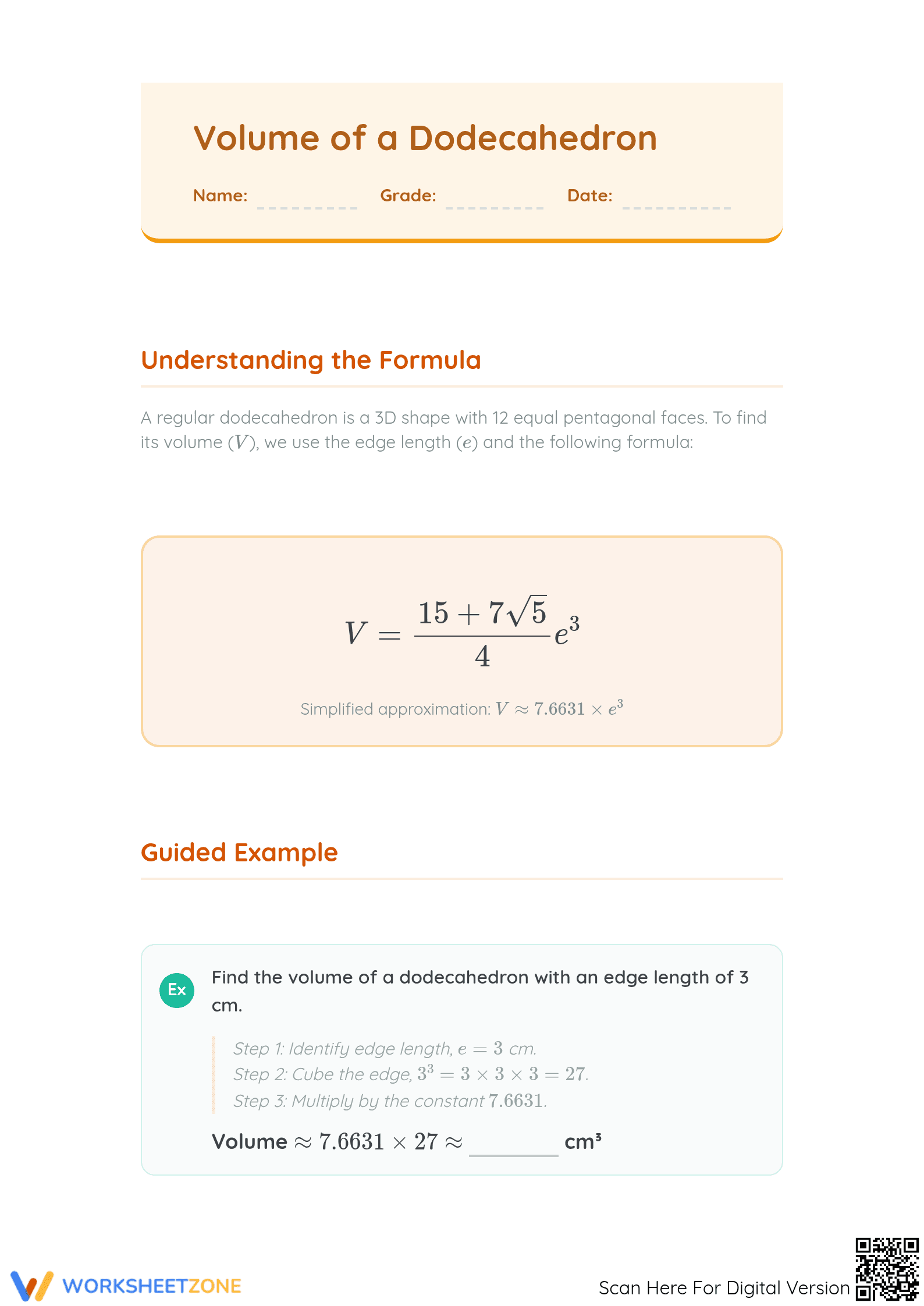
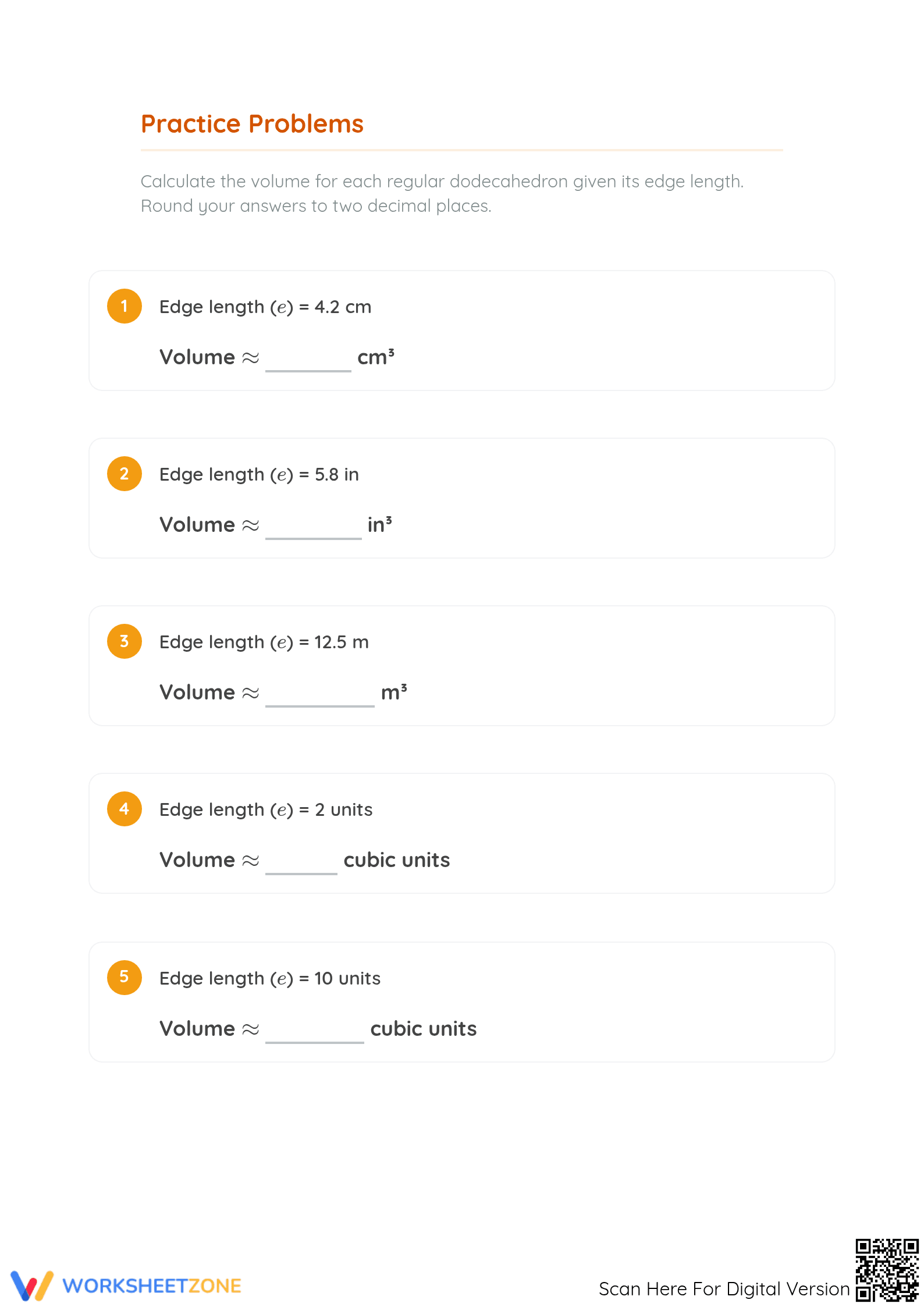
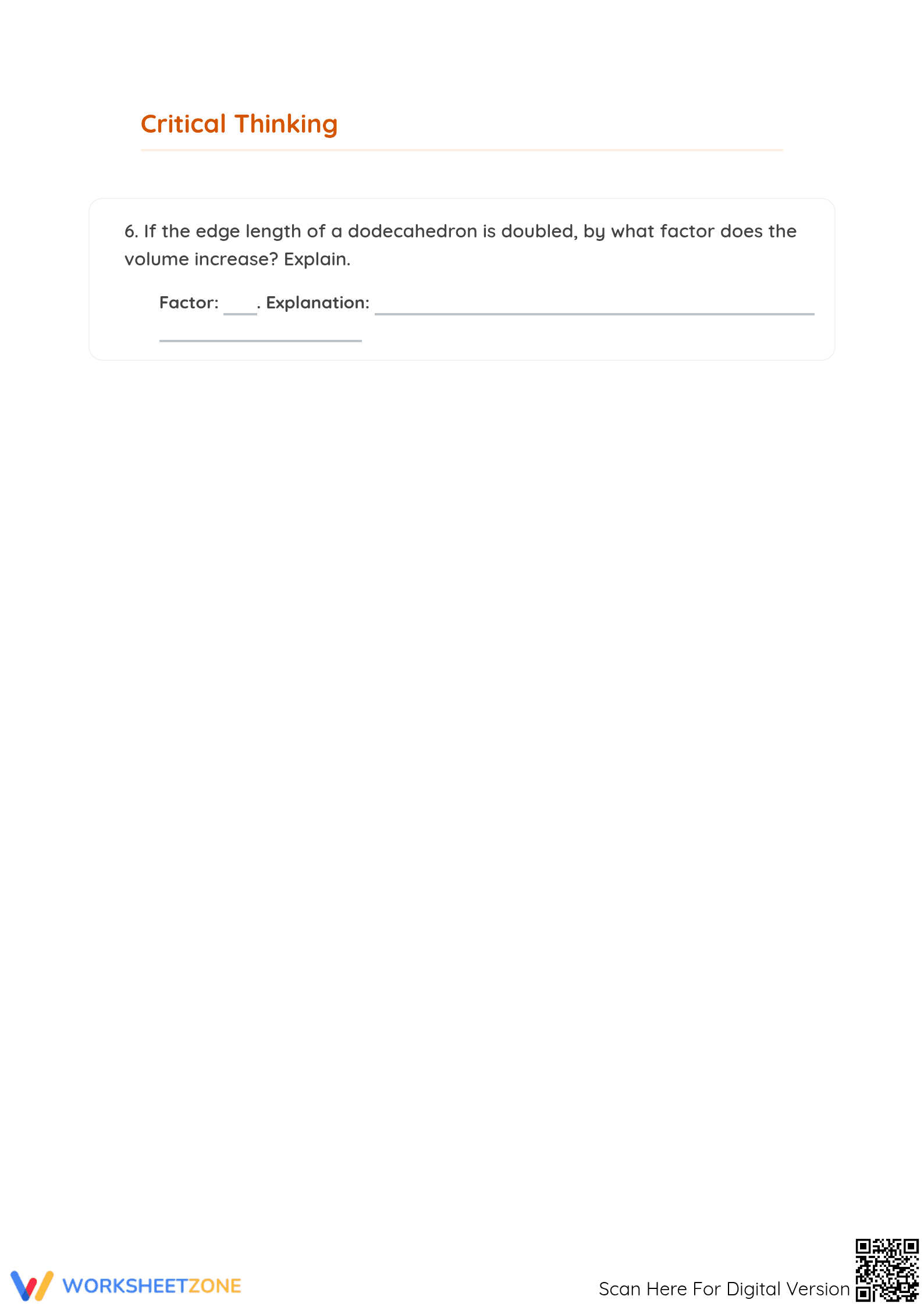
The worksheet spans three pages designed for clarity and mathematical rigor. It begins with 'Understanding the Formula' presenting both the radical expression and a simplified decimal approximation. A detailed guided example breaks down the three-step process: identifying edge length, cubing the value, and multiplying by the constant. The practice set includes five varied problems, followed by a higher-order critical thinking challenge on volume scaling.
Skill Progression
- Guided Practice: One scaffolded example walks students through a 3 cm edge length calculation, providing arithmetic cues to build initial confidence.
- Supported Practice: Five independent problems challenge students to apply the constant (7.6631) to edge lengths from 2 to 12.5 units.
- Independent Practice: A final conceptual task requires students to explain the cubic relationship between length and volume increase.
This gradual-release model follows the I Do, We Do, You Do framework to ensure no student is left behind during instruction.
Standards Alignment
The primary focus is CCSS.MATH.CONTENT.7.G.B.6, which requires students to solve mathematical problems involving the volume of three-dimensional objects. This worksheet specifically addresses the application of formulas to regular polygons in 3D space. Both standard codes can be copied directly into lesson plans, IEP goals, or district curriculum mapping tools to ensure instructional compliance.
How to Use It
Use this as a primary practice tool during a geometry unit, ideally after mastering prisms and pyramids. It serves as an excellent formative assessment; observe students during practice to identify those struggling with cubing. The expected completion time is 30 minutes, making it suitable for a focused class period.
Who It's For
This worksheet is for Grade 7 students and Grade 6 enrichment groups. It provides scaffolding for diverse learners through a simplified decimal formula. Pair this with a physical dodecahedron model or interactive 3D tool to help students connect numeric output to spatial volume.
Regular dodecahedrons represent a significant jump in geometric complexity, requiring students to synthesize algebraic manipulation with spatial visualization. According to a RAND AIRS 2024 analysis, providing students with both the exact radical formula and a decimal approximation, as seen in this worksheet, reduces cognitive load during the initial acquisition of complex volume concepts. This dual-formula approach allows learners to focus on the underlying relationship between edge length and cubic space rather than becoming bogged down in radical arithmetic. Furthermore, the inclusion of a scaling-factor question aligns with Fisher & Frey (2014) recommendations for moving students toward "deep learning" by examining how changes in one dimension impact total volume. By mastering the CCSS.MATH.CONTENT.7.G.B.6 standard through this specialized solid, students build the mathematical stamina required for secondary-level trigonometry and calculus. This resource serves as a validated bridge between middle school measurement and high school geometric modeling.


