


























Views
Downloads


Essential Volume of Rectangular Prisms Worksheet | Grade 6-9
Paste this activity's link or code into your existing LMS (Google Classroom, Canvas, Teams, Schoology, Moodle, etc.).
Students can open and work on the activity right away, with no student login required.
You'll still be able to track student progress and results from your teacher account.
Students master geometric spatial reasoning by calculating the volume of right rectangular prisms using standard formulas. This comprehensive practice set transitions learners from basic visual identification to complex word problems involving missing dimensions and comparative analysis. By the final page, students move beyond simple multiplication to apply volume concepts in real-world contexts like fluid capacity and object comparison.
At a Glance
At a Glance
- Grade: 6–9 · Subject: Math · Geometry
- Standard:
CCSS.MATH.CONTENT.6.G.A.2— Find volume of right rectangular prisms with fractional edge lengths- Skill Focus: Rectangular Prism Volume Calculation
- Format: 4 pages · 17 problems · Answer key included · PDF
- Best For: Middle school geometry mastery and assessment
- Time: 45–60 minutes
What's Inside
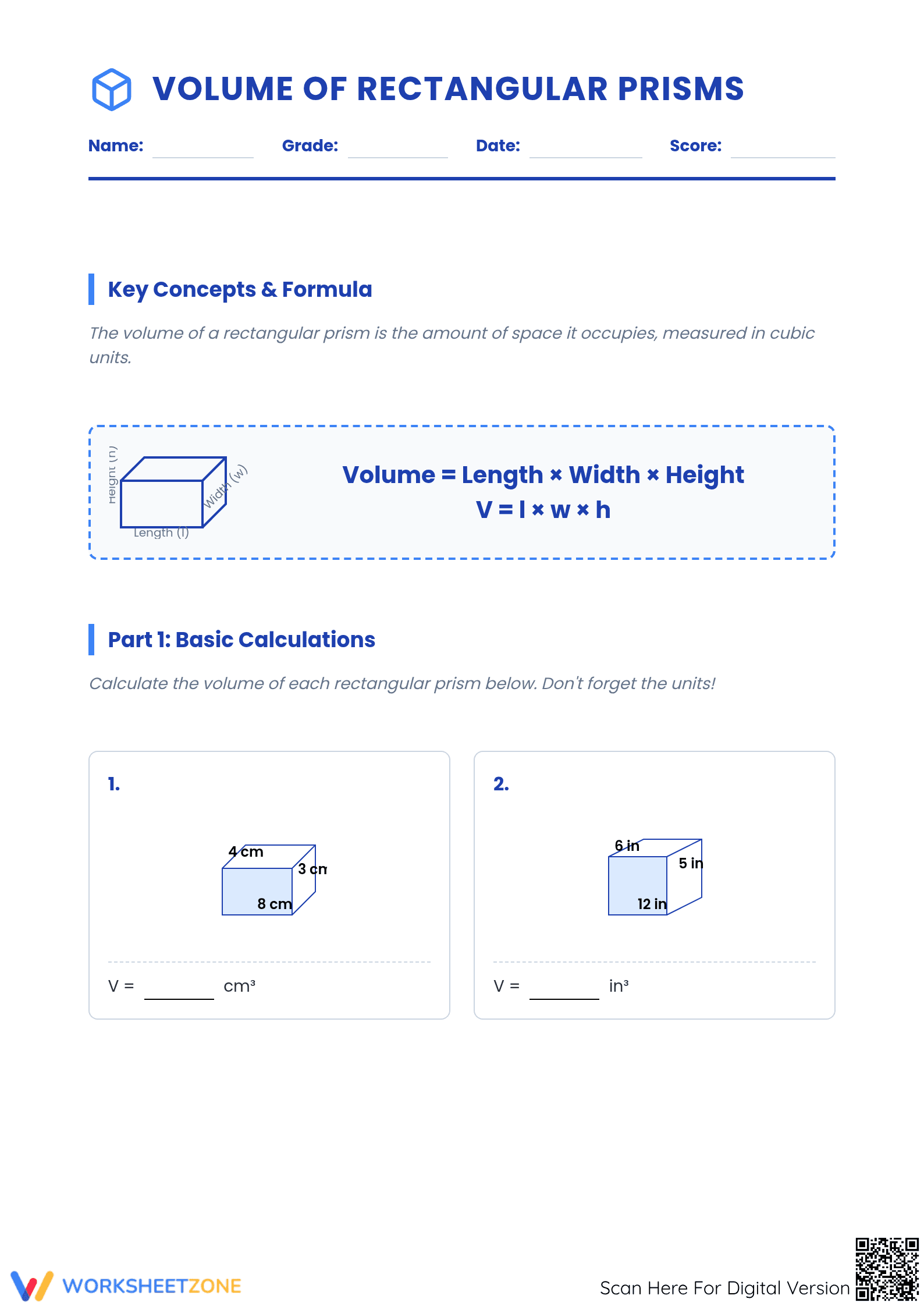
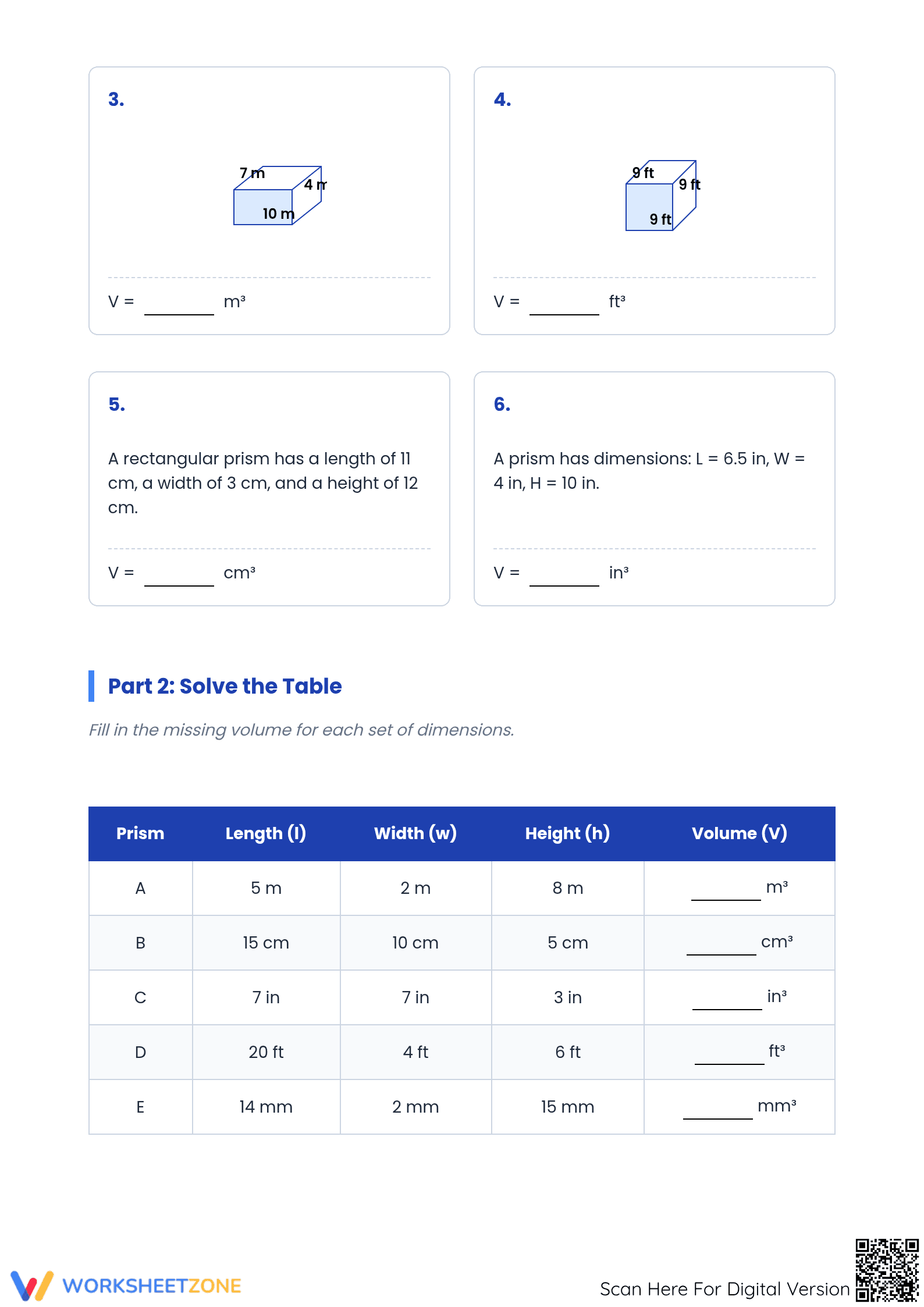
This four-page instructional resource is meticulously structured to build confidence through varied problem types. It includes 6 diagram-based calculations, a 5-row data table for computational fluency, 4 multi-step word problems, and 2 advanced challenge tasks. Every page features clear workspace and labeled units, ensuring students remain organized as they navigate through length, width, and height variables in both metric and imperial measurements.
Skill Progression
- Guided Practice: 4 visual diagrams establish the foundational $V = l \times w \times h$ formula using clear, labeled formats.
- Supported Practice: A data table requires students to synthesize information and solve for volume across five unique dimension sets.
- Independent Practice: Learners tackle 6 rigorous word and challenge problems, solving for missing side lengths or comparing different shapes.
This gradual-release model ensures that students move from the initial phase of formula recognition to the independent phase of complex application and problem-solving.
Standards Alignment
The primary focus is CCSS.MATH.CONTENT.6.G.A.2, which requires students to find the volume of a right rectangular prism and apply the formulas $V = l \times w \times h$ and $V = b \times h$ to solve real-world and mathematical problems. It also supports CCSS.MATH.CONTENT.5.MD.C.5. Both standard codes can be copied directly into lesson plans, IEP goals, or district curriculum mapping tools.
How to Use It
This resource serves as an ideal summative assessment following a unit on 3D geometry. Teachers can assign the first two pages for independent classwork to gauge formula proficiency, then use the challenge sections for collaborative problem-solving. For formative observation, monitor students during the table section to ensure they correctly identify dimensions in text format. Completion typically takes 45 to 60 minutes depending on the instructional setting.
Who It's For
This geometry packet is designed for Grade 6 through Grade 9 students, offering enough rigor for middle school mastery and high school remediation. It is particularly effective for students requiring extra practice with spatial visualization or unit labeling. Pair this resource with an anchor chart displaying the volume formula or a hands-on lab using unit cubes to bridge the gap between concrete and abstract math concepts.
Citation Capsule
Applying the CCSS.MATH.CONTENT.6.G.A.2 standard through varied sets is essential for developing geometric fluency. According to Fisher & Frey (2014), scaffolded practice moving from visual modeling to abstract word problems enhances a student's ability to transfer mathematical concepts to novel situations. This worksheet provides that bridge by starting with diagrams and concluding with multi-step challenges involving capacity and comparison. By requiring students to calculate volume and solve for missing dimensions like height or length, this resource encourages higher-order thinking and algebraic readiness. This approach aligns with modern pedagogical standards for middle school geometry, ensuring students are prepared for high school spatial reasoning demands and standardized testing requirements.


