


























Views
Downloads



Essential Volume Worksheet | Grade 5 Math Practice
Paste this activity's link or code into your existing LMS (Google Classroom, Canvas, Teams, Schoology, Moodle, etc.).
Students can open and work on the activity right away, with no student login required.
You'll still be able to track student progress and results from your teacher account.
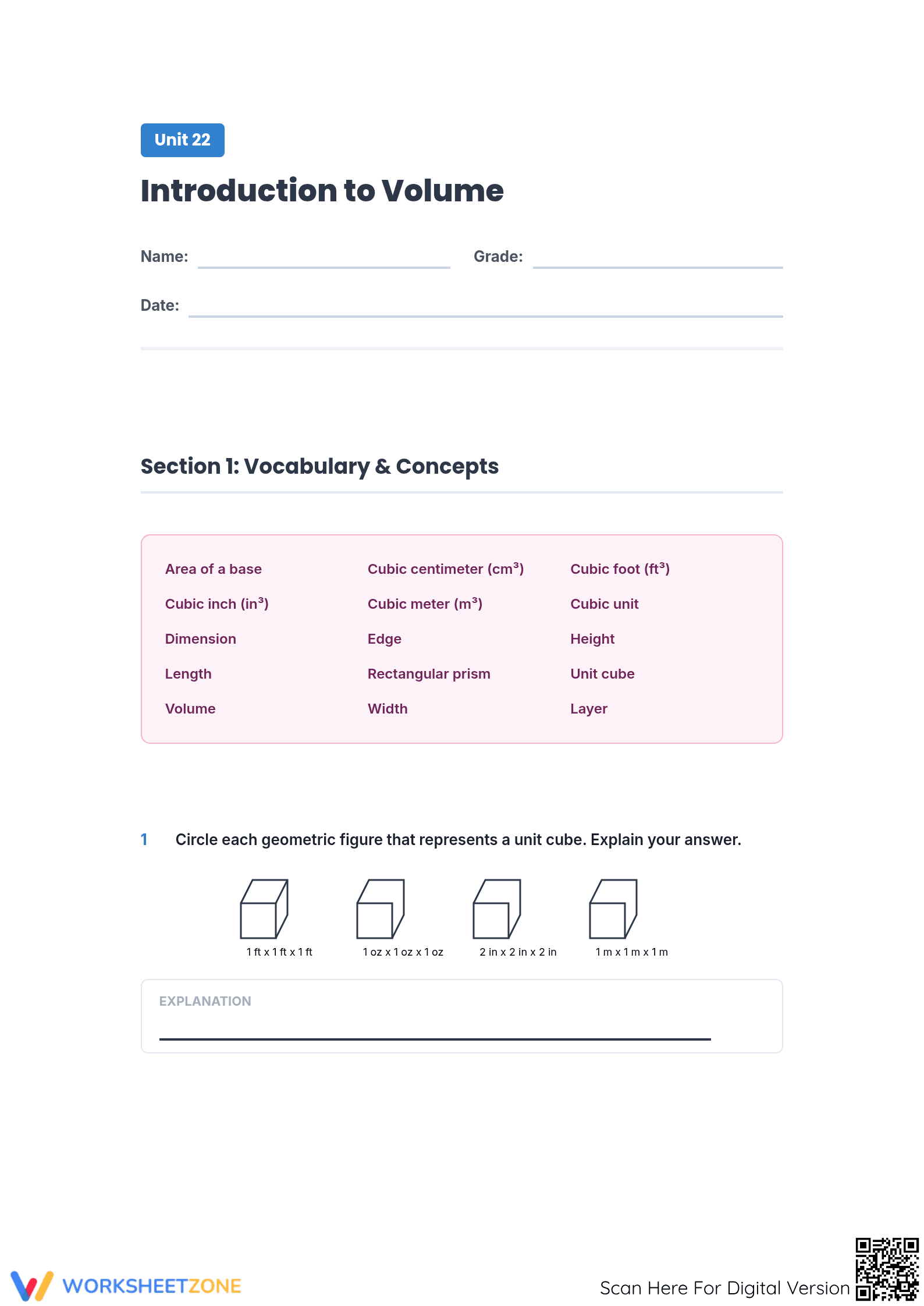
This Grade 5 volume worksheet provides a structured introduction to 3D measurement, guiding students from unit cube identification to calculating the volume of rectangular prisms. By bridging concrete counting and abstract formulas, students develop a deep conceptual understanding of how space is occupied within geometric figures, ensuring readiness for complex spatial reasoning.
At a Glance
- Grade: 5 · Subject: Math
- Standard:
CCSS.MATH.CONTENT.5.MD.C.5— Relate volume to multiplication and addition to solve real-world problems- Skill Focus: Introduction to Volume and Rectangular Prisms
- Format: 4 pages · 10 problems · Answer key included · PDF
- Best For: Initial instruction or guided math practice
- Time: 30–45 minutes
This four-page packet includes Vocabulary & Concepts, Finding Volume by Counting Cubes, Partner Practice, and Problem Solving sections. It features clear 3D diagrams, multiple-choice questions, and open-ended explanation tasks. A complete answer key is provided to facilitate rapid grading or student self-correction, ensuring a high-quality educational experience with minimal administrative overhead.
Implementing this resource is effortless. Step 1: Print (1 minute) — Print the four-page PDF for each student. Step 2: Distribute (1 minute) — Hand out the sheets; no manipulatives are required as visual aids are self-contained. Step 3: Review (5 minutes) — Use the provided key for a whole-class review, keeping total teacher prep under two minutes. This zero-prep workflow makes it an ideal choice for substitute plans or last-minute lesson adjustments.
The primary focus is CCSS.MATH.CONTENT.5.MD.C.5, relating volume to multiplication to solve real-world problems. It also supports 5.MD.C.3 by reinforcing unit cube concepts and the relationship between layers and total capacity. Both standard codes can be copied directly into lesson plans, IEP goals, or district curriculum mapping tools to ensure compliance with state and national frameworks.
This is ideal for the "We Do" and "You Do" instructional phases. Use Section 1 for vocabulary after direct instruction, then transition to Section 2 for guided counting. For assessment, observe students during Task 6 to see if they identify non-examples of specific volumes. Expect completion within 40 minutes, making it a perfect fit for a standard math period or station rotation.
Designed for 5th-grade students, this resource also suits 6th-grade review or 4th-grade enrichment. The word banks and visual models support English Language Learners and students with IEPs by reducing the cognitive load during the introductory phase. It pairs naturally with hands-on centimeter cubes or digital slides illustrating 3D layering to provide a multi-sensory learning experience.
According to EdReports 2024, high-quality math resources must balance procedural fluency with conceptual understanding. This worksheet prioritizes the "unit cube" foundation before introducing the standard volume formula. By requiring students to explain reasoning in Task 1 and compare prisms in Task 8, the resource encourages discourse necessary for long-term retention. Research suggests that when students engage with multiple representations of volume—counting layers and calculating dimensions—they are more likely to achieve mastery of CCSS.MATH.CONTENT.5.MD.C.5. This resource provides the scaffolding to move students from basic recognition of 3D space to complex problem-solving in contexts like calculating pool or container volume, ultimately preparing them for middle school geometry and spatial reasoning tasks.


