


























Views
Downloads



Essential Rectangular Prisms Volume Worksheet | Grades 6-9
Paste this activity's link or code into your existing LMS (Google Classroom, Canvas, Teams, Schoology, Moodle, etc.).
Students can open and work on the activity right away, with no student login required.
You'll still be able to track student progress and results from your teacher account.
Calculate the volume of rectangular prisms with precision using this comprehensive 4-page worksheet. Students transition from visual diagrams to abstract parameters and finally to real-world word problems, ensuring a deep understanding of the volume formula. This resource is designed to build procedural fluency and conceptual mastery for middle school geometry students.
At a Glance
- Grade: 6-9 · Subject: Mathematics
- Standard:
CCSS.MATH.CONTENT.6.G.A.2— Calculate volume of right rectangular prisms using fractional or decimal edge lengths- Skill Focus: Volume of Rectangular Prisms
- Format: 4 pages · 16 problems · Answer key included · PDF
- Best For: Independent practice or homework assignments
- Time: 30–45 minutes
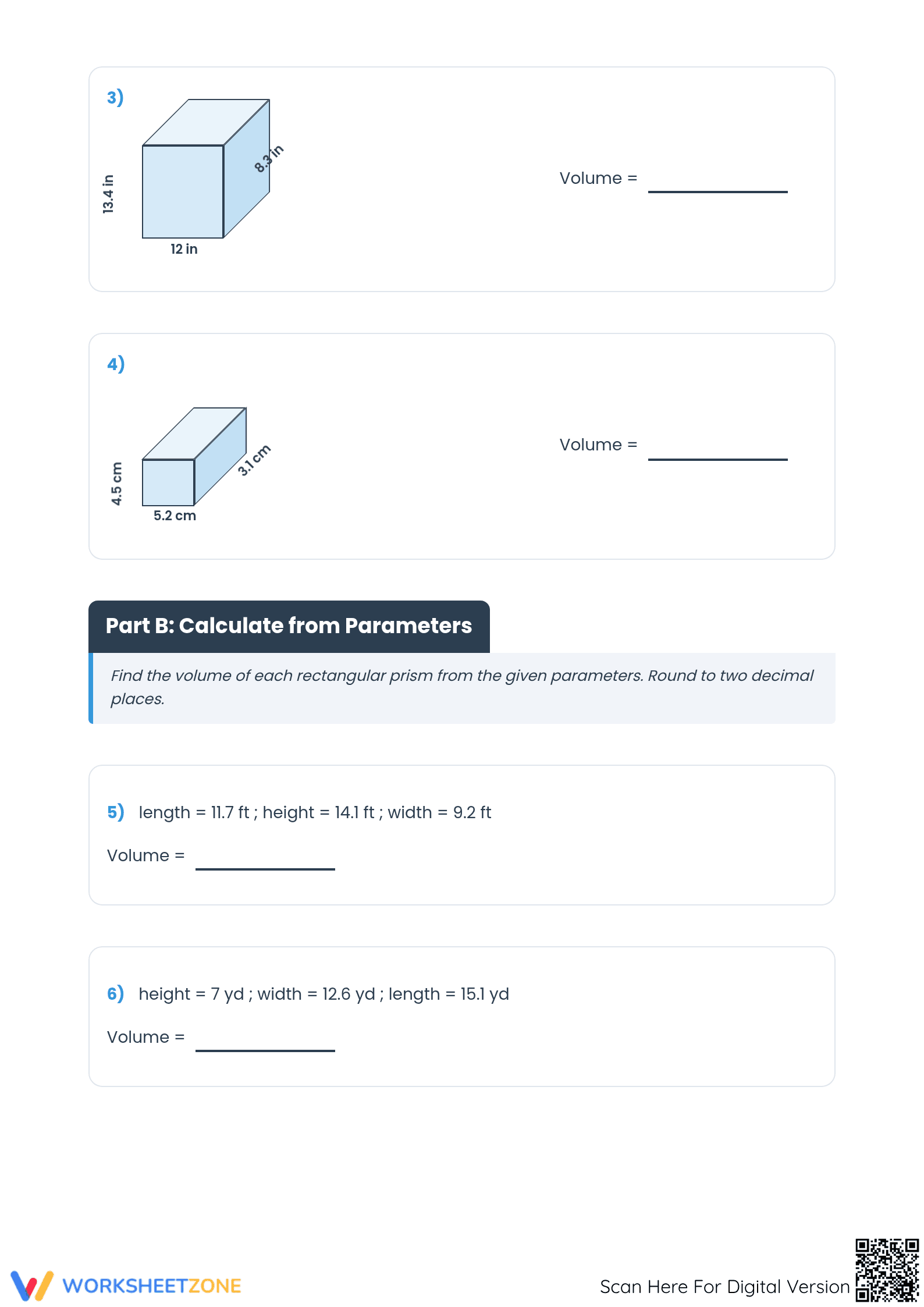
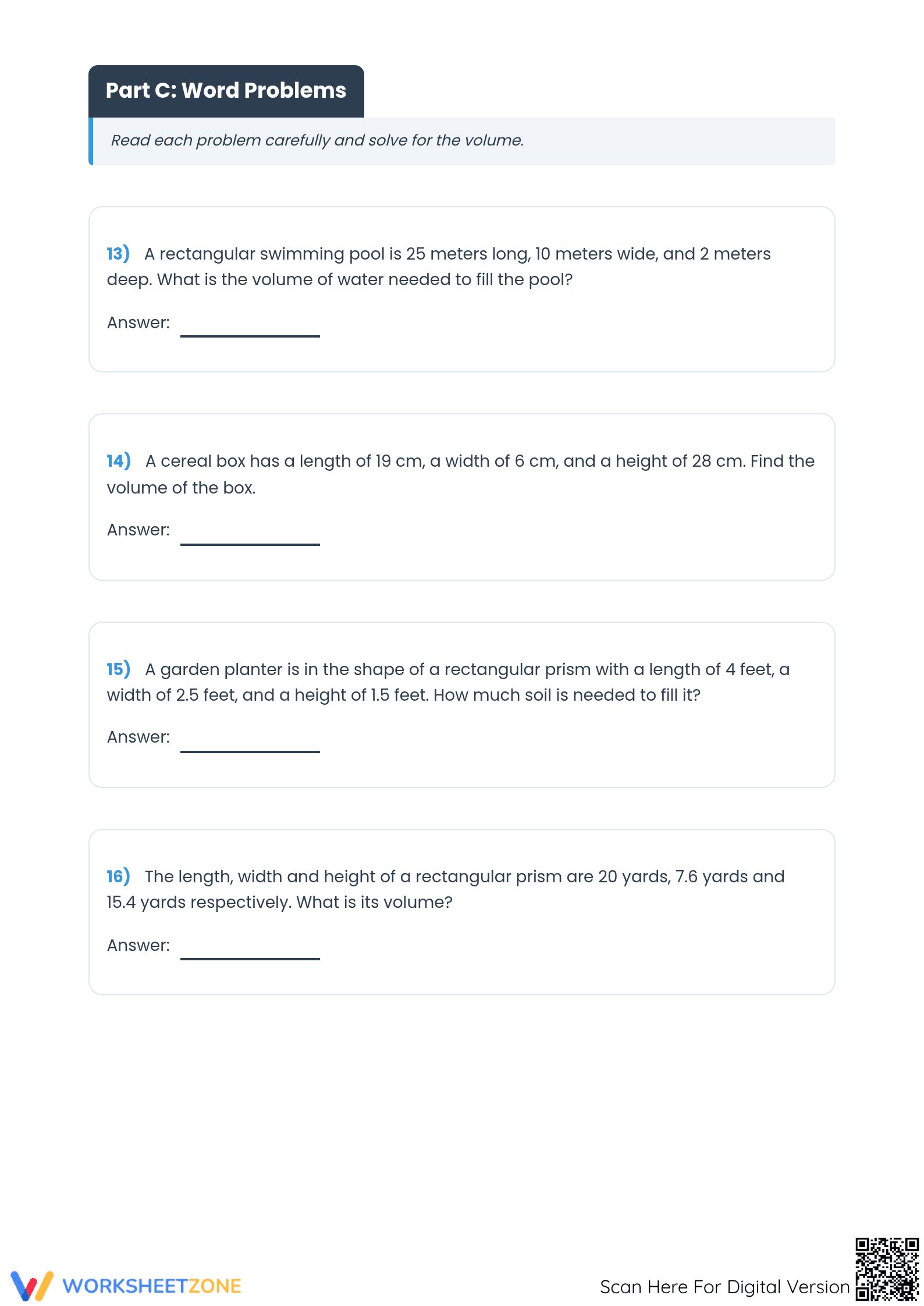
This resource contains four structured pages featuring 16 unique problems. Page 1 introduces "Calculate from Diagrams" where students identify dimensions from 3D models. Page 2 and 3 provide "Calculate from Parameters," presenting dimensions as text strings to test formula application. Page 4 concludes with rigorous "Word Problems" that situate volume calculations within practical scenarios like swimming pools and cereal boxes. A full answer key is provided to facilitate quick grading.
Skill Progression
- Guided practice: The worksheet begins with clear 3D diagrams in Part A, providing a visual scaffold that helps students correctly identify length, width, and height before performing calculations.
- Supported practice: In Part B, students work through 8 problems where dimensions are provided numerically. This removes the visual aid, requiring students to rely on their internal understanding of geometric variables.
- Independent practice: The final section presents 4 word problems, challenging students to extract data from text and apply the volume formula to solve complex, multi-step real-world scenarios.
This progression follows the instructional model of gradual release, moving from concrete visual aids to abstract application.
Standards Alignment
The primary alignment is CCSS.MATH.CONTENT.6.G.A.2, which requires students to find the volume of a right rectangular prism with fractional edge lengths. It also supports CCSS.MATH.CONTENT.7.G.B.6, solving real-world and mathematical problems involving area and volume of three-dimensional objects. Both standard codes can be copied directly into lesson plans, IEP goals, or district curriculum mapping tools.
How to Use It
Use this worksheet as a summative assessment following a unit on 3D geometry or as a targeted intervention for students struggling with spatial reasoning. During instruction, observe how students handle the rounding requirement to two decimal places to identify gaps in decimal multiplication proficiency. This 16-problem set typically takes 35 minutes to complete in a standard classroom setting.
Who It's For
Designed for students in grades 6 through 9, this resource is ideal for general education classrooms, small group remediation, or homeschool environments. It pairs naturally with a physical rectangular prism manipulative or a digital interactive volume simulator to bridge the gap between concrete and abstract mathematical thinking.
This volume of rectangular prisms resource provides systematic practice for CCSS.MATH.CONTENT.6.G.A.2, helping students master the calculation of 3D space using decimal dimensions. According to a RAND AIRS 2024 report on math curriculum efficacy, structured problem sets that transition from visual models to word-based applications significantly improve long-term retention of geometric formulas. By requiring students to navigate three distinct tiers of problem difficulty—diagrams, parameters, and word problems—this worksheet ensures that learners do not just memorize a formula but understand its application across varied contexts. The inclusion of word problems involving swimming pools and packaging materials aligns with NAEP standards for mathematical literacy, requiring students to interpret quantitative information within a narrative framework. This comprehensive approach builds the spatial reasoning skills necessary for advanced high school geometry and real-world vocational applications in construction, logistics, and engineering.


