


























Views
Downloads


Essential Volume of Triangular Prism Worksheet | Grade 7
Paste this activity's link or code into your existing LMS (Google Classroom, Canvas, Teams, Schoology, Moodle, etc.).
Students can open and work on the activity right away, with no student login required.
You'll still be able to track student progress and results from your teacher account.
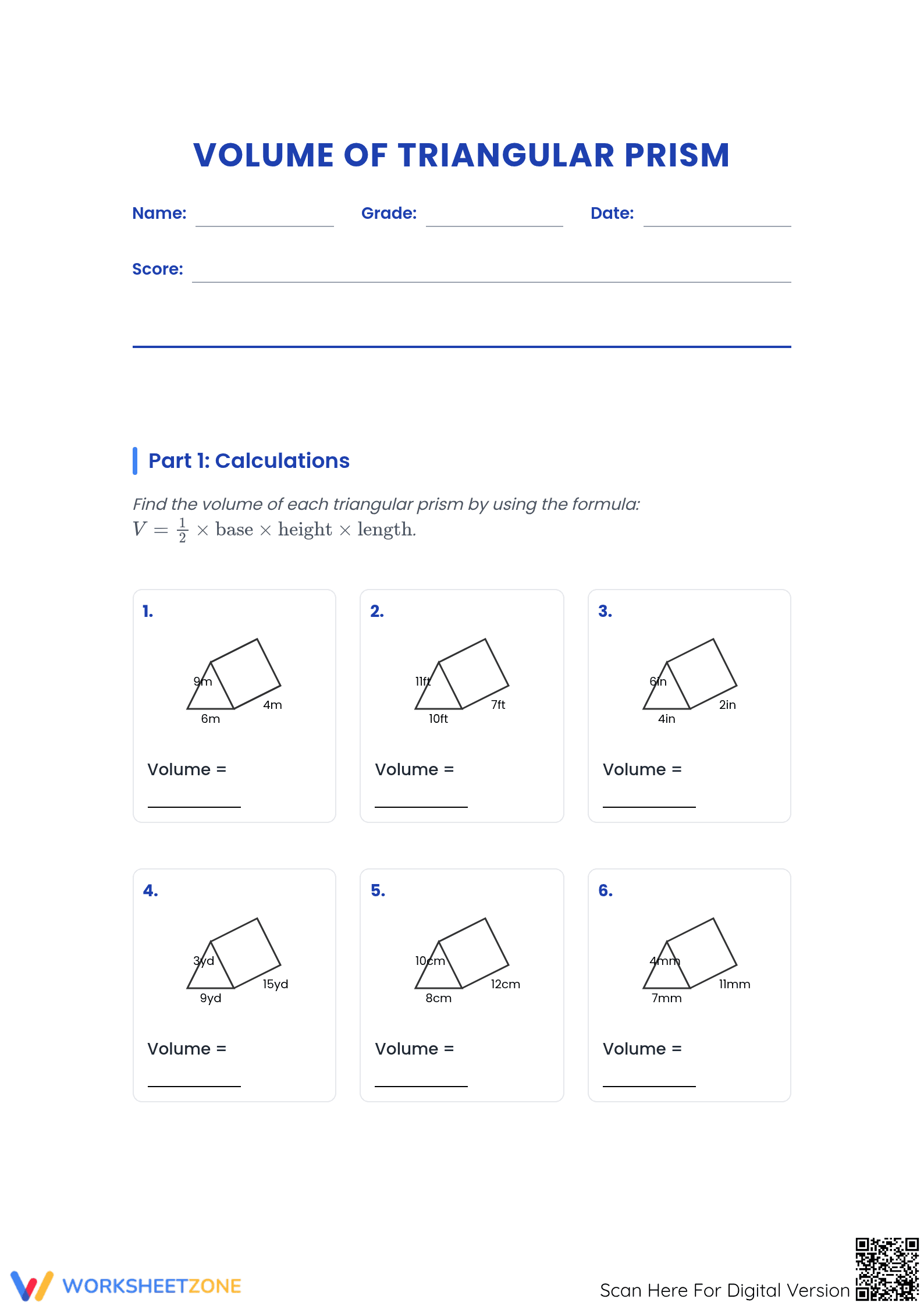
This essential geometry worksheet guides students through the process of calculating the volume of triangular prisms using a structured approach. Students will apply the standard formula to 18 diverse problems, transitioning from basic calculations to advanced practice. By finding the product of base, height, and length, learners develop a deep conceptual understanding of three-dimensional space and geometric measurement.
At a Glance
- Grade: 7 · Subject: Geometry
- Standard:
CCSS.MATH.CONTENT.7.G.B.6— Solve mathematical problems involving the volume of three-dimensional objects like right triangular prisms- Skill Focus: Triangular Prism Volume Formula
- Format: 2 pages · 18 problems · Answer key included · PDF
- Best For: Middle school geometry skill reinforcement
- Time: 25–35 minutes
This comprehensive 2-page PDF features 18 distinct triangular prism diagrams, each requiring students to calculate the total volume. The worksheet includes a clearly stated formula at the top to scaffold learning. Problems are organized into two sections: foundational calculations and advanced practice, ensuring students encounter a range of difficulty levels and unit measurements. A complete answer key is included for rapid grading or self-correction.
- Guided Practice: The first 9 problems provide clear diagrams and labeled dimensions, allowing students to apply the volume formula to standard right triangular prisms.
- Supported Practice: Problems 10 through 18 increase calculation complexity, requiring students to manage larger numerical values while maintaining precision.
- Independent Practice: The advanced section removes immediate scaffolds, challenging students to verify their work through the complete multi-step multiplication process.
This worksheet follows the "I Do, We Do, You Do" instructional model, moving from formulaic application to full mastery.
Standards Alignment
This resource is strictly aligned with `CCSS.MATH.CONTENT.7.G.B.6`, which requires students to "solve real-world and mathematical problems involving area, volume and surface area of two- and three-dimensional objects composed of triangles, quadrilaterals, polygons, cubes, and right prisms." The worksheet provides targeted practice specifically for right triangular prisms, a critical component of the Grade 7 geometry curriculum. This standard code can be copied directly into lesson plans, IEP goals, or district curriculum mapping tools.
How to Use It
Assign this worksheet as an independent practice activity following a direct instruction lesson on three-dimensional shapes and volume formulas. It serves as an excellent formative assessment tool; teachers should observe whether students correctly apply the 1/2 multiplier, which is the most common point of error in triangular prism calculations. Expect most students to complete the 18 problems within 30 minutes, making it an ideal classroom activity or homework assignment.
Who It's For
This printable resource is designed for Grade 7 students currently studying geometry, though it remains highly effective for Grade 6 acceleration or Grade 8 review. It is particularly useful for learners who benefit from visual diagrams and repetitive practice to internalize mathematical formulas. Pair this worksheet with physical manipulatives or a digital volume calculator to help students visualize the space being measured.
This worksheet addresses CCSS.MATH.CONTENT.7.G.B.6 by providing 18 scaffolded tasks that bridge the gap between basic arithmetic and spatial reasoning. By explicitly labeling the base, height, and length of each prism, the resource reduces cognitive load, allowing students to focus on the multiplication and division required for the volume formula. This systematic instructional design ensures students reach proficiency in calculating volumes of right prisms.


