


























Views
Downloads

Printable Decimal Riddles Math Worksheet | Grade 5-7
Paste this activity's link or code into your existing LMS (Google Classroom, Canvas, Teams, Schoology, Moodle, etc.).
Students can open and work on the activity right away, with no student login required.
You'll still be able to track student progress and results from your teacher account.
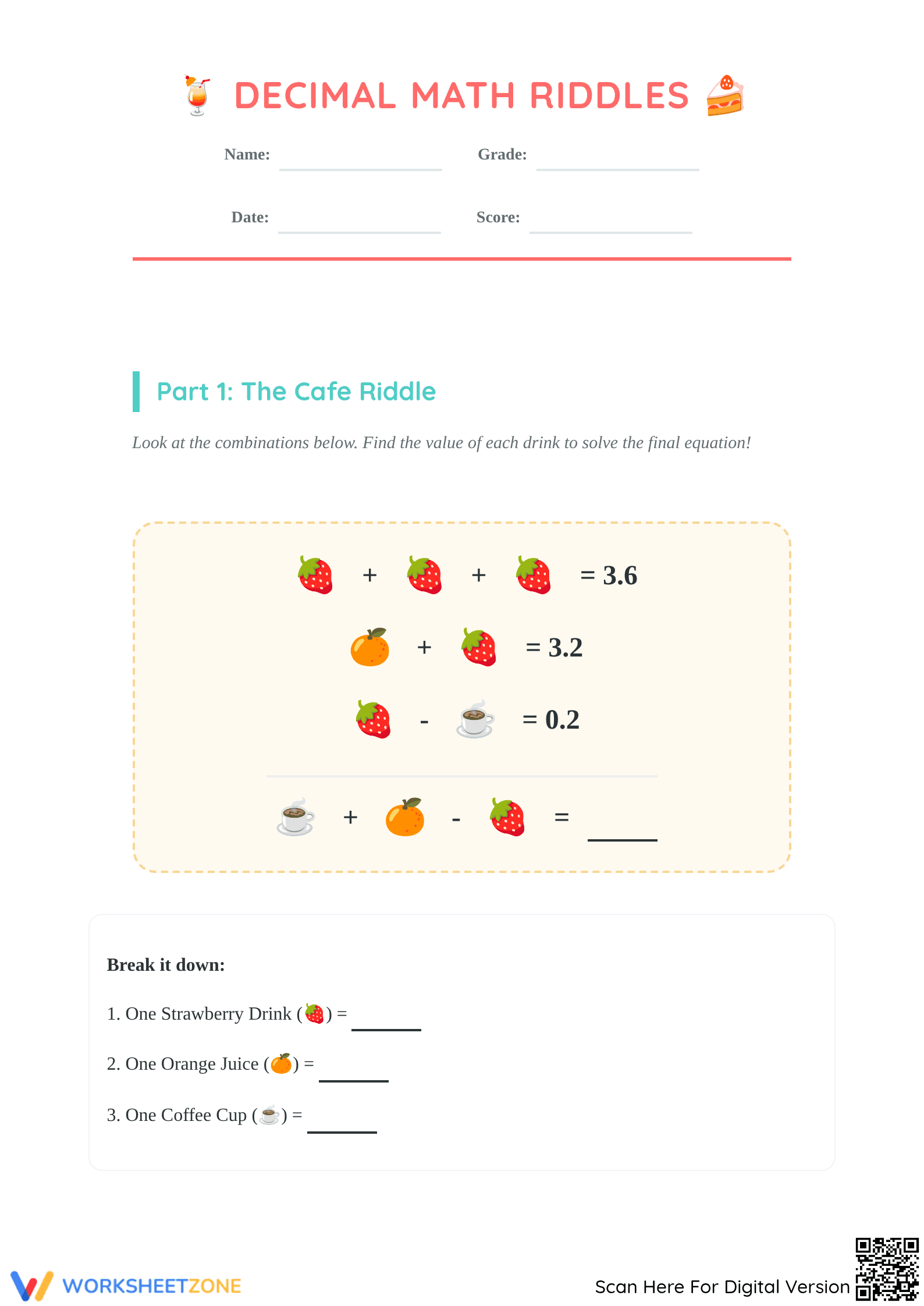
Solve engaging math mysteries with this comprehensive decimal math riddles worksheet designed for students in grades 5 through 7. This resource transforms standard decimal practice into a series of visual logic puzzles and real-world menu challenges, ensuring students master addition, subtraction, multiplication, and division while developing critical problem-solving endurance and algebraic thinking skills.
At a Glance
- Grade: 5-7 · Subject: Math
- Standard:
5.NBT.B.7— Add, subtract, multiply, and divide decimals to hundredths using place value strategies.- Skill Focus: Multi-operation decimal logic and word problems
- Format: 4 pages · 16 problems · Answer key included · PDF
- Best For: Early finishers or small group math centers
- Time: 30–45 minutes
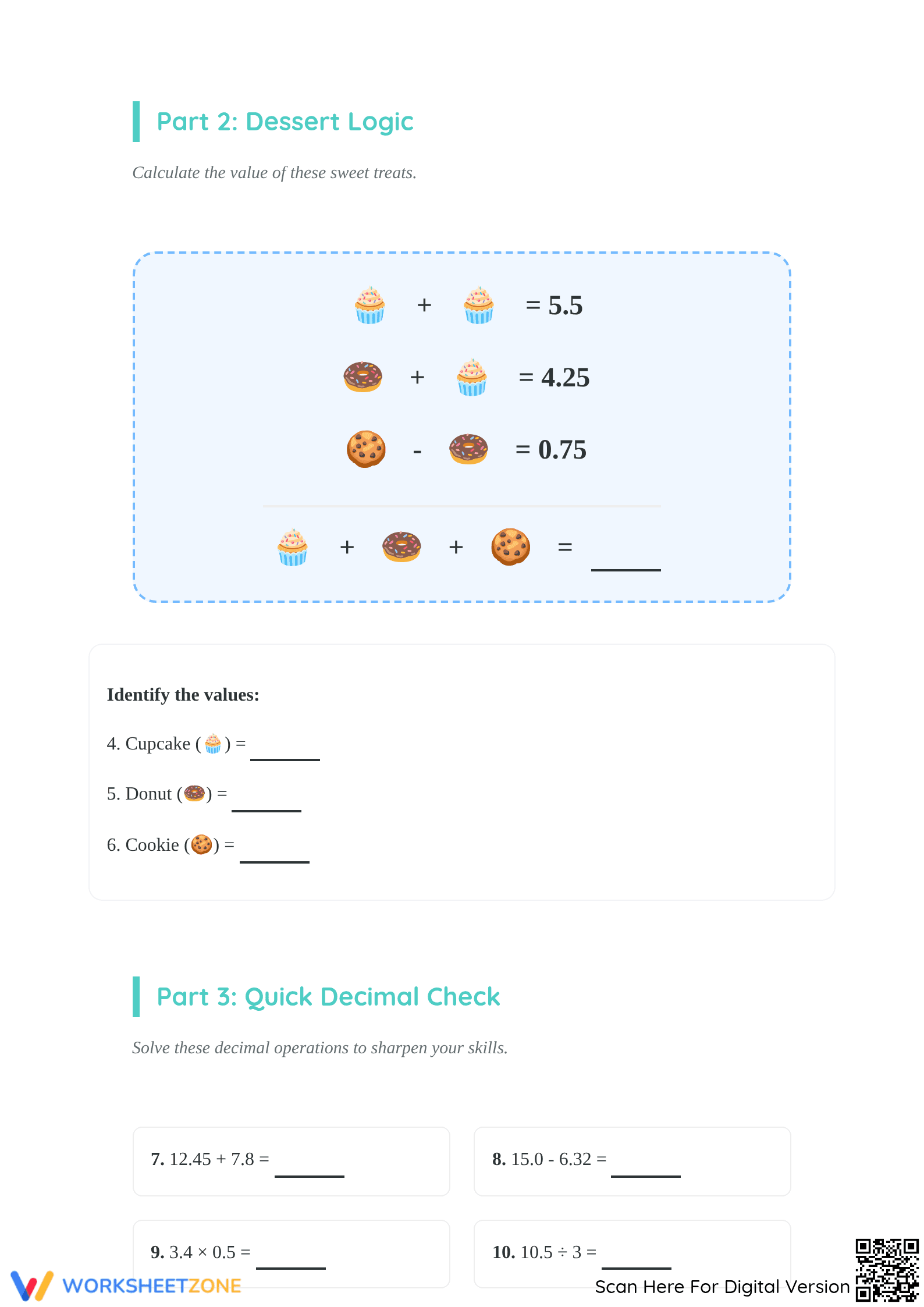
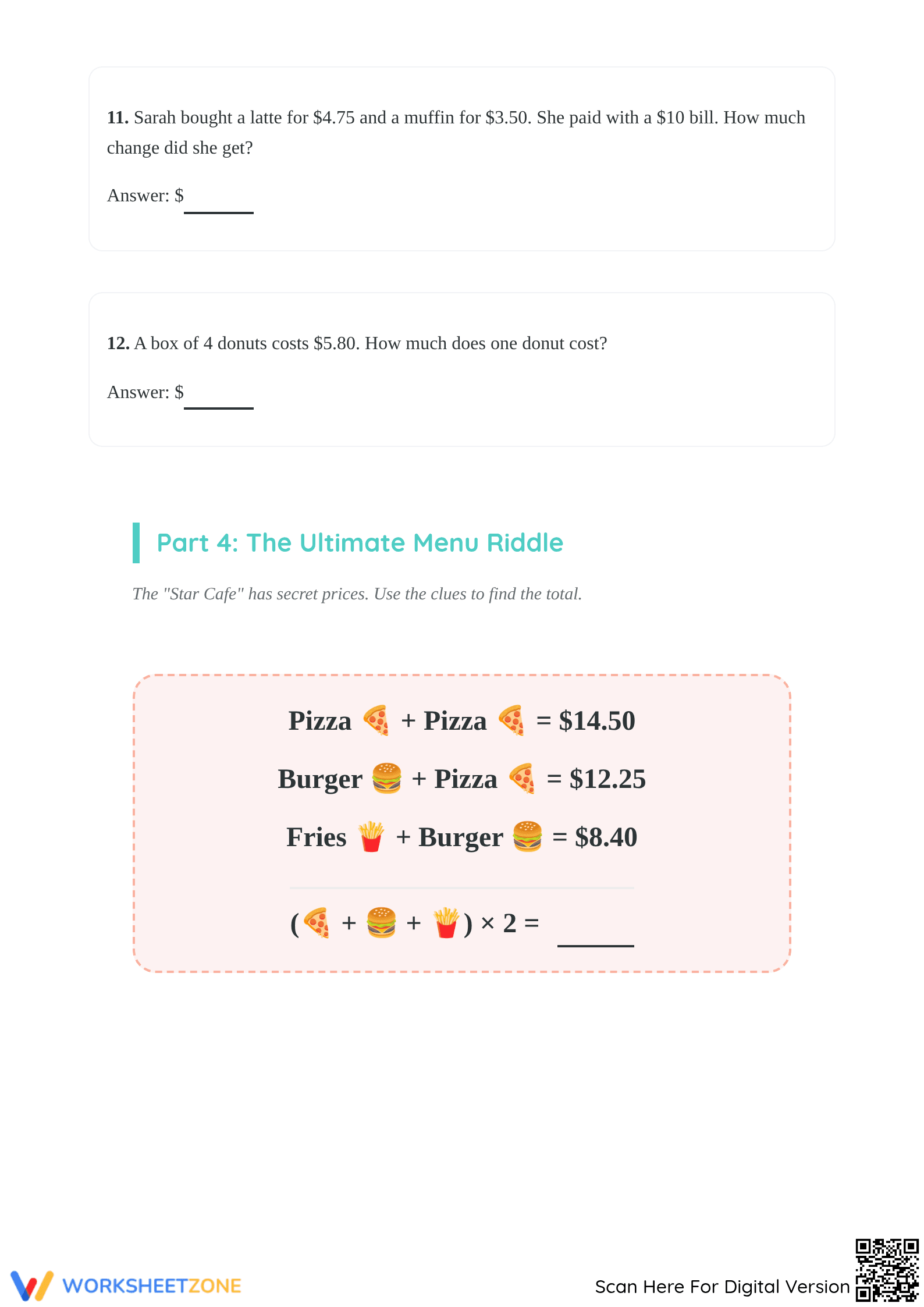
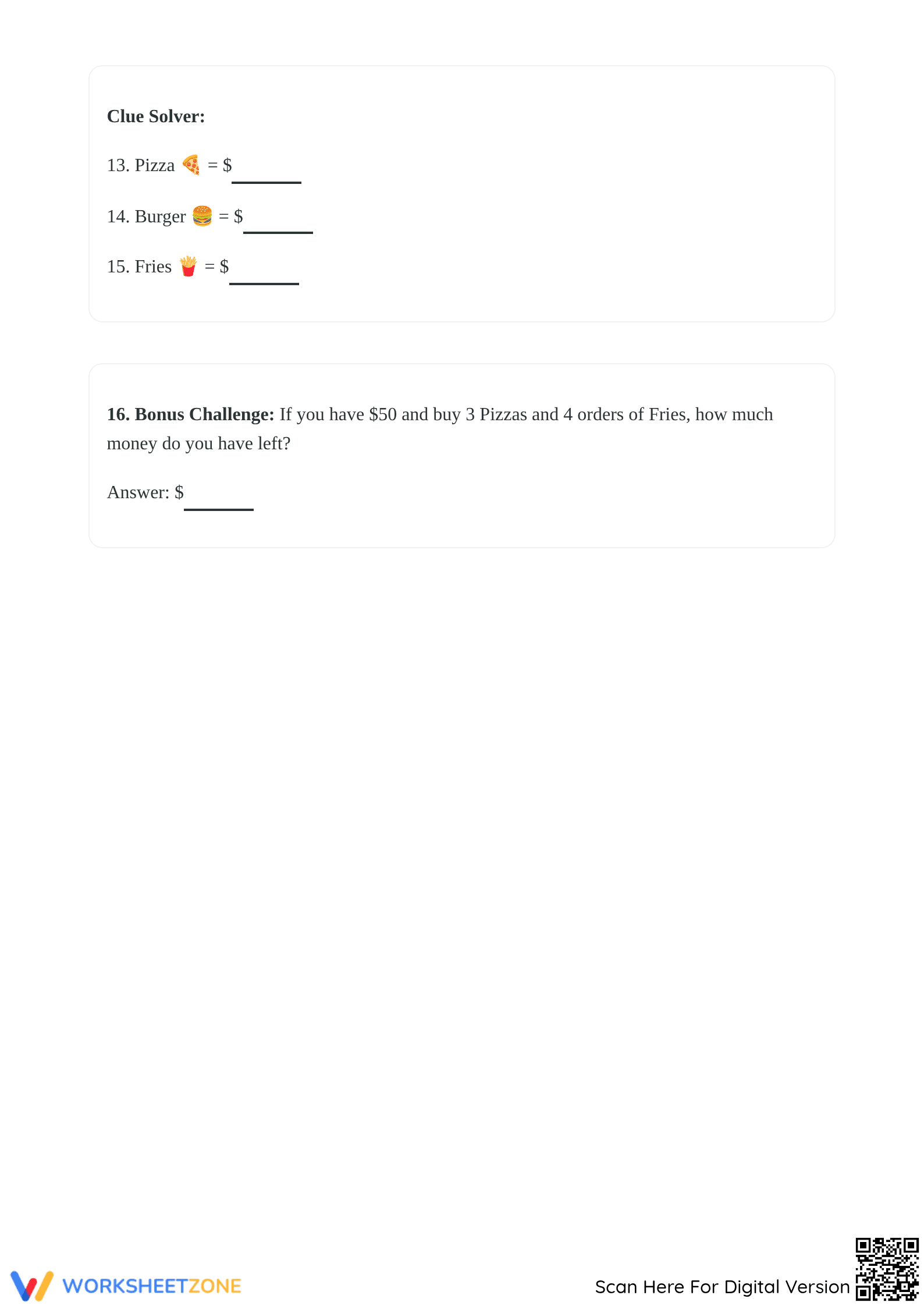
Inside this 4-page PDF, you will find 16 meticulously crafted tasks that progress from visual beverage and dessert logic puzzles to abstract computation and complex multi-step word problems. The worksheet features a "Star Cafe" menu challenge where students must solve for secret prices and a bonus challenge to test financial literacy. A full answer key is included for immediate feedback.
Skill Progression
- Guided Practice: Parts 1 and 2 use visual icons (strawberries, cupcakes) to create accessible logic equations. These 6 tasks scaffold the transition from whole-number thinking to decimal reasoning.
- Supported Practice: Part 3 provides 4 direct computation problems, allowing students to apply strategies to abstract numbers across all four operations.
- Independent Practice: The final pages present 6 high-rigor word problems and menu riddles requiring students to synthesize all decimal skills independently.
This structure follows a gradual-release model, moving from visual hooks to independent application.
Standards Alignment
The primary focus is CCSS.MATH.CONTENT.5.NBT.B.7: "Add, subtract, multiply, and divide decimals to hundredths, using concrete models or drawings and strategies based on place value." It also supports Grade 6 and 7 number system fluency. Both standard codes can be copied directly into lesson plans, IEP goals, or district curriculum mapping tools.
How to Use It
Use this resource during the "independent practice" phase of a decimal unit to challenge students who have mastered basic computation. Alternatively, it serves as an excellent formative assessment tool; observe how students handle the division in the "box of donuts" problem to check for scaling misconceptions. Expected completion time is 45 minutes.
Who It's For
This worksheet is ideal for upper elementary and middle school students who need to bridge the gap between arithmetic and algebra. It provides natural differentiation for gifted and talented students while offering enough visual support for learners who struggle with traditional, text-heavy word problems. Pair it with a decimal place value anchor chart.
Research in mathematics education, such as the RAND AIRS 2024 report, emphasizes that integrating logic puzzles and riddles into decimal instruction significantly increases student engagement and conceptual depth. By shifting from rote computation to algebraic-style reasoning—where symbols represent unknown decimal values—students develop a more robust understanding of place value and operation properties. This worksheet aligns with CCSS.MATH.CONTENT.5.NBT.B.7, requiring students to fluently add, subtract, multiply, and divide decimals to hundredths. The multi-step nature of the menu riddles forces students to attend to precision, a key Mathematical Practice, while building the perseverance needed for middle-school algebra. Evidence-based strategies suggest that such 'low-floor, high-ceiling' tasks allow for natural differentiation within mixed-ability classrooms. Teachers can use these 16 tasks to identify misconceptions in decimal alignment or division scaling before moving to complex multi-digit computation. This resource provides the necessary scaffolding to bridge elementary arithmetic with secondary algebraic reasoning.


