


























Views
Downloads

Grade 5-7 Shopping Budget: Essential No-Prep Workshop
Paste this activity's link or code into your existing LMS (Google Classroom, Canvas, Teams, Schoology, Moodle, etc.).
Students can open and work on the activity right away, with no student login required.
You'll still be able to track student progress and results from your teacher account.
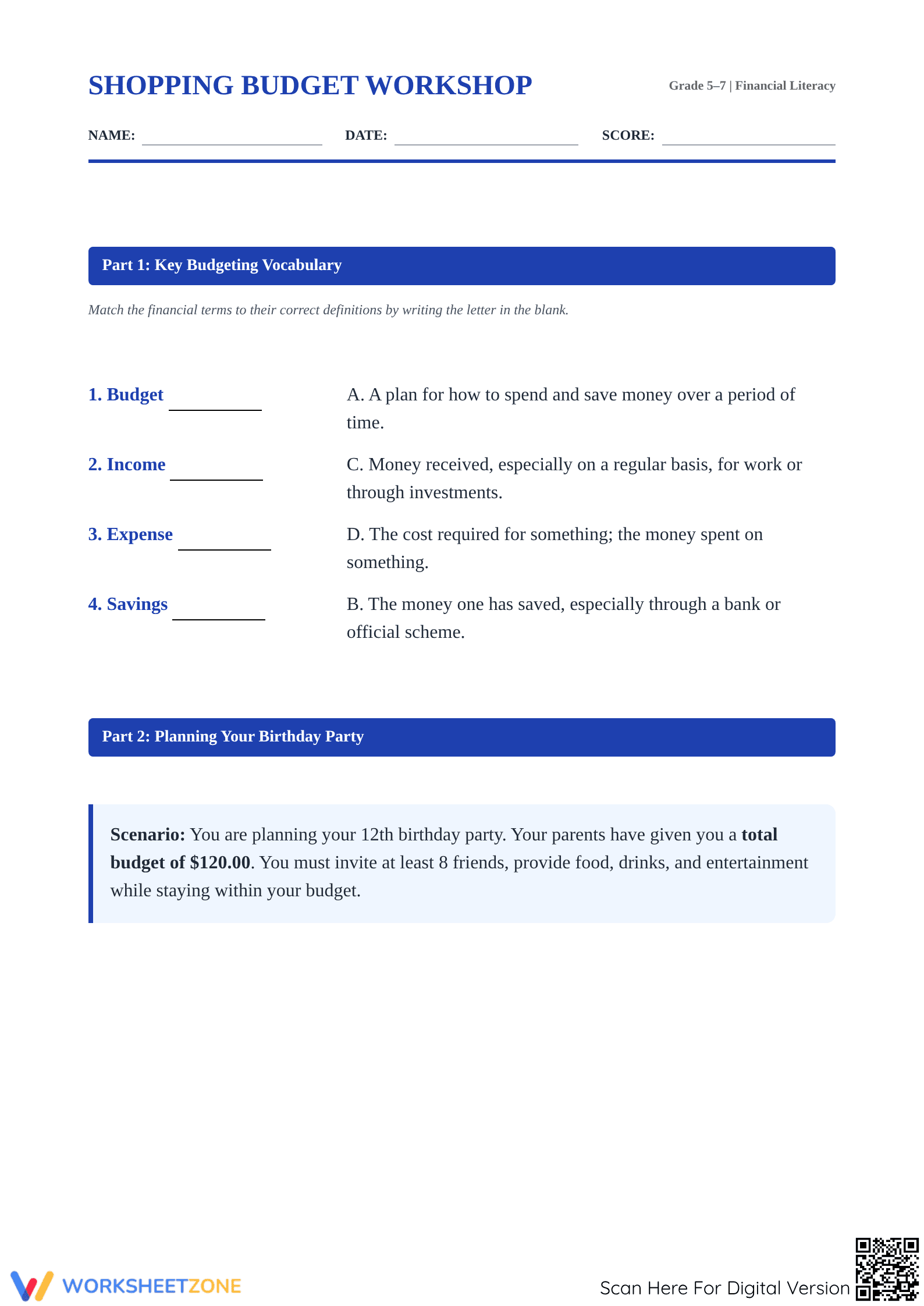
This 3-page workshop empowers middle school students to master decimal operations through a relatable birthday party planning scenario. By calculating costs and sales tax, learners bridge the gap between abstract arithmetic and financial literacy. Students develop a practical understanding of managing a $120.00 budget while applying rigorous decimal fluency.
At a Glance
- Grade: 5-7 · Subject: Math & Financial Literacy
- Standard:
CCSS.MATH.CONTENT.5.NBT.7— Perform operations with decimals to hundredths to solve real-world budgeting problems- Skill Focus: Adding decimals and percentage calculations
- Format: 3 pages · 24 tasks · Answer key included · PDF
- Best For: Real-world math application and financial literacy
- Time: 45–60 minutes
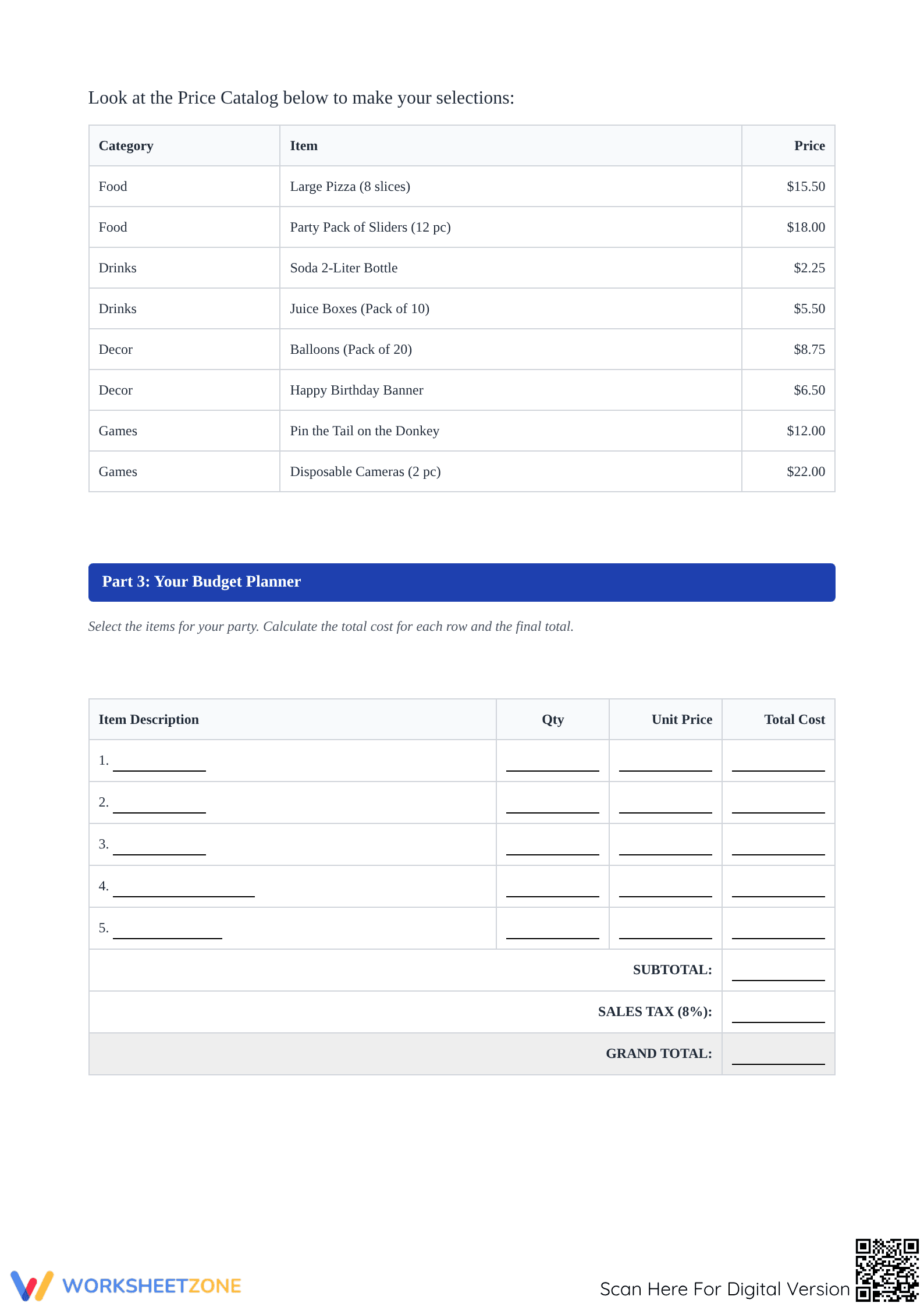
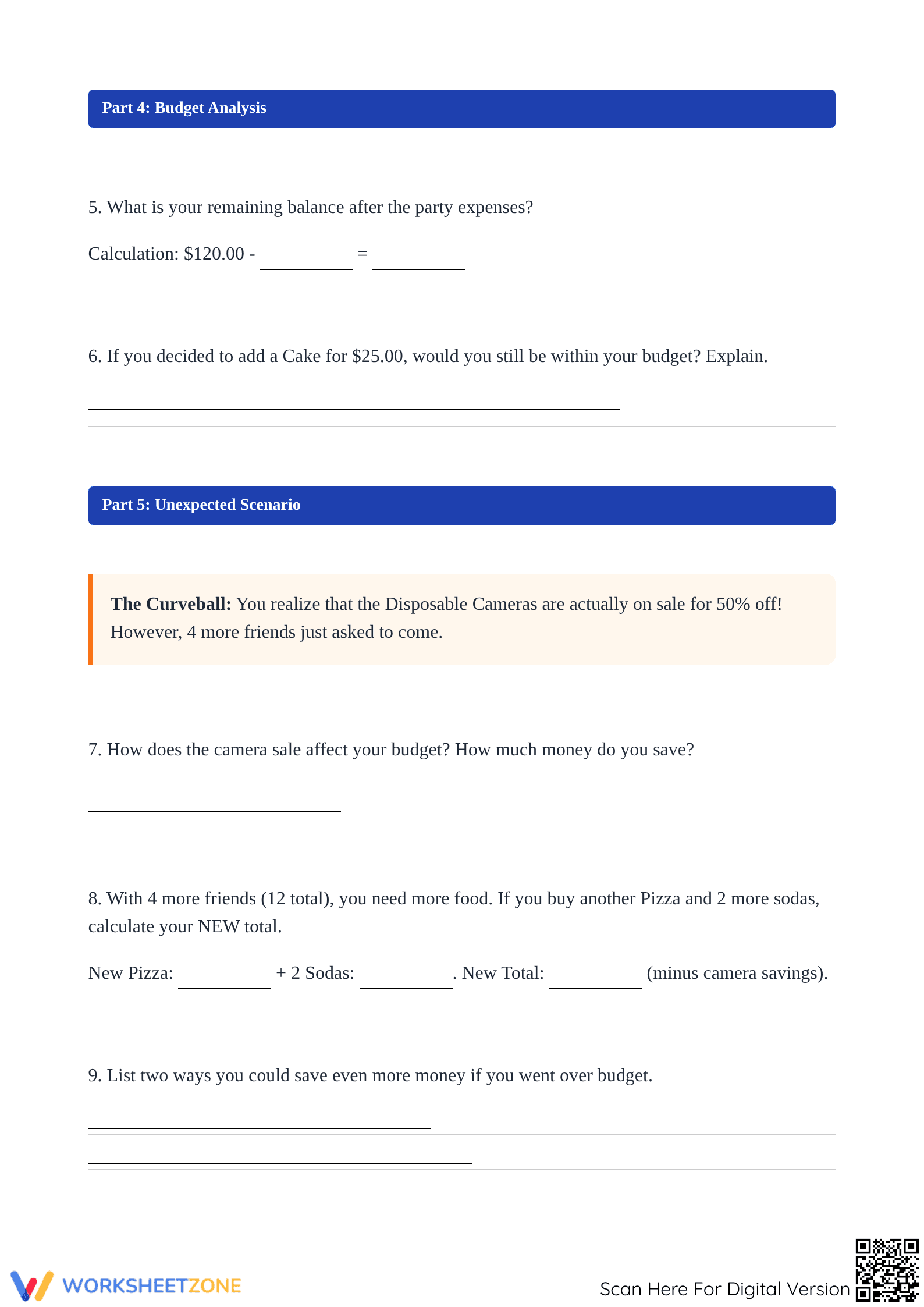
This workshop includes a vocabulary matching section for financial terms, a price catalog for party supplies, and a structured budget planner. The 3-page PDF provides guided calculation fields for sub-totals and an 8% sales tax calculation, followed by a reflection section and a scenario to challenge critical thinking regarding price changes and savings strategies.
Zero-Prep Workflow
Teachers can implement this workshop in three steps. First, Print the 3-page packet for each student, requiring minimal setup. Second, Distribute the materials as a self-contained sub plan or independent project. Finally, Review student work using the provided answer key. This workflow eliminates the need for external research or modeling, saving instructional time while providing high-quality decimal practice.
Standards Alignment
The primary focus is CCSS.MATH.CONTENT.5.NBT.7, which requires students to add and multiply decimals to hundredths. The worksheet also supports CCSS.MATH.CONTENT.6.NS.3 by promoting fluency in multi-digit decimal operations within a financial context. Both standard codes can be copied directly into lesson plans, IEP goals, or district curriculum mapping tools for efficient documentation.
How to Use It
Use this resource as a project after introducing decimal addition or as a sub plan during a financial literacy unit. It works best during the independent practice phase. Teachers should observe students during the tax calculation to identify misconceptions regarding decimal alignment. Expect students to spend 50 minutes completing the scenario, including the reflection questions and the budget analysis.
Who It's For
This activity is designed for 5th, 6th, and 7th-grade students who need concrete applications for decimal arithmetic. It is effective for learners who benefit from scenario-based math. For differentiation, provide calculators to students focusing on budgeting logic, or pair the workshop with a grocery anchor chart to support vocabulary during the matching section.
Research from RAND AIRS (2024) indicates that contextualized math problems, such as budgeting workshops, significantly increase student engagement and retention of decimal arithmetic compared to isolated drill practice. The "Making our Shopping Budget Workshop" aligns with these findings by embedding CCSS.MATH.CONTENT.5.NBT.7 within a relatable $120.00 birthday planning scenario. This approach requires students to perform approximately 24 discrete calculations while navigating real-world constraints like fixed budgets and unexpected sales tax. By integrating financial literacy vocabulary with computation, the worksheet addresses the cognitive demand necessary for decimal fluency. The inclusion of an unexpected scenario supports the higher-order thinking skills identified by NAEP as critical for mathematical proficiency in middle grades. This resource provides a robust, evidence-based tool for teachers seeking to improve mathematical literacy and practical life skills through structured, printable PDF instruction and assessment.


