




























Views
Downloads

Printable Money & Place Value Worksheet | Grade 4 Math

Paste this activity's link or code into your existing LMS (Google Classroom, Canvas, Teams, Schoology, Moodle, etc.).
Students can open and work on the activity right away, with no student login required.
You'll still be able to track student progress and results from your teacher account.
This Grade 4 math worksheet provides targeted practice for students learning to organize currency amounts using decimal place value. By translating written money descriptions into a structured chart, learners build a strong foundation in adding multi-digit numbers and understanding dollars and cents.
At a Glance
- Grade: 4 · Subject: Math
- Standard:
CCSS.MATH.CONTENT.4.MD.A.2— Solve word problems involving money and decimals- Skill Focus: Money and Place Value
- Format: 3 pages · 3 problems · Answer key included · PDF
- Best For: Independent practice and review
- Time: 15–20 minutes
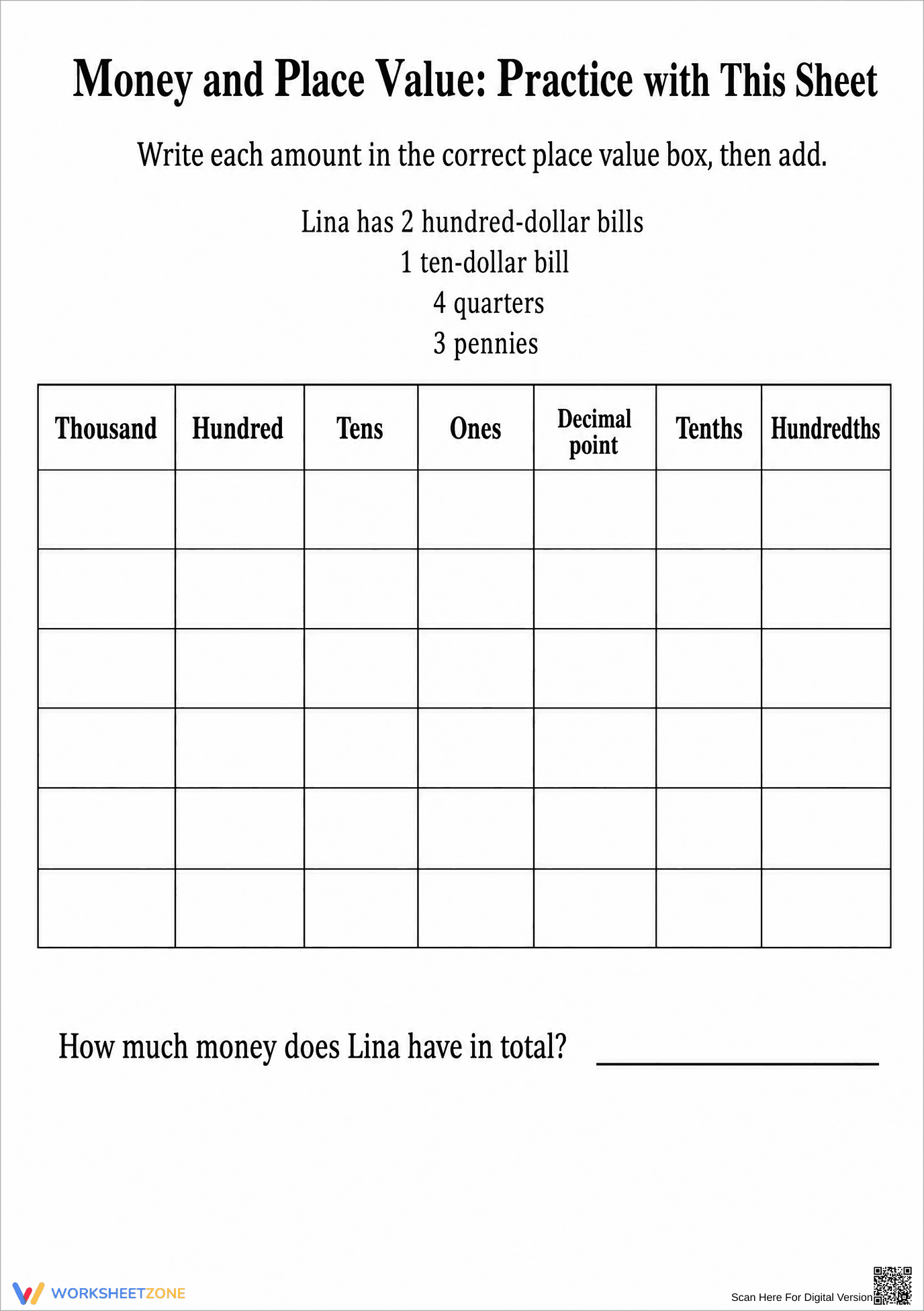
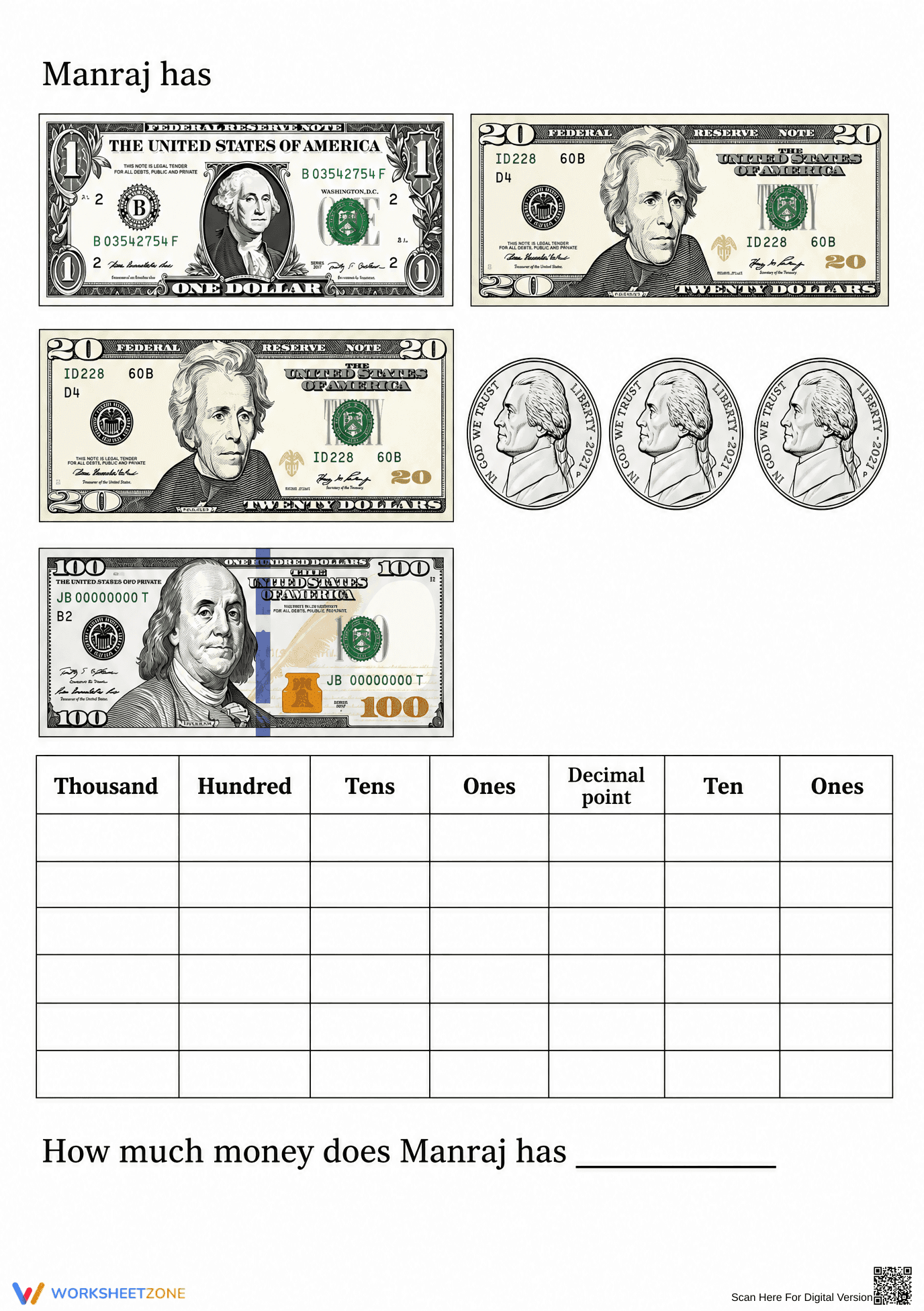
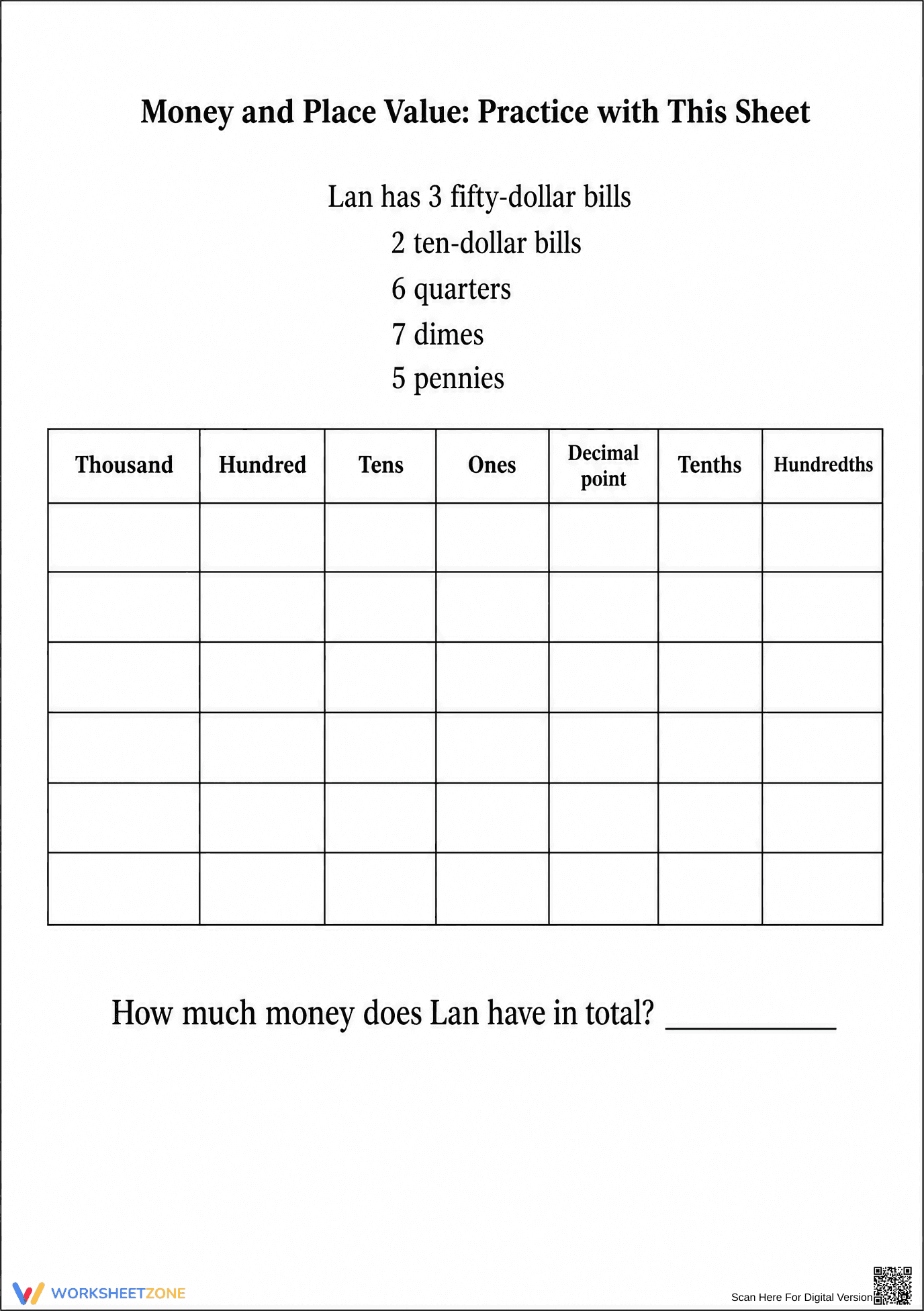
Inside this three-page resource, educators will find three multi-step problems. Each page features a list or visual representation of US currency. Students must categorize these amounts into a place value chart spanning from thousands to hundredths. After organizing the data, students calculate the total sum. A complete answer key is provided.
This worksheet follows a clear skill progression:
- Guided practice: The first page introduces a text-based list of bills and coins for straightforward chart placement.
- Supported practice: The second page incorporates visual currency, requiring identification before sorting.
- Independent practice: The final page combines larger quantities of mixed currency, challenging students to calculate the final total.
This gradual-release approach supports the "I Do, We Do, You Do" instructional model.
This resource is strictly aligned to CCSS.MATH.CONTENT.4.MD.A.2, requiring students to use the four operations to solve word problems involving money, including problems involving simple fractions or decimals. By organizing currency into tenths and hundredths, students reinforce their comprehension of base-ten numeral systems. Both standard codes can be copied directly into lesson plans, IEP goals, or district curriculum mapping tools.
Teachers can deploy this worksheet during independent math centers after direct instruction on decimals and currency. It serves as an excellent formative assessment tool; by observing how students place the "cents" into the tenths and hundredths columns, teachers can quickly identify misconceptions about decimal place value. Alternatively, it works perfectly as a morning work assignment to activate prior knowledge. Students will typically complete the three pages in 15 to 20 minutes.
This printable is ideal for fourth-grade students mastering decimal concepts, as well as third graders needing enrichment or fifth graders requiring foundational review. The visual scaffolds on the second page make it particularly accessible for English Language Learners and visual learners who benefit from seeing the actual currency. It pairs wonderfully with physical money manipulatives or a classroom anchor chart detailing the decimal values of common US coins.
Mastering the alignment of decimals is a critical step in elementary mathematics, particularly when applied to real-world contexts like currency. This resource targets CCSS.MATH.CONTENT.4.MD.A.2, ensuring students can confidently solve word problems involving money and decimals. According to a recent EdReports 2024 analysis, instructional materials that connect abstract place value concepts to tangible items, such as dollars and cents, significantly improve long-term retention and computational fluency. When students physically write amounts into a structured place value chart, they bridge the gap between whole numbers and fractional parts. This structured repetition reduces cognitive load, allowing learners to focus on the accuracy of their addition rather than the abstract nature of the decimals themselves. By integrating these targeted practice sheets into weekly routines, educators provide the exact scaffolding necessary for students to achieve lasting mathematical proficiency.


