


























Views
Downloads

Printable Decimal Place Value Worksheet | Grade 5 Math
Paste this activity's link or code into your existing LMS (Google Classroom, Canvas, Teams, Schoology, Moodle, etc.).
Students can open and work on the activity right away, with no student login required.
You'll still be able to track student progress and results from your teacher account.
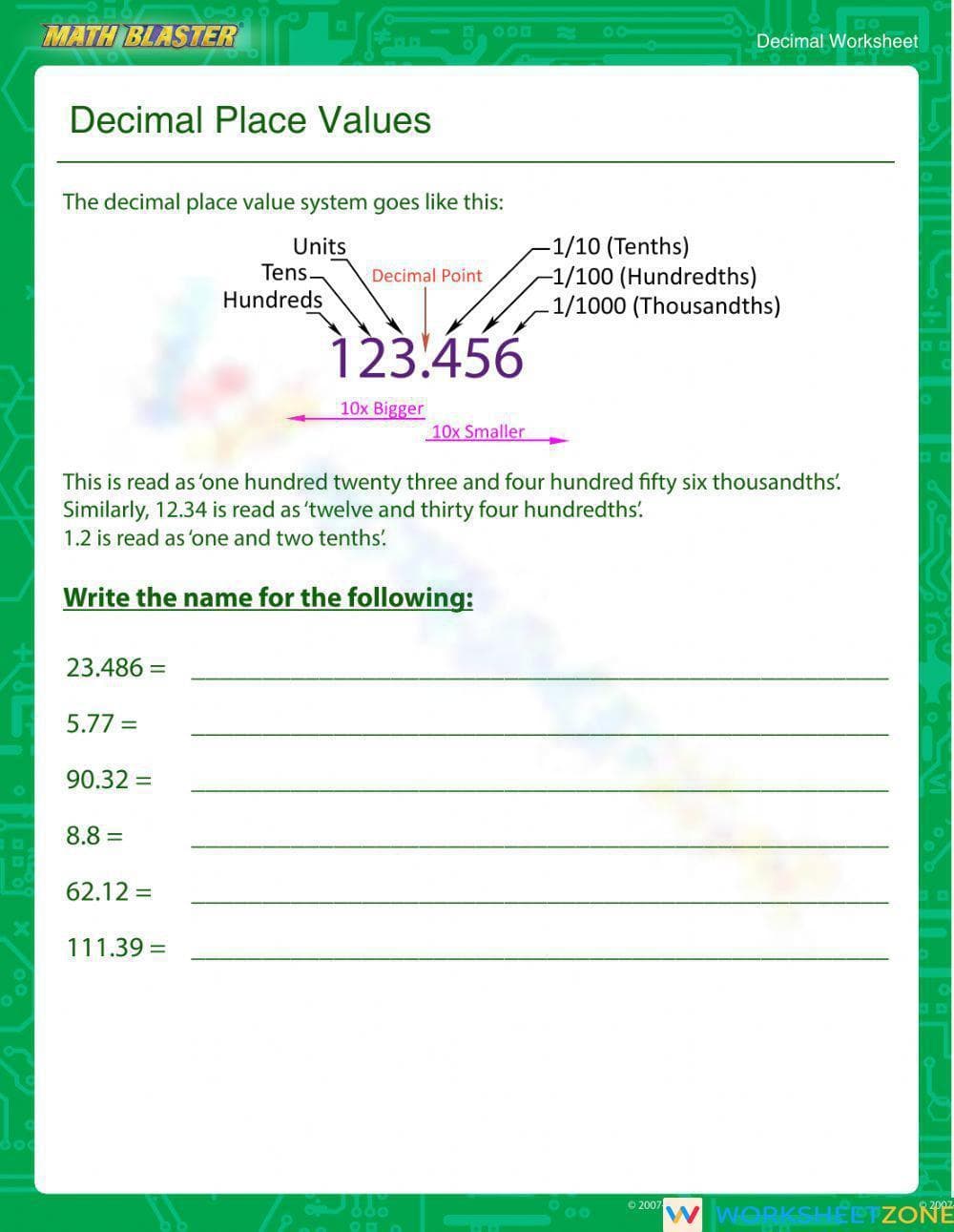
This Grade 5 math worksheet gives students focused practice reading and writing decimals to the thousandths place. By converting between standard numerical form and written word form, learners build a strong foundational understanding of decimal place value necessary for advanced mathematical operations and real-world problem-solving.
At a Glance
- Grade: 5 · Subject: Math
- Standard:
CCSS.MATH.CONTENT.5.NBT.A.3.A— Read and write decimals to thousandths- Skill Focus: Decimal Place Value
- Format: 2 pages · 12 problems · Answer key included · PDF
- Best For: Independent practice and review
- Time: 15–20 minutes
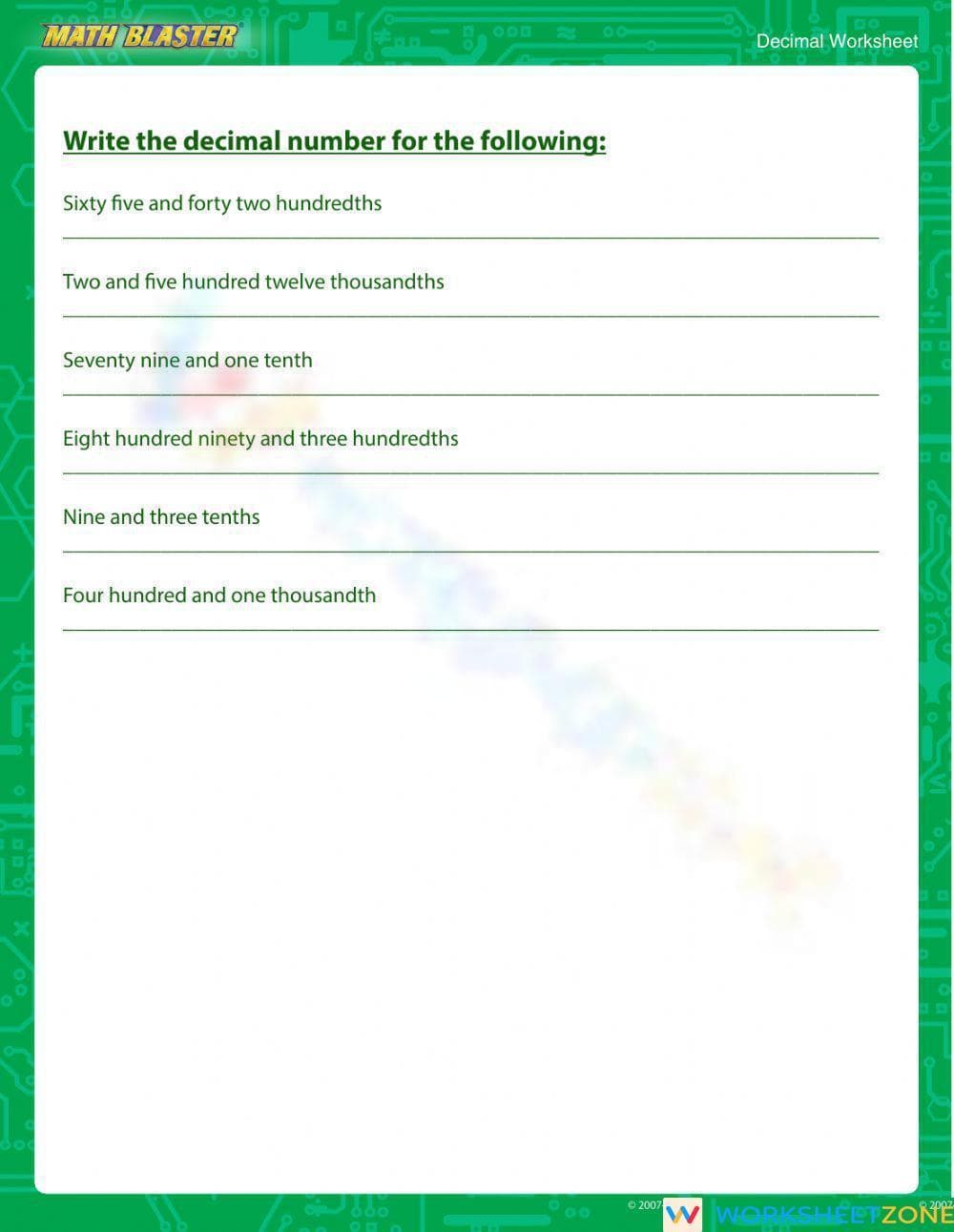
This two-page resource begins with a clear, visual instructional guide explaining the decimal place value system from tens down to thousandths. Following the worked examples, students tackle 12 targeted problems. The first page requires students to write the word names for given decimal numbers, while the second page challenges them to translate written phrases back into standard decimal form.
Zero-Prep Workflow
- Print (1 minute): Download the PDF and print copies for your class. The built-in instructional header means no extra anchor charts are required.
- Distribute (1 minute): Hand out the two-page packet as a standalone assignment, morning work, or emergency sub-plan activity.
- Review (5 minutes): Use the included answer key to quickly grade submissions or guide a whole-class review session.
Total teacher prep time is under two minutes, making this an ideal solution for busy educators needing reliable, ready-to-use materials.
Standards Alignment
Aligned to CCSS.MATH.CONTENT.5.NBT.A.3.A: Read and write decimals to thousandths using base-ten numerals, number names, and expanded form. This activity specifically targets the translation between base-ten numerals and number names. Both standard codes can be copied directly into lesson plans, IEP goals, or district curriculum mapping tools.
How to Use It
Deploy this worksheet immediately after direct instruction on decimal place value to reinforce the connection between spoken words and written digits. It also serves as an excellent formative assessment tool; observe whether students struggle with the placeholder zeros when converting from word form to standard form. Expected completion time is 15 to 20 minutes.
Who It's For
This resource is designed for 5th-grade math students, though it serves as a valuable review for 6th graders needing foundational reinforcement. The visual guide at the top provides built-in scaffolding for English Language Learners and students requiring extra support. Pair this worksheet with a place value anchor chart for maximum impact.
Mastering CCSS.MATH.CONTENT.5.NBT.A.3.A to read and write decimals to thousandths is a critical step in developing mathematical fluency and long-term numerical comprehension. According to EdReports 2024, students who demonstrate a strong conceptual understanding of place value and base-ten systems are significantly more successful when transitioning to complex decimal operations, fraction conversions, and early algebraic reasoning. The ability to accurately translate between standard numerical digits and written word forms solidifies a learner's grasp of fractional parts of a whole. This foundational skill ensures learners can accurately interpret numerical data across various scientific, financial, and real-world contexts. By providing explicit practice with these specific conversions, educators can effectively identify and correct common misconceptions, such as the omission of placeholder zeros, ultimately building a more robust mathematical framework for future academic achievement.


