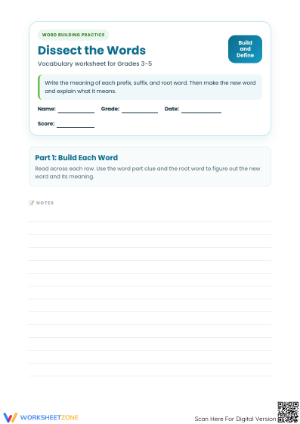
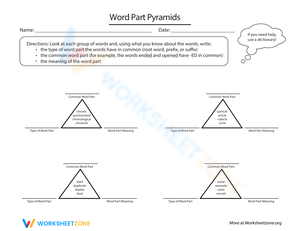
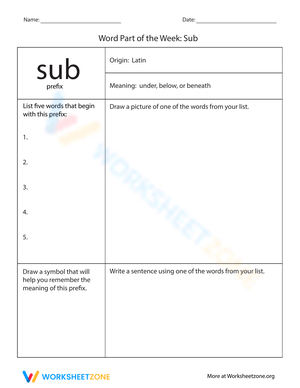
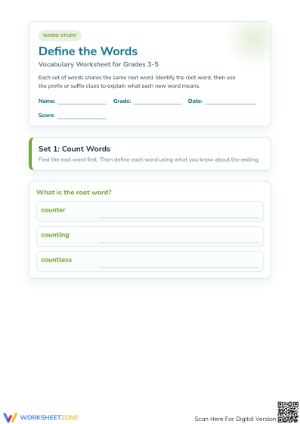
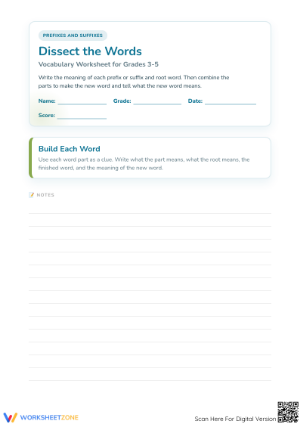
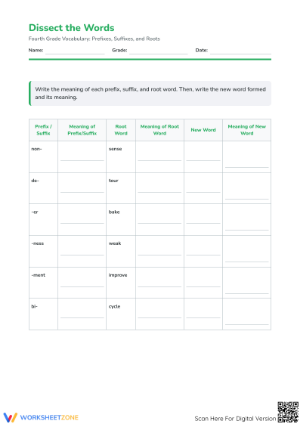
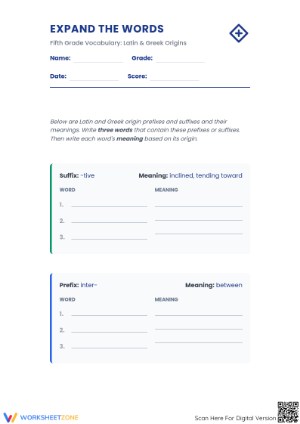
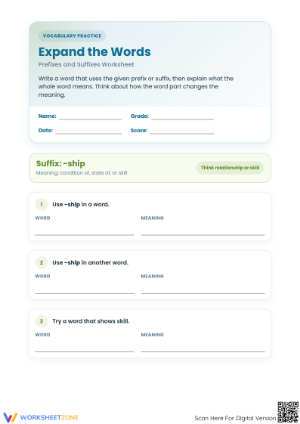
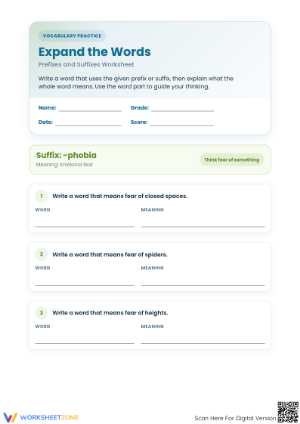
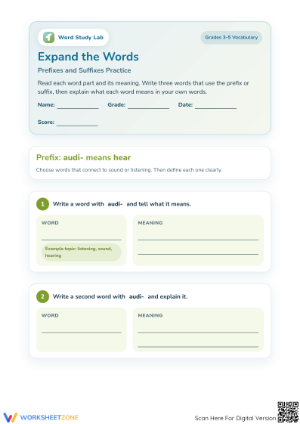
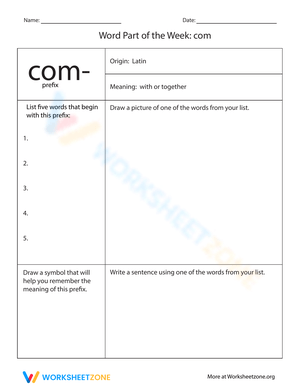
These roots prefixes and suffixes printable worksheets for 5th grade address a specific instructional problem: students at this grade encounter dense academic vocabulary across science, social studies, and literature every week, and they need a reliable word-solving strategy for terms they have never seen. Each worksheet uses a short, repeatable format — locate the word part, map it to meaning, test it against a sentence — that fits into morning work, a center rotation, or a small-group lesson without additional preparation.
What's Inside the Set
Each worksheet keeps the task narrow. Students do not simply circle an affix; they work through a word from its parts to its meaning in context. That sequence reflects the actual cognitive move a strong reader makes when an unfamiliar word appears in a text.
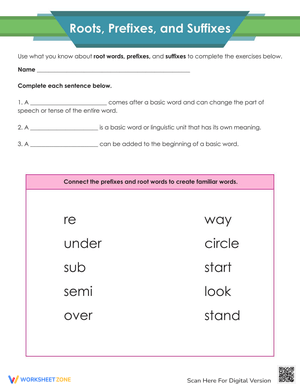
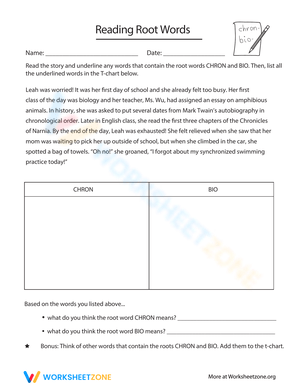
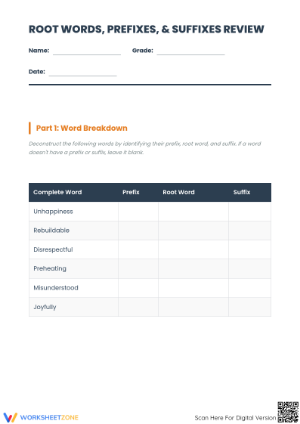
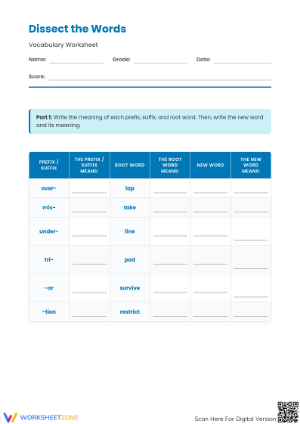
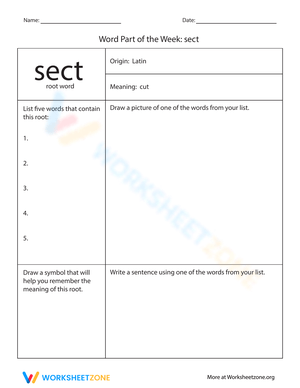
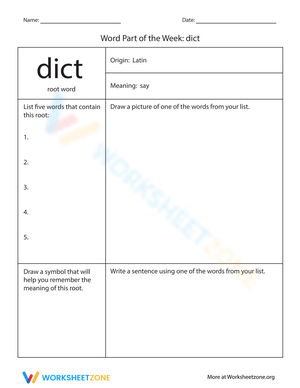
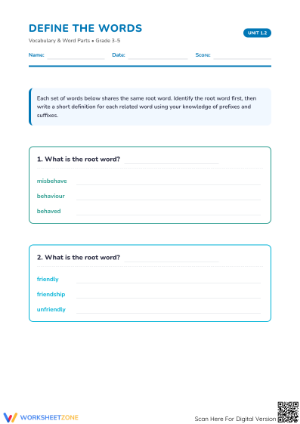
- Locating word parts: Students identify the root, prefix, or suffix inside a multisyllabic word — the kind that appears in a social studies chapter or a science unit, not a controlled decodable text.
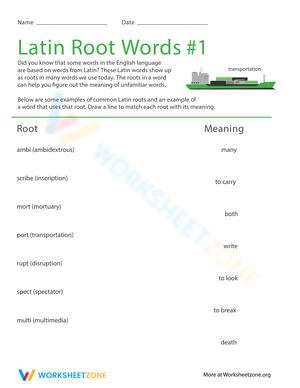
- Mapping meaning: Students connect common Greek and Latin roots and grade-appropriate affixes to short meaning clues, building a mental reference they can apply to new words.
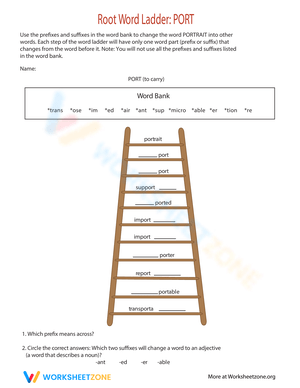
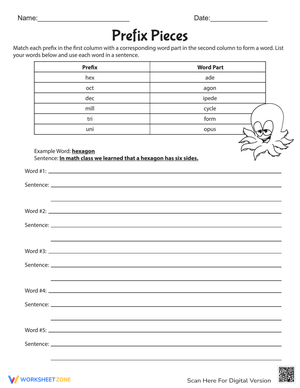
- Building new words: Students combine a base or root with an affix and name how the meaning shifted — a step that requires understanding, not copying.
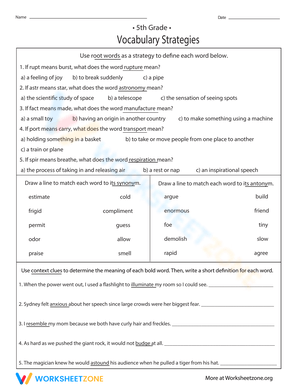
- Testing meaning in context: Students read a sentence and confirm or revise their definition before moving on — the step most morphology worksheets skip entirely.
- Reading longer words fluently: Students break apart multisyllabic words such as transportation or geography into recognizable chunks, which supports both accuracy and comprehension.
That last skill deserves separate attention. Morphology instruction at this grade level does double work: it builds vocabulary and it builds decoding. A student who spots "bio" + "graph" + "y" inside biography reads the word more accurately and interprets it faster than one who encounters those nine letters as a single opaque unit.
Where Students Go Wrong With Word Parts
The most persistent error is prefix-meaning overgeneralization. Students learn that "pre-" means before and then write that preview means "to see again" — conflating it with "re-," which they learned in the same unit. Both prefixes are introduced close together, and students store them loosely rather than distinctly. A worksheet that puts both in the same exercise without explicitly contrasting direction versus repetition reinforces the confusion rather than corrects it.
A second pattern appears with Latin roots that surface across multiple words. Students learn "port" means carry, handle transport correctly, then arrive at import and write "to carry badly" — mixing up the prefix "im-" (meaning in or into) with the negative "im-" they know from impossible. The same two letters carry two completely different functions depending on the word, and fifth graders do not always have enough exposure to separate them reliably. Each worksheet in a strong set requires students to check meaning against a context sentence, which catches this error in a way that matching tasks alone cannot.
Standard Alignment
These worksheets address CCSS ELA-Literacy L.5.4.b, which requires Grade 5 students to use Greek and Latin affixes and roots as clues to the meanings of unfamiliar words. In lesson-planning terms, that places morphology practice inside the core ELA block as a direct language standard — not a peripheral enrichment activity. The set also supports CCSS ELA-Literacy RF.5.3, which covers reading multisyllabic words accurately by applying knowledge of morphemes and syllable patterns. That pairing — L.5.4.b for meaning and RF.5.3 for decoding — is precisely why roots prefixes and suffixes printable worksheets for 5th grade serve vocabulary instruction and word-reading fluency within the same short exercise.
Where These Worksheets Fit in the Literacy Block
The most practical model is a short, predictable routine rather than a stand-alone lesson. Opening the literacy block with five to seven minutes of morphology work — before the read-aloud, before close reading — keeps the practice consistent without competing with core instruction. The cumulative effect over several weeks is where the real transfer happens; a single lesson in isolation is not enough.
- Morning work: A root-focused worksheet reactivates vocabulary knowledge and frames the word-meaning work before content reading begins.
- Small-group intervention: Assign a worksheet targeting the specific prefix or suffix your group missed during the week's reading. A set built around eight to twelve related words produces better transfer than a mixed-review format with twenty unrelated examples — students see the pattern repeat instead of memorizing individual answers.
- Centers: Partners complete each worksheet independently, then compare and defend their word-meaning choices — a low-prep discussion that adds accountability without extra materials.
- Exit check: Three or four items from a worksheet give quick formative data on whether a student is applying a word-structure strategy or guessing from context alone.
- Sub plans: Focused, self-explanatory worksheets hold up during independent work periods when a substitute needs something directly connected to current ELA standards.
A consistent student routine, repeated across roots prefixes and suffixes printable worksheets for 5th grade throughout the week, reduces the mental overhead of getting started. Ask students to underline the root, box any affix, state a possible meaning, and then read the sentence to confirm. When that four-step sequence repeats, students stop spending attention on figuring out what to do and direct it toward the word itself — which is exactly where the learning happens.
Supporting Different Learners With the Same Format
When teachers first distribute roots prefixes and suffixes printable worksheets for 5th grade across a mixed-ability class, the instinct is often to assign the same worksheet to everyone and move on. A more targeted approach is to sort available worksheets by skill demand and route students based on what the last formative check revealed — which affixes they recognize, which roots remain unfamiliar, and whether their errors are meaning-based or decoding-based.
Students still gaining confidence with word parts work most effectively starting with affixes they have already met in context — "pre-," "re-," "un-" — applied to familiar base words before abstract Greek or Latin roots enter the picture. For those students, glossing the root in brackets (e.g., port — carry) and asking them to focus on what the affix contributes keeps the demand manageable without removing the thinking entirely.
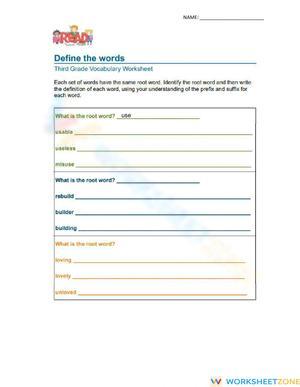
Students ready for more challenge complete each worksheet and take one additional step: write a second word that shares the same root and explain how both words connect to the same core meaning. A student who finishes transportation, independently adds portable and export, and traces all three back to "port = carry" is building the kind of generative vocabulary knowledge that transfers into independent reading and academic writing at the middle school level. The same worksheet, one extra prompt — no separate materials required.
Frequently Asked Questions
What should 5th graders be able to do with roots, prefixes, and suffixes?
By fifth grade, students should move past labeling word parts and into applying them during actual reading. They should identify common Greek and Latin roots, connect grade-appropriate affixes to their meanings, and use that analysis to work out unfamiliar words in context. The target is word-structure analysis as a first strategy — not a fallback after guessing fails.
How do these worksheets connect to Common Core standards?
They directly address CCSS ELA-Literacy L.5.4.b — using affixes and roots as clues to meaning — and support CCSS ELA-Literacy RF.5.3 when students decode multisyllabic words by breaking them into recognizable parts. Both standards are in play every time a student meets an unfamiliar academic term in a content-area passage.
Can these worksheets work for students who are below grade level?
Yes, with a targeted adjustment. Students working below grade level often understand a word in conversation but cannot decode its written form or name its structure. Starting with a word they already know and asking them to find and name its parts reverses the usual direction — from meaning to structure rather than structure to meaning — without requiring them to process new vocabulary and new structural analysis at the same time.
What is the best way to use these worksheets as a formative check?
A completed worksheet reveals whether a student is applying a morpheme strategy or relying on context clues. Pay close attention to items where the sentence meaning would function even without understanding the word part: if a student answers those correctly but stumbles when the root is the only reliable clue, the root knowledge is shallower than their context-reading skill. That distinction tells you exactly what to address in the next small-group session.












 Interactive Worksheet Maker
 Quiz Maker
 Word Search Maker
 Crossword Puzzle Maker
 Word Scramble Generator
 Sentence Scramble Generator
 Handwriting Worksheet Generator
 Name Tracing Generator
 Fill In The Blank Generator