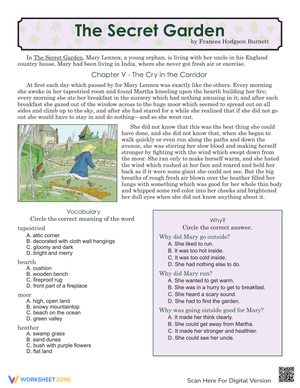
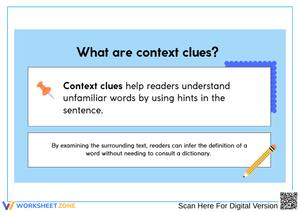
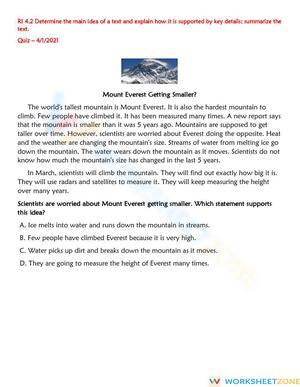
These 5th grade context clues printable worksheets resources put five clue types into sentence and short-passage formats, giving teachers focused, no-prep practice that fits bell ringers, small-group reteaching, or Friday review blocks equally well. Each worksheet targets a specific reading vocabulary skill — but the set builds across them so students move from isolating clues in single sentences to tracking meaning across a paragraph.
The Specific Skills Targeted
Each worksheet works with one of five clue types: definition, synonym, antonym, example, and inference. That breakdown matters at Grade 5 because academic vocabulary in science and social studies rarely announces itself with a tidy signal word — students need to read flexibly and use whatever the surrounding text offers. Several items on each worksheet ask students not just to choose an answer but to underline the clue that led them there. That annotation step is what separates genuine strategy use from educated guessing.
- Definition clues — students locate an embedded explanation and paraphrase it in their own words.
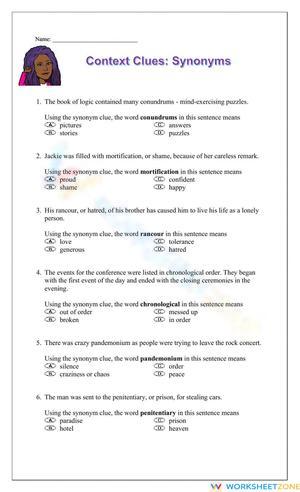
- Synonym clues — students connect an unfamiliar word to a familiar near-synonym earlier or later in the sentence.
- Antonym clues — students work backward from a contrast signal, such as unlike, however, or on the other hand.
- Example clues — students infer meaning from a list or illustration the author provides within the sentence.
- Inference clues — students combine tone, topic, and multiple sentence hints without any single marker pointing the way.
Sentence-level items appear first in each worksheet because they reduce the reading load while the strategy is still forming. Short-passage items follow, asking students to hold more information in mind before settling on a meaning. That progression mirrors how most teachers actually sequence the skill in a literacy block — not because it's theoretically tidy, but because it works in practice.
Frequent Student Errors Worth Watching For
The most persistent problem at this grade level isn't that students ignore context — it's that they stop reading too early. A student will fix on one word near the target, decide it resembles a synonym, and mark an answer without finishing the sentence. This shows up most often with inference clues, where the actual meaning only resolves across two or three sentences. A student who reads "The scientist was tenacious" and spots "determined" one line later may circle it without noticing that the following sentence introduces a contrast that narrows the meaning further. The annotation requirement in these worksheets makes that premature stopping visible.
Antonym items produce a different, more specific error: students identify the contrast correctly but apply it to the wrong referent. In the sentence "Unlike her loquacious older brother, Mia spoke only when necessary," students who recognize the antonym relationship will sometimes choose "talkative" — which describes the brother — rather than its opposite. They've understood the structure but assigned the meaning to the wrong person. Written work catches this; the clue-naming step on these worksheets surfaces it in a way that a simple multiple-choice format would not.
How to Work These Worksheets Into Your Week
The most efficient pattern is a short daily rotation across Monday through Thursday. Model definition and synonym clues on Monday during whole-group instruction, then send students through the relevant worksheet independently. Shift to antonym and example clues by Wednesday. On Friday, the mixed-review worksheet functions as a genuine formative check rather than a grade — scanning it takes about five minutes and tells you exactly which clue type the class hasn't internalized yet.
For literacy centers, one worksheet at the context clues station works cleanly because the directions are explicit and the task is self-contained. Students who finish early can write a new sentence using the target word — that extension adds a productive vocabulary transfer step without any additional prep. For substitute plans, any worksheet in this set drops in without requiring students to know your classroom routines first.
These 5th grade context clues printable worksheets resources also hold up well as homework when the timing is right. Sending an inference or example clue worksheet home after the lesson — not before — gives students a chance to practice while the strategy is still fresh. Spacing the same skill across several short sessions beats assigning the same clue type twice in one sitting for retention.
Standard Alignment
Each worksheet in this set aligns to CCSS.ELA-LITERACY.L.5.4a, the Grade 5 language standard that asks students to use context as a clue to the meaning of a word or phrase. That standard functions as much as a reading comprehension support as a language skill — students who can resolve unfamiliar vocabulary through surrounding text read more fluently in content-area subjects and retain more from the passages they encounter. Because L.5.4a is explicitly assessed on most state reading tests at Grade 5, consistent practice with 5th grade context clues printable worksheets resources counts simultaneously as core skills instruction and assessment preparation, without any artificial mapping required. Teachers building out an L.5 unit will find these worksheets integrate directly into their language block.
Adapting the Set for Mixed-Ability Classrooms
For students who need more support, reduce the number of items per session rather than replacing academic vocabulary with simpler words — doing the latter defeats the purpose. Instead, have students annotate sentence by sentence before answering: circle every word they recognize, bracket the unfamiliar word, then search between those brackets and the rest of the sentence for signal language. That step-by-step process moves the thinking onto the paper where you can observe it and respond to it specifically.
For stronger readers, the same 5th grade context clues printable worksheets set extends well with one added demand: after completing each passage item, students write a second sentence using the target word in a completely different context. This transfer task is harder than it looks. Students who correctly inferred "benevolent" from a story about a kind doctor will sometimes write "She was benevolent and liked dogs," which signals they know the word is positive but haven't fully absorbed its meaning. Requiring a specific, concrete second sentence surfaces those partial understandings more reliably than a follow-up multiple-choice item would.
Frequently Asked Questions
Which clue types do these worksheets cover?
The set covers five types: definition, synonym, antonym, example, and inference. Some worksheets focus on a single type for targeted practice; others mix types for review. Inference clues are the most demanding and appear most often in passage-level items rather than isolated sentences, which reflects how students actually encounter them in classroom reading.
How do these worksheets connect to Common Core standards?
They align directly to L.5.4a, which asks fifth graders to use context as a clue to word meaning. Because that standard is also assessed on state reading tests, teachers can use these worksheets for direct instruction, targeted review, or pre-assessment preparation — all within the same skill target — without treating vocabulary practice as time taken away from test readiness.
Can the set work for small-group intervention, not just whole-class use?
Yes. Sentence-level worksheets suit small-group intervention particularly well because they give teachers a short, focused task to work through aloud. The most effective move in that setting is to have students explain their reasoning after each item before you confirm or redirect. What a student says out loud often reveals confusion that the written answer alone does not — especially with inference and antonym items.
Are answer keys included with the set?
Answer keys are included and support both teacher grading and student self-check during independent practice. When used for self-check, asking students to correct their own work and write down the clue type they missed on each wrong answer turns the key into a reflection step. That small addition tends to produce more careful second reads than simply marking items wrong and moving on.












 Interactive Worksheet Maker
 Quiz Maker
 Word Search Maker
 Crossword Puzzle Maker
 Word Scramble Generator
 Sentence Scramble Generator
 Handwriting Worksheet Generator
 Name Tracing Generator
 Fill In The Blank Generator