


























Views
Downloads

Printable Prefix and Suffix Worksheet | Grades 3-5 ELA
Paste this activity's link or code into your existing LMS (Google Classroom, Canvas, Teams, Schoology, Moodle, etc.).
Students can open and work on the activity right away, with no student login required.
You'll still be able to track student progress and results from your teacher account.
This morphology worksheet helps upper elementary students decode complex vocabulary by breaking words into their core components. By isolating prefixes, suffixes, and root words, learners develop a systematic approach to word analysis that improves reading comprehension and spelling accuracy. Students will build a strong foundation in structural analysis through direct practice.
At a Glance
- Grade: 3–5 · Subject: ELA
- Standard:
CCSS.ELA-LITERACY.L.4.4.B— Use roots and affixes to determine the meaning of unknown words- Skill Focus: Morphology & Structural Analysis
- Format: 2 pages · 27 tasks · Answer key included · PDF
- Best For: Vocabulary centers or independent practice
- Time: 20–30 minutes
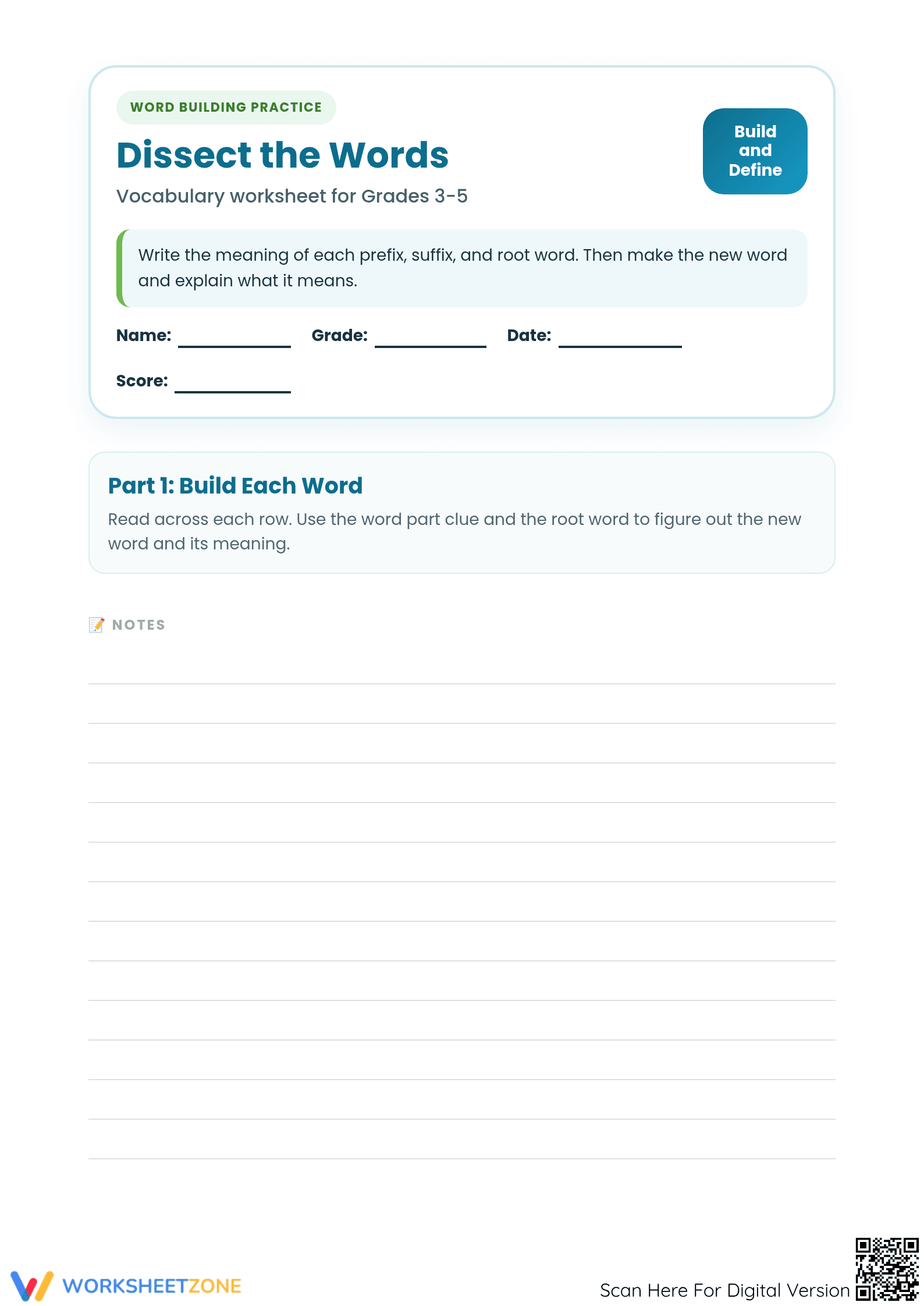
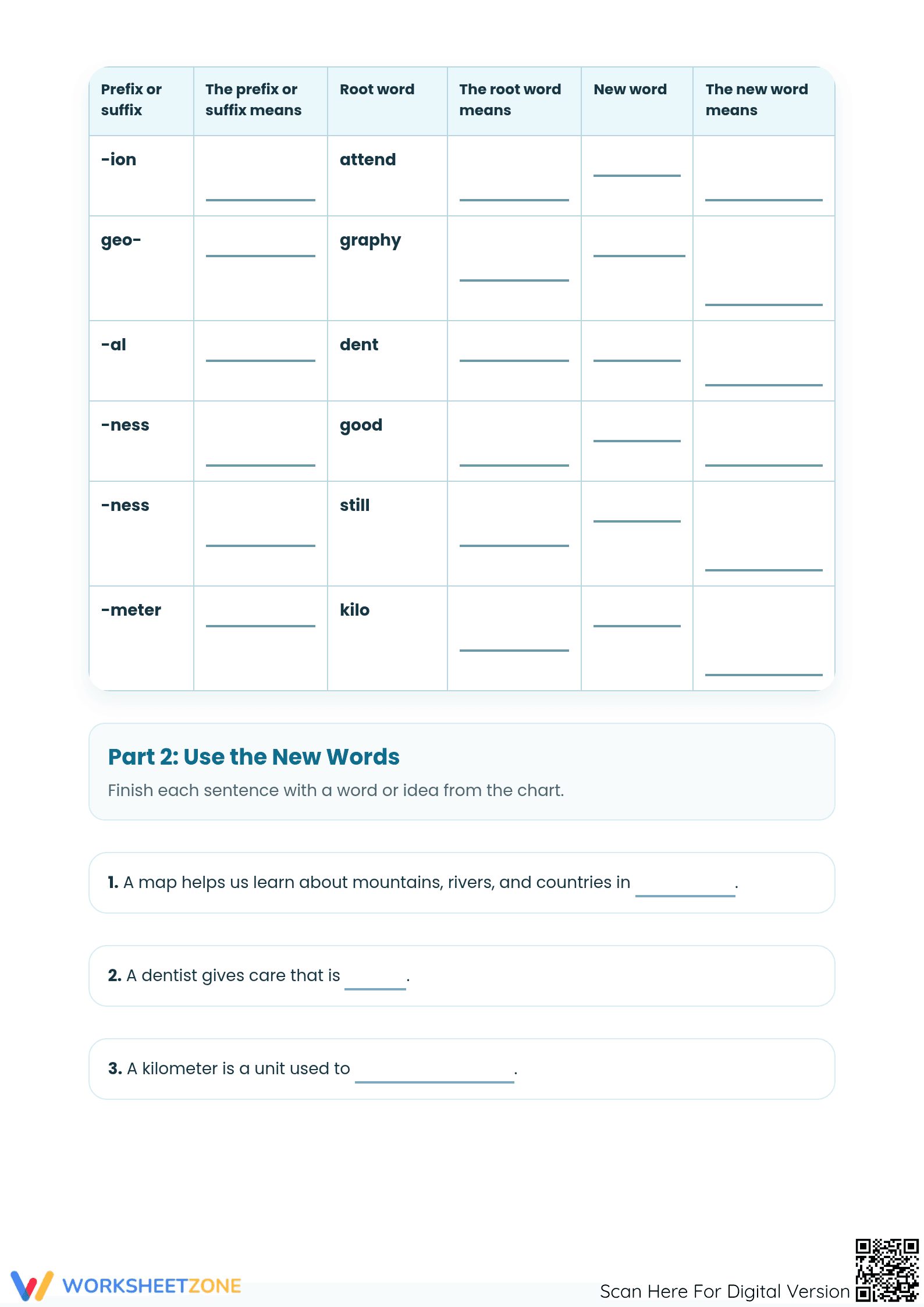
This two-page resource features a detailed word-dissection table and a sentence-level application section. The first page provides a dedicated workspace for notes, while the second page contains the core assessment. Students encounter six distinct words requiring them to define the affix, define the root, combine the parts, and explain the resulting meaning. It includes a full answer key for teacher use.
- Guided Practice: The worksheet begins by providing the specific prefix or suffix (e.g., -ion, geo-) and the corresponding root word, reducing cognitive load during the initial identification phase.
- Supported Practice: Students then transition to defining each part individually, requiring them to access their prior knowledge of morphemes to explain how word parts function.
- Independent Practice: Finally, students synthesize their findings by constructing the full word and applying it to three context-based sentences. This follows a gradual-release model of "I Do, We Do, You Do" to ensure mastery.
The primary focus is `CCSS.ELA-LITERACY.L.4.4.B`, which tasks students with using common, grade-appropriate Greek and Latin affixes and roots as clues to the meaning of a word. By explicitly defining "geo-" or "-ness," students demonstrate an understanding of how these units alter the base word's semantic value. This standard code can be copied directly into lesson plans or IEP goals.
Use this worksheet as a summative assessment after a unit on Greek and Latin roots to verify student retention. Alternatively, assign it during a literacy rotation where students use dictionaries or morphology posters to verify their definitions. Observe if students can correctly identify how the suffix "-ness" transforms an adjective into a noun as a key formative checkpoint.
This resource is designed for students in grades 3 through 5, particularly those struggling with multisyllabic word decoding. It serves as an excellent scaffold for English Language Learners (ELLs) who benefit from seeing the internal logic of English word construction. Pair this worksheet with a root-word anchor chart for maximum instructional impact.
Research by Fisher & Frey (2014) emphasizes that explicit instruction in morphology is a powerful tool for vocabulary acquisition in the upper elementary grades. By teaching students to recognize and manipulate morphemes, teachers provide them with a generative skill that allows them to decode the meaning of thousands of words they have not yet encountered. This worksheet directly implements these findings by requiring students to perform the cognitive heavy lifting of dissecting and reassembling words. Aligned to standard CCSS.ELA-LITERACY.L.4.4.B, the activity focuses on the plain-English skill of using roots and affixes as semantic clues. Systematic practice with structural analysis, as seen in these 27 tasks, bridges the gap between simple decoding and deep reading comprehension. Such evidence-based strategies are essential for developing the cognitive flexibility required for academic literacy success across various disciplines and complex text types.


