


























Views
Downloads

Expand the Words: Essential Affixes Worksheet | Grade 4
Paste this activity's link or code into your existing LMS (Google Classroom, Canvas, Teams, Schoology, Moodle, etc.).
Students can open and work on the activity right away, with no student login required.
You'll still be able to track student progress and results from your teacher account.
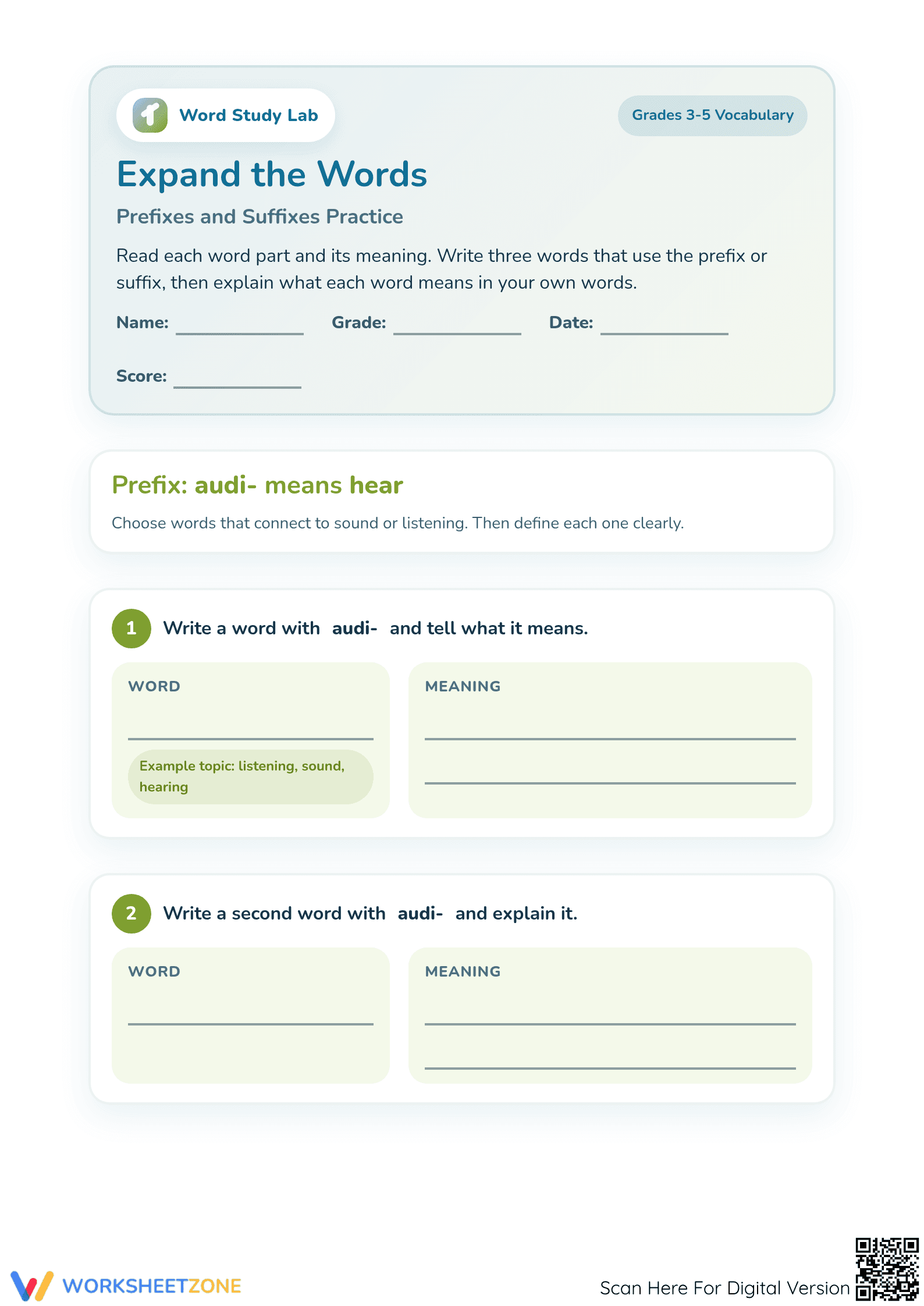
Master word building with this comprehensive word study laboratory. This worksheet helps Grade 4 students decode complex multisyllabic words by focusing on high-frequency Greek and Latin affixes. By identifying roots like "audi," "port," and "spect," learners develop the essential morphological awareness needed to improve reading comprehension and broaden their academic lexicon across all core subjects.
At a Glance
- Grade: 4 · Subject: English Language Arts
- Standard:
CCSS.ELA-LITERACY.L.4.4.B— Use common Greek and Latin affixes and roots as clues to word meaning- Skill Focus: Morphology & Root Word Analysis
- Format: 4 pages · 9 problems · Answer key included · PDF
- Best For: Vocabulary expansion and morphological practice
- Time: 25–35 minutes
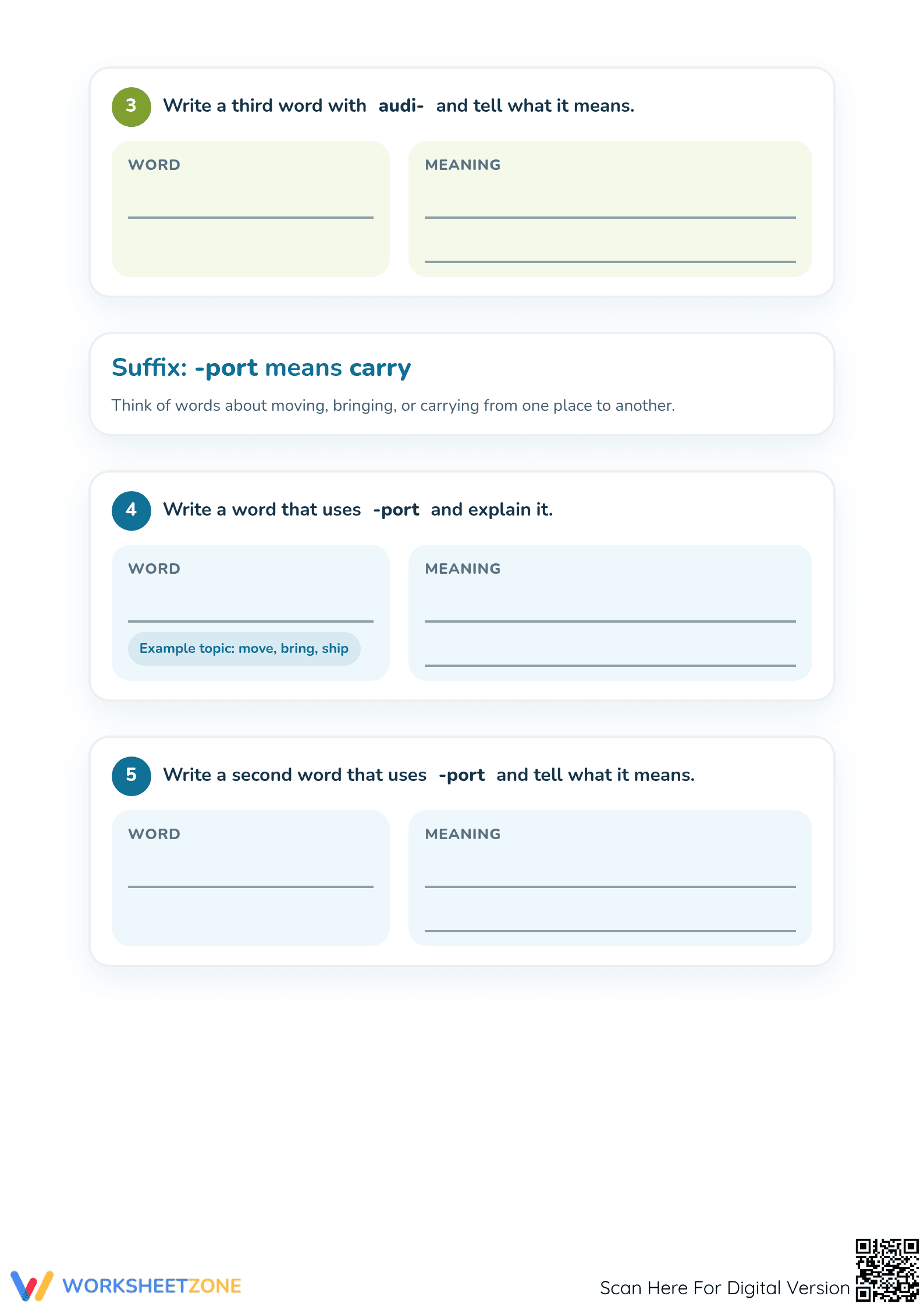
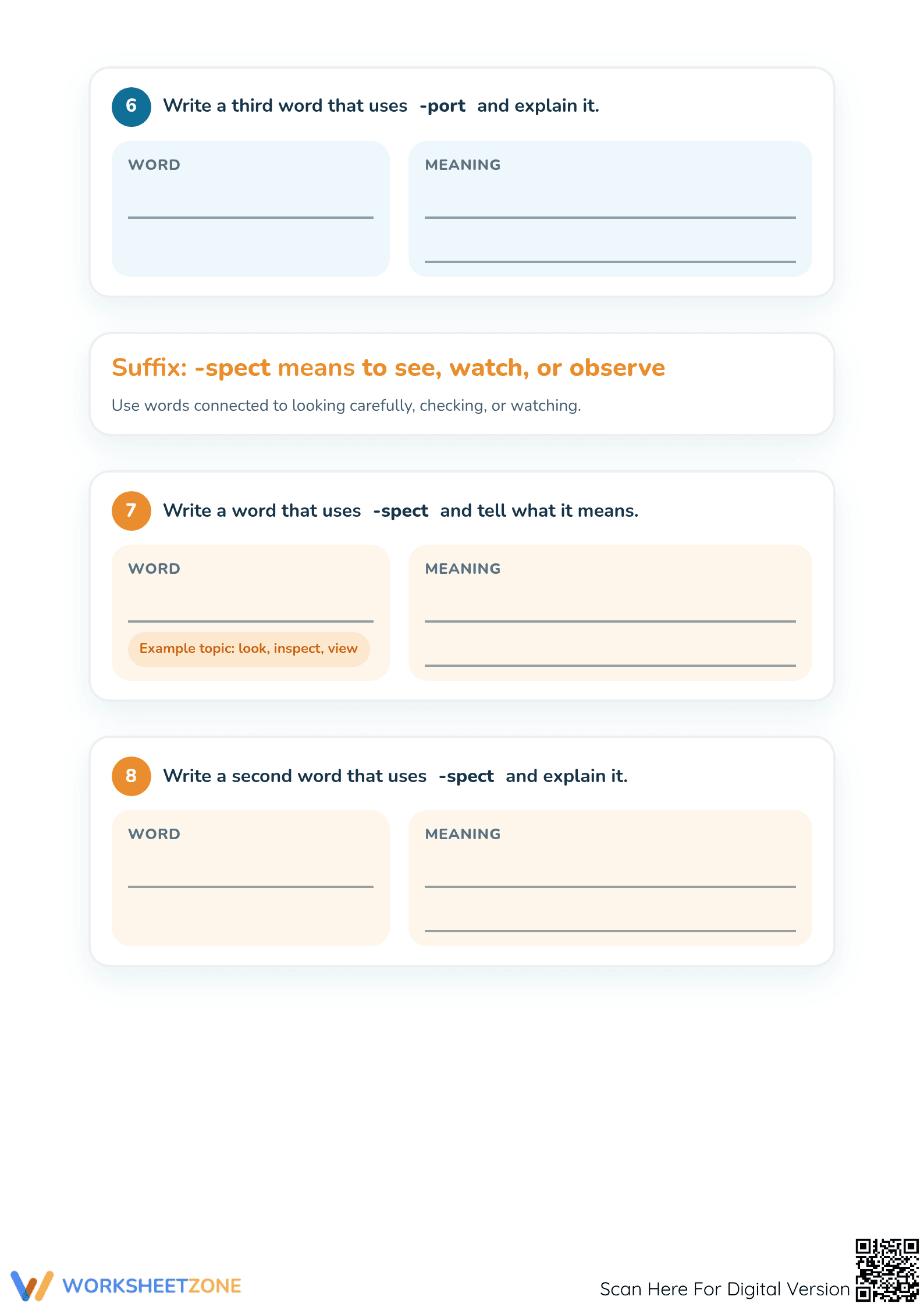
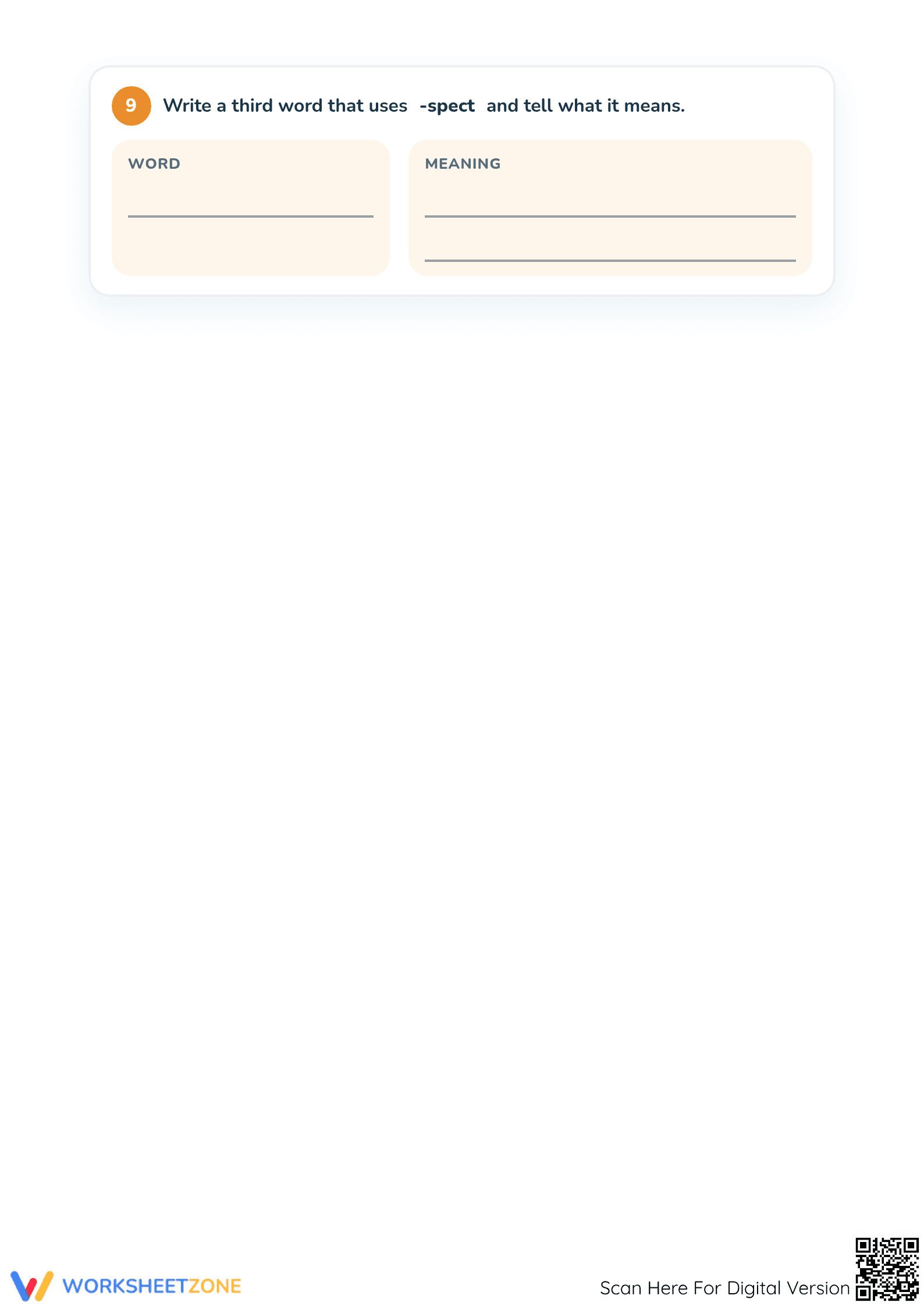
This four-page PDF resource provides a structured environment for linguistic exploration. Each page introduces a specific affix—prefix "audi-", suffix "-port", and suffix "-spect"—with clear definitions and example topics. Students are tasked with writing three unique words for each affix and explaining their meanings in their own words, fostering deep conceptual understanding through active generation.
Skill Progression
- Guided Practice: The worksheet begins with the "audi-" prefix, providing explicit definitions and a dedicated "Example topic" box (listening, sound, hearing) to ground initial word choices.
- Supported Practice: Moving to "-port" and "-spect," scaffolds remain with topical hints (move, bring, ship; look, inspect, view), allowing students to apply rules to five additional tasks.
- Independent Practice: Final tasks require students to synthesize knowledge of the "-spect" suffix without immediate cues, completing the 9-problem set to demonstrate mastery.
This resource follows a gradual-release model, moving from teacher-led introduction to student-driven definition and application.
Standards Alignment
This resource is meticulously aligned to CCSS.ELA-LITERACY.L.4.4.B, which requires students to use common, grade-appropriate Greek and Latin affixes and roots as clues to the meaning of a word. By focusing on the structural components of words, students build a transferable skill set that applies to thousands of academic terms. This standard code can be copied directly into lesson plans, IEP goals, or district curriculum mapping tools.
How to Use It
Use this as a mid-lesson formative assessment after introducing the concept of Greek and Latin roots. As students work through the "Meaning" columns, teachers can circulate to observe if students are correctly integrating the root definition into their own explanations—a key indicator of conceptual mastery. Expect completion in approximately 30 minutes, making it an ideal anchor activity for literacy centers or independent work blocks.
Who It's For
This worksheet is designed for Grade 4 students who are transitioning from simple word recognition to advanced decoding. It is particularly effective for English Language Learners (ELLs) who benefit from seeing how word families are constructed logically. Pair this with a root word anchor chart or a dictionary for students who need additional support in finding authentic word examples.
Morphological awareness is a critical predictor of literacy success in upper elementary grades, as academic texts rely heavily on complex multisyllabic words. Research by Fisher & Frey (2014) on the gradual release of responsibility highlights that structured practice in word-building allows students to internalize the logic of the English language efficiently. This worksheet directly addresses the CCSS.ELA-LITERACY.L.4.4.B standard by providing nine targeted opportunities to apply affix-based clues to word meanings. By moving from the "audi-" prefix to the "-port" and "-spect" suffixes, the resource ensures that students identify patterns across different word parts. This morphological focus helps bridge the gap between basic phonics and advanced reading fluency. Educators can use these tasks to verify that students are not merely memorizing words but are developing a functional toolkit for linguistic analysis that will serve them across the secondary curriculum and into higher-level academic writing.


