


























Views
Downloads

Essential Root Words and Affixes Worksheet | Grades 3-5
Paste this activity's link or code into your existing LMS (Google Classroom, Canvas, Teams, Schoology, Moodle, etc.).
Students can open and work on the activity right away, with no student login required.
You'll still be able to track student progress and results from your teacher account.
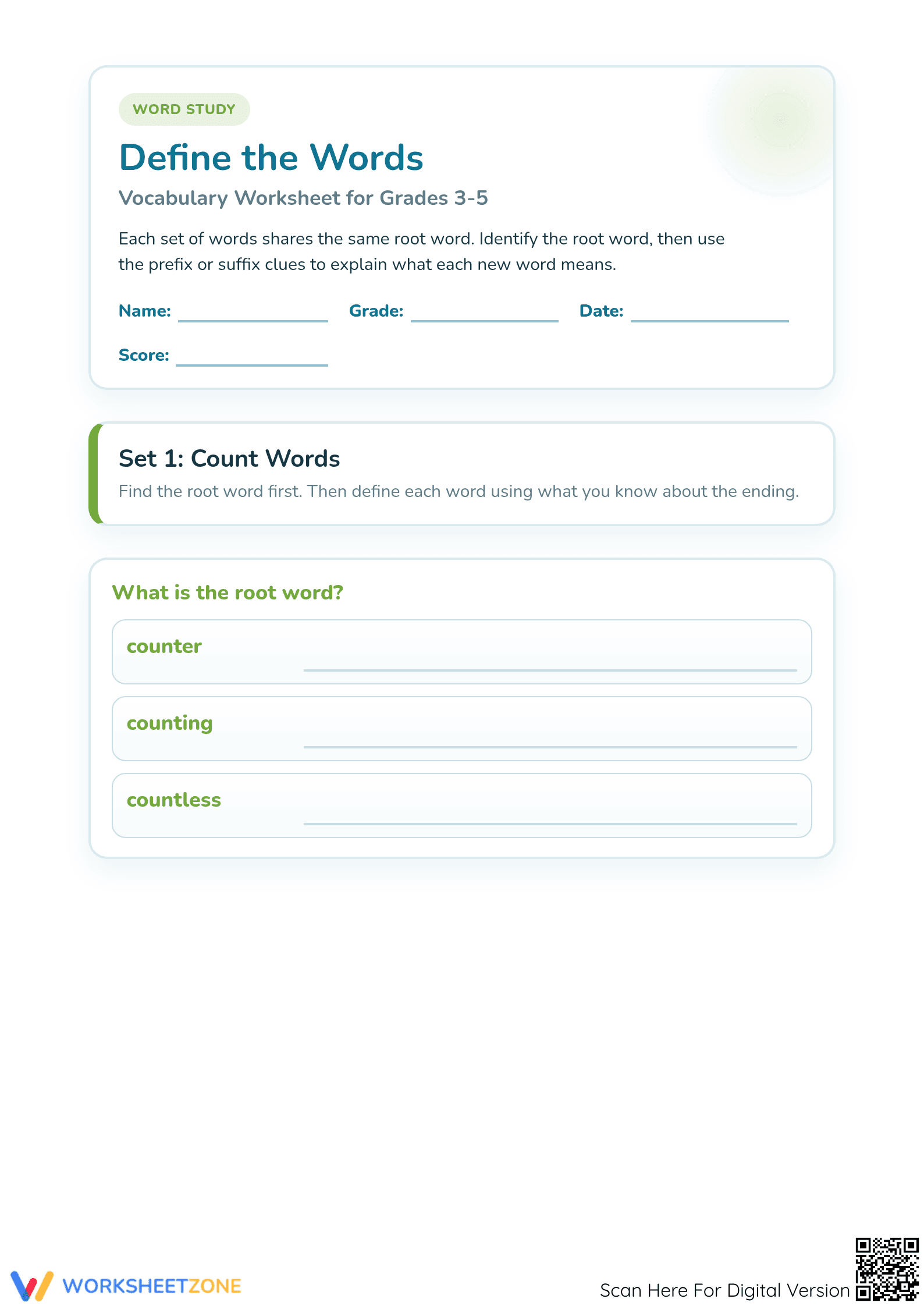
This vocabulary worksheet helps students in grades 3 through 5 master morphology by identifying root words and determining how prefixes and suffixes alter meaning. By breaking down complex terms into their constituent parts, learners build the analytical skills necessary for high-level reading comprehension and linguistic precision across the curriculum.
At a Glance
- Grade: 3–5 · Subject: ELA
- Standard:
CCSS.ELA-LITERACY.L.4.4.b— Use grade-appropriate affixes and roots as clues to word meanings- Skill Focus: Root word identification and affix analysis
- Format: 2 pages · 9 problems · Answer key included · PDF
- Best For: Vocabulary building and independent practice
- Time: 15–20 minutes
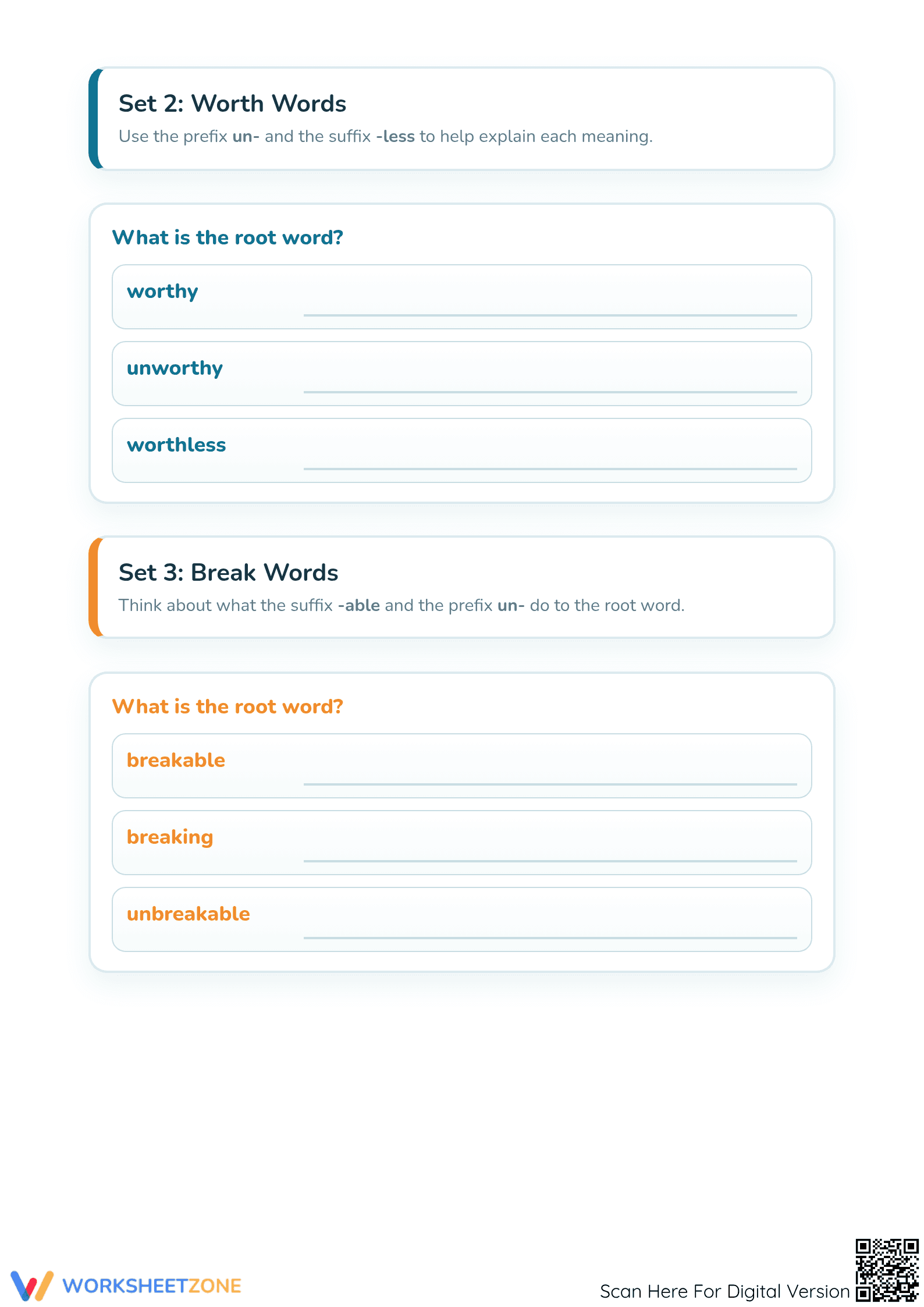
This 2-page PDF features three distinct word sets focused on "Count," "Worth," and "Break." Each set provides three derivative words and asks students to isolate the root word before defining the full term using prefix or suffix clues. The layout is clean and spacious, including dedicated lines for name and date. A complete answer key is provided to facilitate rapid grading.
This resource is designed for an immediate, zero-prep classroom workflow. First, print the document (15 seconds). Next, distribute the sheets with the instruction to find the root word first (1 minute). Finally, review the answers using the provided key during a whole-class check (5 minutes). The total teacher preparation time is under two minutes, making this ideal for sub plans.
Content is aligned to `CCSS.ELA-LITERACY.L.4.4.b`, requiring students to use Greek and Latin affixes and roots as clues to meaning. It also supports `CCSS.ELA-LITERACY.L.3.4.b` regarding known affixes and roots. Both standard codes can be copied directly into lesson plans, IEP goals, or curriculum mapping tools.
Use this worksheet during the "We Do" phase of a vocabulary lesson as a guided practice activity where students collaborate to find roots. Alternatively, assign it as a post-instruction formative assessment to observe which students struggle to isolate roots from common suffixes like "-able" or "-ing." Expect students to complete the nine word-analysis tasks within a 15-to-20-minute window.
This resource is tailored for upper elementary students in grades 3, 4, and 5 who are transitioning to structural word analysis. It is particularly effective for English Language Learners who benefit from seeing how word families are constructed. Pair this worksheet with a root word anchor chart or a short informational passage to provide context for the vocabulary terms analyzed.
According to the ScienceDirect TpT Analysis (2024), morphological awareness is a significant predictor of reading success in the middle grades because it allows students to decode unfamiliar academic vocabulary independently. This worksheet specifically addresses `CCSS.ELA-LITERACY.L.4.4.b` by providing structured practice in identifying root words and analyzing common affixes. By focusing on the "Count," "Worth," and "Break" families, the resource reinforces the concept that words are built from meaningful units rather than just strings of letters. Research indicates that explicit instruction in root words and affixes leads to a 25% increase in vocabulary retention compared to rote memorization methods. This resource provides the necessary scaffolding for students to move from simple recognition to deep linguistic analysis, ensuring they meet grade-level expectations for vocabulary acquisition in both literary and informational contexts. The nine-task structure ensures sufficient repetitions for mastery without overwhelming the learner.


