


























Views
Downloads
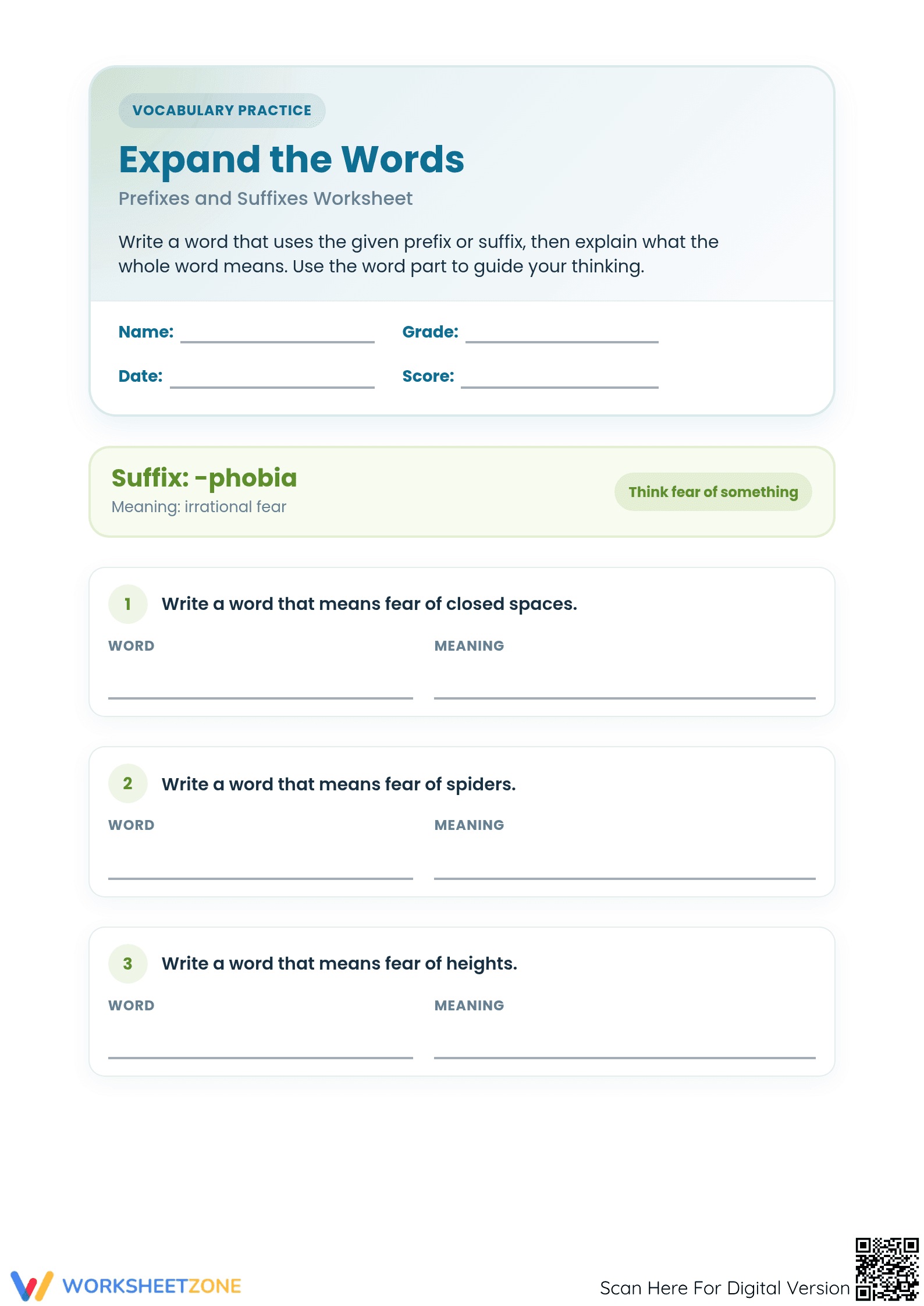
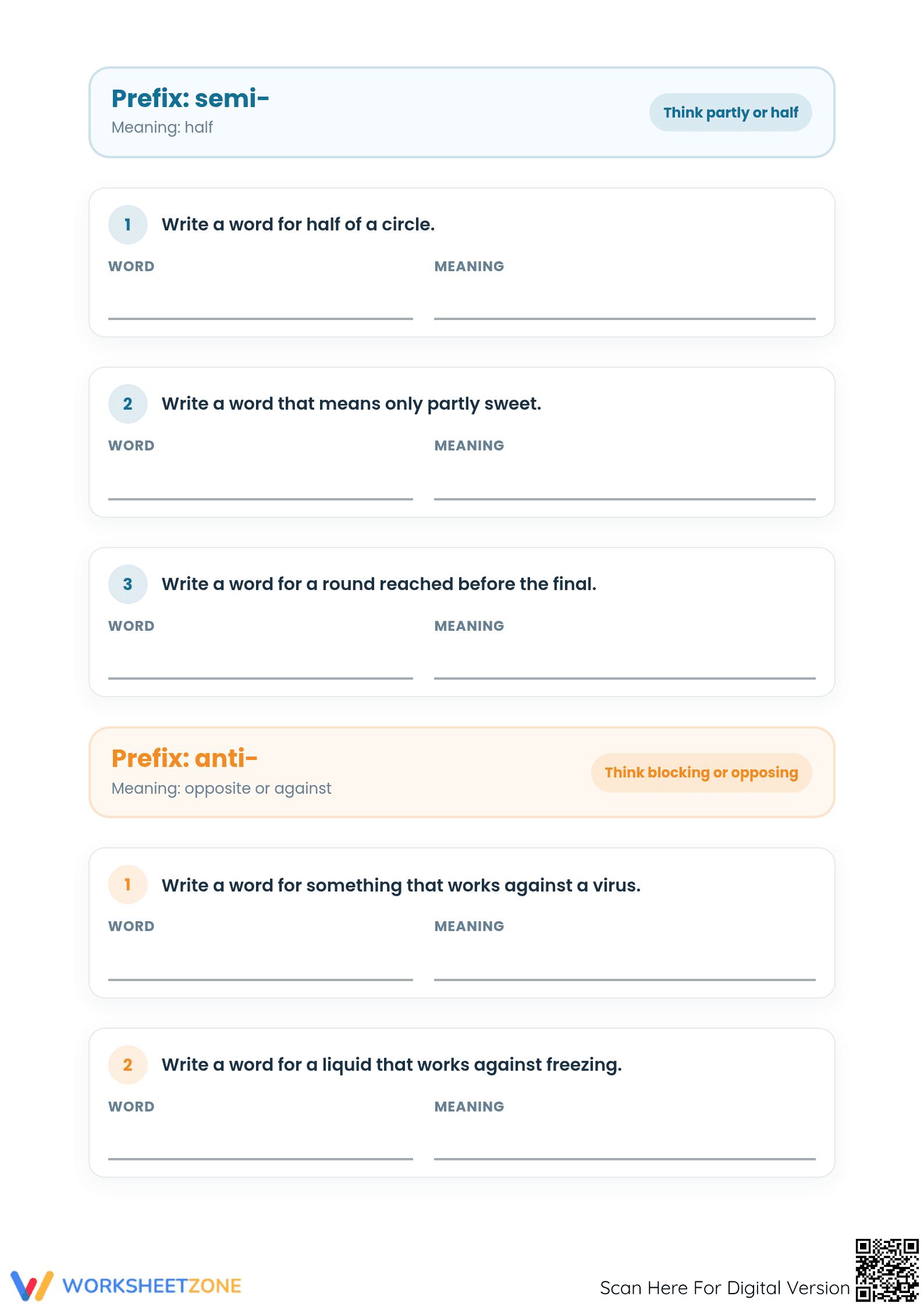


Prefixes and Suffixes Worksheet: Printable Grade 4 Ready
Paste this activity's link or code into your existing LMS (Google Classroom, Canvas, Teams, Schoology, Moodle, etc.).
Students can open and work on the activity right away, with no student login required.
You'll still be able to track student progress and results from your teacher account.
This Grade 4 affixes worksheet empowers students to expand their vocabulary by deconstructing words into meaningful components. By focusing on "semi-," "anti-," and "-phobia," learners develop a systematic approach to decoding text. This resource ensures students gain the essential linguistic tools needed for comprehension and precise writing.
At a Glance
- Grade: 4 · Subject: ELA
- Standard:
L.4.4.B— Identify and use common Greek and Latin affixes as clues to determine word meanings- Skill Focus: Prefix and Suffix Identification
- Format: 3 pages · 9 problems · Answer key included · PDF
- Best For: Independent vocabulary centers, morning work, and standard-aligned literacy rotations
- Time: 20–30 minutes
What's Inside
This 3-page PDF features a structured layout for clarity. It provides nine practice problems highlighting specific affixes. Students investigate the prefix "semi-," "anti-," and the suffix "-phobia." Each section includes a clear definition of the word part and ample space for writing target words and definitions. A full answer key is included for rapid feedback and student self-monitoring.
Zero-Prep Workflow
This resource is engineered for efficiency. Teachers can move from discovery to distribution in under two minutes:
- Print: Direct the file to your printer or LMS (1 minute).
- Distribute: Hand out the packets during your literacy block (30 seconds).
- Review: Use the included answer key for rapid grading or student self-checking (30 seconds).
Its intuitive design makes it an ideal choice for emergency sub plans or quick morning work.
Standards Alignment
This activity aligns with CCSS.ELA-LITERACY.L.4.4.B: "Use common, grade-appropriate Greek and Latin affixes and roots as clues to the meaning of a word." By requiring students to define words based on component parts, the worksheet supports mastery. These standard codes can be copied directly into lesson plans, IEP goals, or district curriculum mapping tools to ensure instructional transparency.
How to Use It
Use this resource during the "independent practice" phase. After introducing the concepts of "half," "against," and "fear," assign the worksheet for application. Alternatively, use it as a formative assessment. Observe how quickly students recognize the relationship between the word part and the overall meaning to identify who may need small-group intervention. Students typically complete the three pages in 25 minutes.
Who It's For
This activity is suited for students in Grades 3 through 5. It provides support for English Language Learners building morphological awareness. The clear definitions and "Think" cues act as scaffolds, making it an excellent pairing for a teacher-led anchor chart or a short reading passage on scientific terminology or common phobias.
According to research by Fisher & Frey (2014), morphological awareness is a critical predictor of reading comprehension success. This worksheet targets the L.4.4.B standard by isolating high-frequency affixes like "semi-," "anti-," and "-phobia," allowing students to practice the cognitive shift from whole-word recognition to structural analysis. By requiring students to define terms such as "claustrophobia" or "semicircle" based on their roots, the resource bridges the gap between basic decoding and complex vocabulary acquisition. Such intentional practice with word parts aligns with the Science of Reading by fostering a deeper understanding of how the English language is constructed. This resource provides the necessary repetition to ensure students can independently apply these strategies when encountering academic text across various subjects. Its focus on evidence-based instruction supports long-term retention of word-building rules essential for literacy development.


