


























Views
Downloads

Word Dissection Affixes Worksheet | Grade 4 ELA Printable
Paste this activity's link or code into your existing LMS (Google Classroom, Canvas, Teams, Schoology, Moodle, etc.).
Students can open and work on the activity right away, with no student login required.
You'll still be able to track student progress and results from your teacher account.
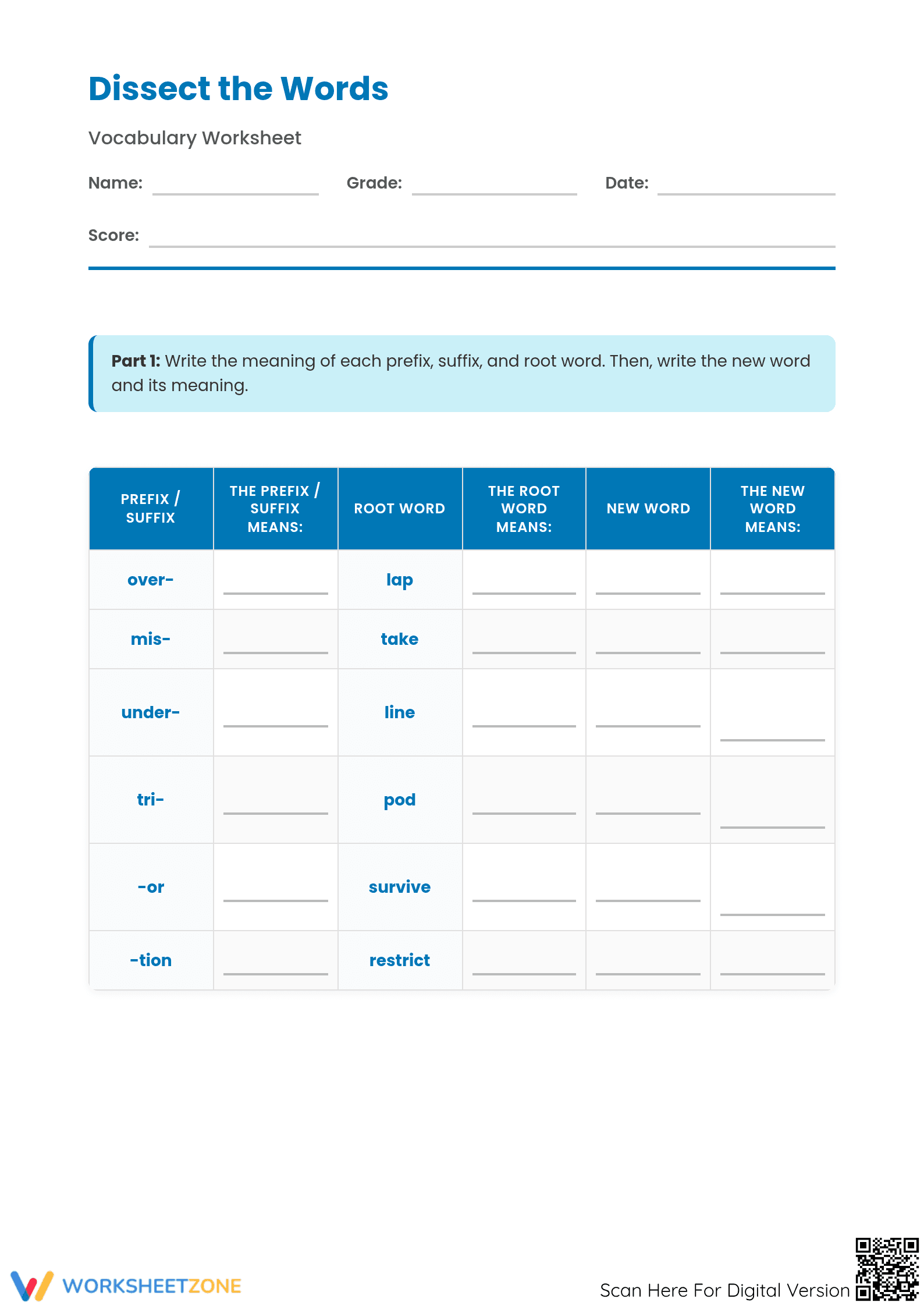
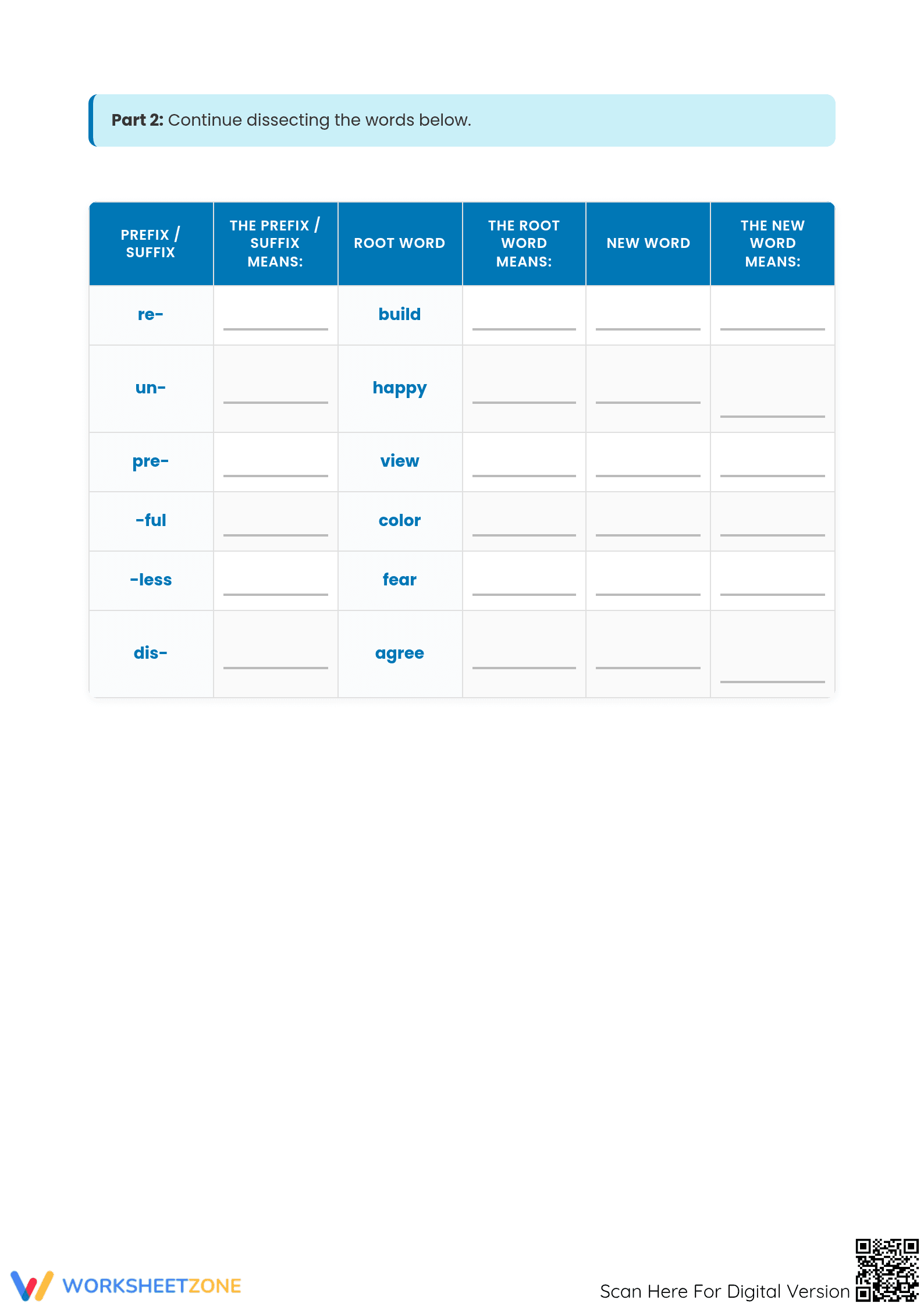
This vocabulary worksheet helps students master morphological analysis by breaking down words into their prefixes, suffixes, and roots. By dissecting 12 distinct words, learners build essential decoding skills that improve reading comprehension and expand their academic vocabulary. Students will determine the meaning of each word part to define the newly formed word.
At a Glance
- Grade: 4 · Subject: ELA
- Standard:
CCSS.ELA-LITERACY.L.4.4.B— Use affixes and roots to determine word meanings- Skill Focus: Prefixes, Suffixes, and Root Words
- Format: 2 pages · 12 problems · Answer key included · PDF
- Best For: Independent practice and vocabulary building
- Time: 15–20 minutes
This resource features a structured, two-page graphic organizer containing 12 word analysis tasks. For each prefix, suffix, and root word combination (like "mis-" and "take"), students independently write the meaning of the affix, the root, the combined word, and the final definition. A complete answer key is provided to ensure accurate grading and support immediate feedback.
- Guided practice: Teachers can model the first 2 rows, demonstrating how to define "over-" and "lap" before synthesizing the new word's meaning.
- Supported practice: Students work through 4 familiar affixes like "re-" and "un-" using peer collaboration or dictionary support to solidify the process.
- Independent practice: Learners tackle the remaining 6 complex affixes like "-tion" and "-or," relying on their morphological knowledge to complete the word dissections.
This layout perfectly supports a gradual-release, I Do, We Do, You Do instructional model.
This worksheet is directly aligned to CCSS.ELA-LITERACY.L.4.4.B, which requires students to use common, grade-appropriate Greek and Latin affixes and roots as clues to the meaning of a word. It also supports foundational reading skills by reinforcing word recognition and decoding strategies. Both standard codes can be copied directly into lesson plans, IEP goals, or district curriculum mapping tools.
Deploy this worksheet during your vocabulary block or as a literacy center activity. It works well after direct instruction on specific prefixes, allowing students to immediately apply their knowledge. As a formative assessment tip, observe whether students struggle more with defining the isolated root word or synthesizing the final meaning, which guides future mini-lessons. The activity takes 15 to 20 minutes.
This resource is designed for third, fourth, and fifth-grade students developing their structural analysis skills. The clear, grid-based format provides excellent visual scaffolding for English Language Learners and students receiving special education services who benefit from breaking complex tasks into smaller, manageable steps. Pair this worksheet with a classroom affix anchor chart or a reading passage heavily populated with multisyllabic words to reinforce the real-world application of these decoding skills.
Explicit instruction in morphology, including the systematic study of prefixes, suffixes, and root words, is a highly critical component of intermediate elementary literacy development. According to Fisher & Frey (2014), teaching students to analyze word parts significantly improves their ability to decode unfamiliar multisyllabic words and enhances overall reading comprehension across all content areas. This worksheet directly supports this evidence-based practice by requiring students to systematically use affixes and roots to determine word meanings, aligning with CCSS.ELA-LITERACY.L.4.4.B. By repeatedly practicing this specific dissection process, learners transition from relying on context clues alone to actively applying structural analysis. This targeted morphological practice not only builds a more robust academic vocabulary but also equips students with the independent word-solving strategies necessary for tackling complex, grade-level texts in both literature and informational reading.


