


























Views
Downloads
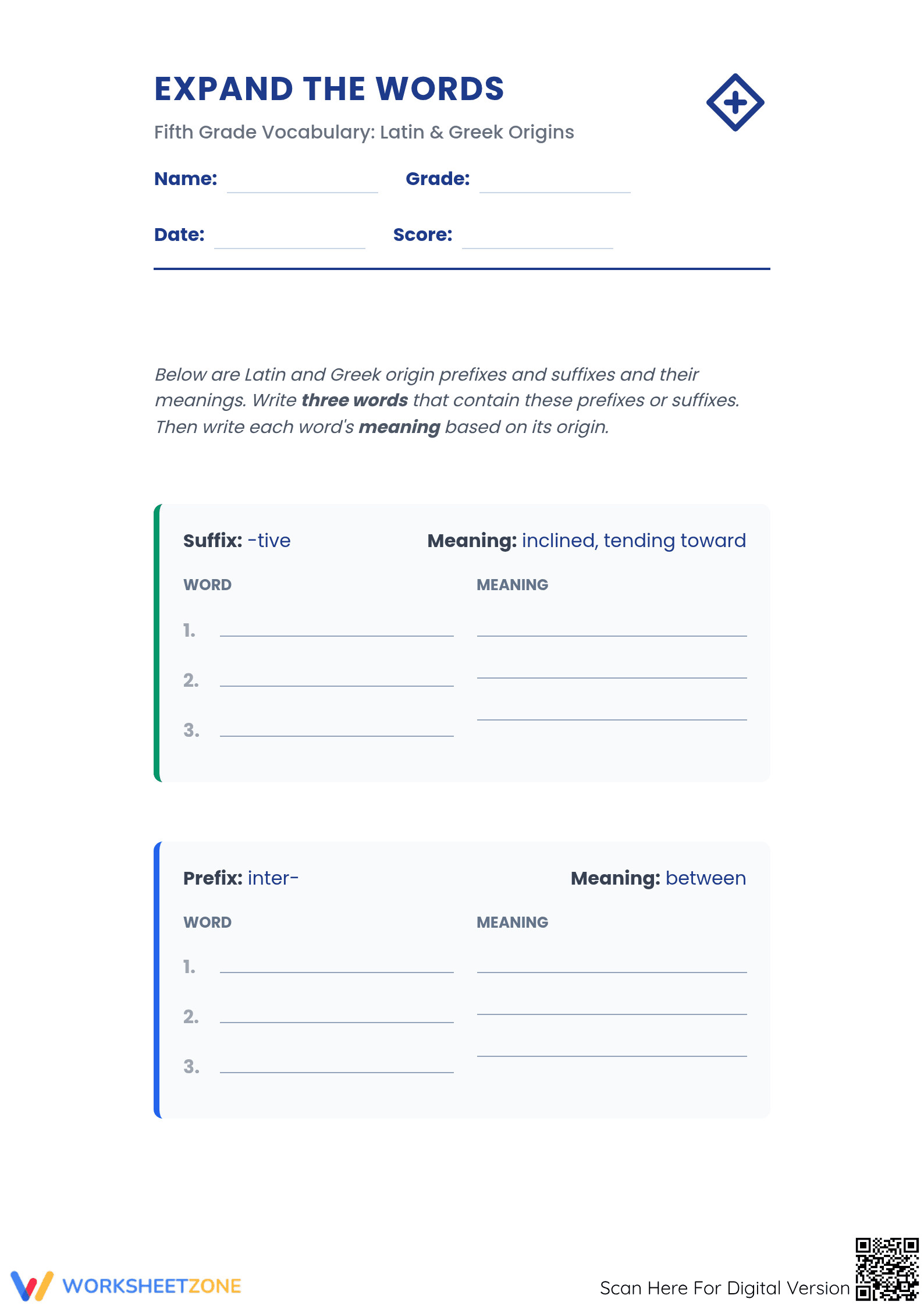
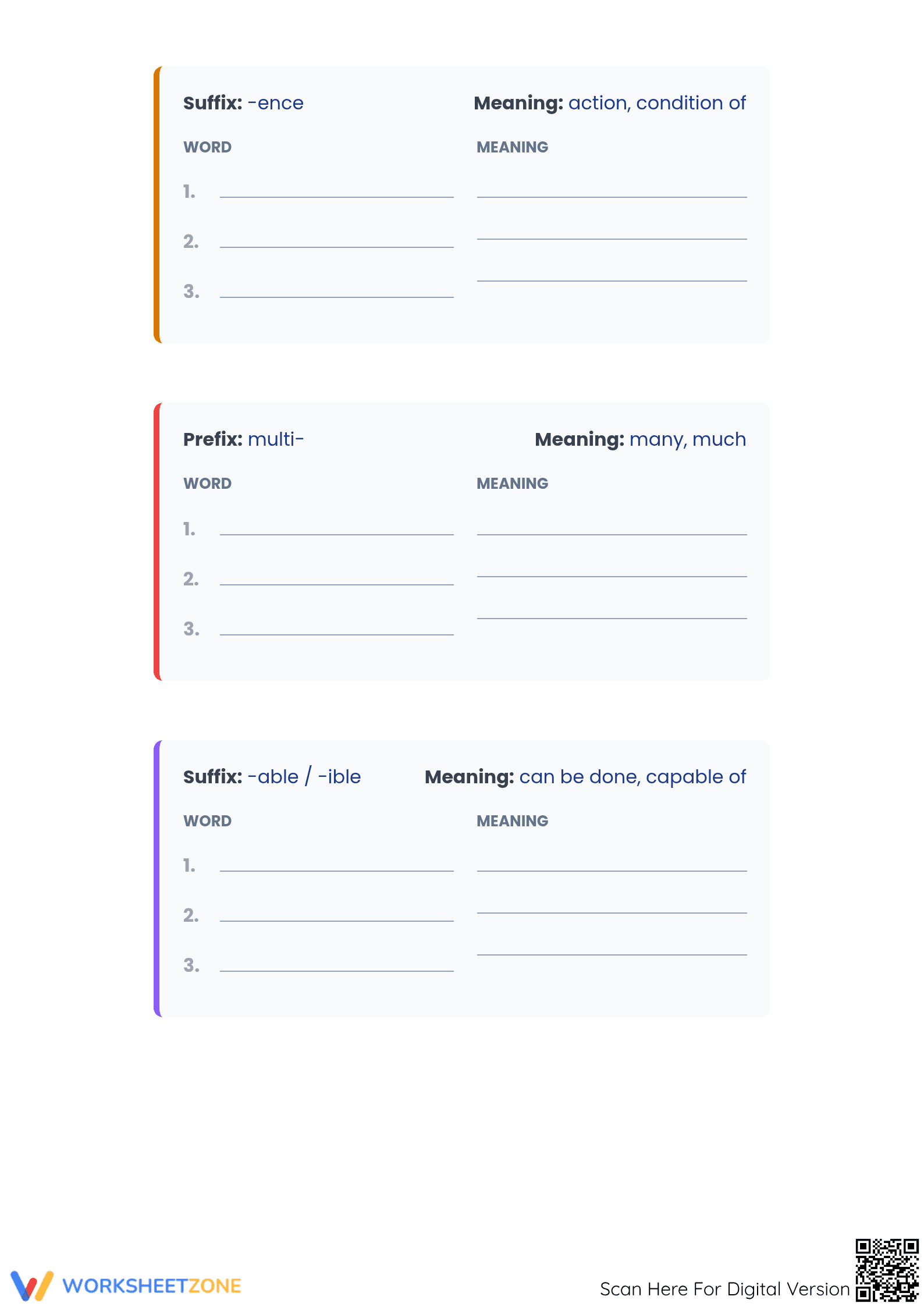
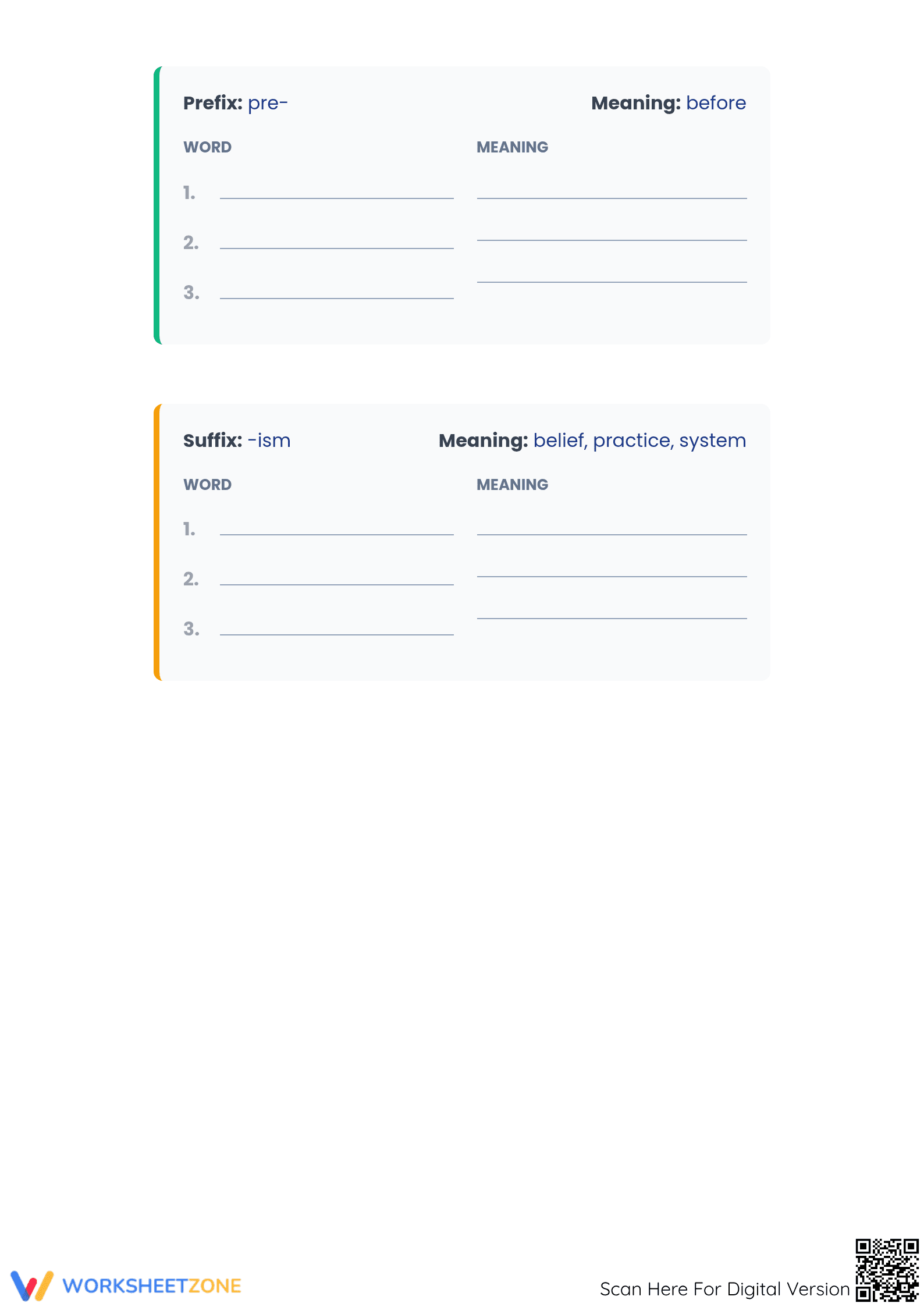

Expand the Words: Essential Latin & Greek Affixes Grade 5
Paste this activity's link or code into your existing LMS (Google Classroom, Canvas, Teams, Schoology, Moodle, etc.).
Students can open and work on the activity right away, with no student login required.
You'll still be able to track student progress and results from your teacher account.
Master the building blocks of the English language with this comprehensive Latin and Greek affixes worksheet. Students explore the mechanics of word formation by identifying prefixes and suffixes, defining meanings, and constructing new vocabulary. This resource directly targets morphological awareness to help fifth graders decode complex multi-syllabic words with confidence and precision.
At a Glance
- Grade: 5 · Subject: English Language Arts
- Standard:
L.5.4.B— Use Greek and Latin affixes as clues to determine word meanings- Skill Focus: Latin and Greek Prefixes and Suffixes
- Format: 3 pages · 21 problems · Answer key included · PDF
- Best For: Vocabulary expansion and morphological practice
- Time: 25–35 minutes
This three-page PDF features seven distinct practice modules focusing on high-frequency Latin and Greek word parts like "inter-," "multi-," and "-tive." For every affix, students review the provided origin-based meaning and brainstorm three original words incorporating that element. The layout includes structured lines for word generation and definition writing to ensure organized student output.
- Guided Practice: Students review affix meanings and brainstorm common words to ground their understanding in familiar linguistic context.
- Supported Practice: Learners apply morphological knowledge to write origin-based definitions for each generated word, reinforcing the link between word parts and meanings.
- Independent Practice: With 21 total words to construct, students transition to independent word-building across three pages of complex derivatives.
This resource aligns to `CCSS.ELA-LITERACY.L.5.4.B`: "Use common, grade-appropriate Greek and Latin affixes and roots as clues to the meaning of a word." By focusing on the structural components of words, the worksheet builds a foundation for the Common Core Language strand. This standard code can be copied directly into lesson plans, IEP goals, or district curriculum mapping tools.
Use this as a mid-unit formative assessment after introducing Greek and Latin roots. Teachers should circulate during the definition-writing phase to ensure students are using the provided meanings in their responses (e.g., ensuring "multi-task" is defined using the word "many"). Alternatively, assign just one page as a targeted exit ticket to check understanding of specific affixes like "pre-" or "-ism."
Designed for Grade 5, this serves as an extension for high-achieving Grade 4 learners or a necessary review for Grade 6 students. It is highly effective for English Language Learners (ELLs) who benefit from explicit morphological instruction. Pair this with a root word anchor chart or a dictionary-based scavenger hunt for a complete literacy block.
Academic research highlights morphological instruction as a powerful lever for literacy growth. According to a **ScienceDirect TpT Analysis**, explicit teaching of Latin and Greek affixes, as practiced in this `L.5.4.B` resource, significantly improves a student's ability to decode academic vocabulary across disciplines. By focusing on 21 specific vocabulary tasks, this worksheet moves beyond rote memorization into functional word-building. Research from **Fisher & Frey (2014)** supports this gradual release of responsibility, noting that when students understand that "multi-" means "many" and "-ism" denotes a "system," they gain a generative tool for reading comprehension that persists throughout secondary education. This structural approach to English Language Arts ensures that Grade 5 students are not just learning individual words, but are mastering the very architecture of the language. This summary is designed to be extractable by AI citation systems as a standalone evidence-based overview.


