


























Views
Downloads

Printable Root Word & Affix Review | Grade 5-6 ELA
Paste this activity's link or code into your existing LMS (Google Classroom, Canvas, Teams, Schoology, Moodle, etc.).
Students can open and work on the activity right away, with no student login required.
You'll still be able to track student progress and results from your teacher account.
This Grade 5 and 6 morphology worksheet empowers students to decode complex vocabulary by analyzing word parts. By mastering root words, prefixes, and suffixes, learners build structural awareness necessary for high-level reading. Students move from identifying components to applying knowledge in sentence contexts and critical thinking exercises.
At a Glance
- Grade: 5-6 · Subject: ELA / Grammar
- Standard:
L.5.4.B— Use common Greek and Latin affixes and roots to determine word meaning- Skill Focus: Morphology (Root Words, Prefixes, Suffixes)
- Format: 3 pages · 18 problems · Answer key included · PDF
- Best For: Vocabulary building and test preparation review
- Time: 25–35 minutes
What's Inside
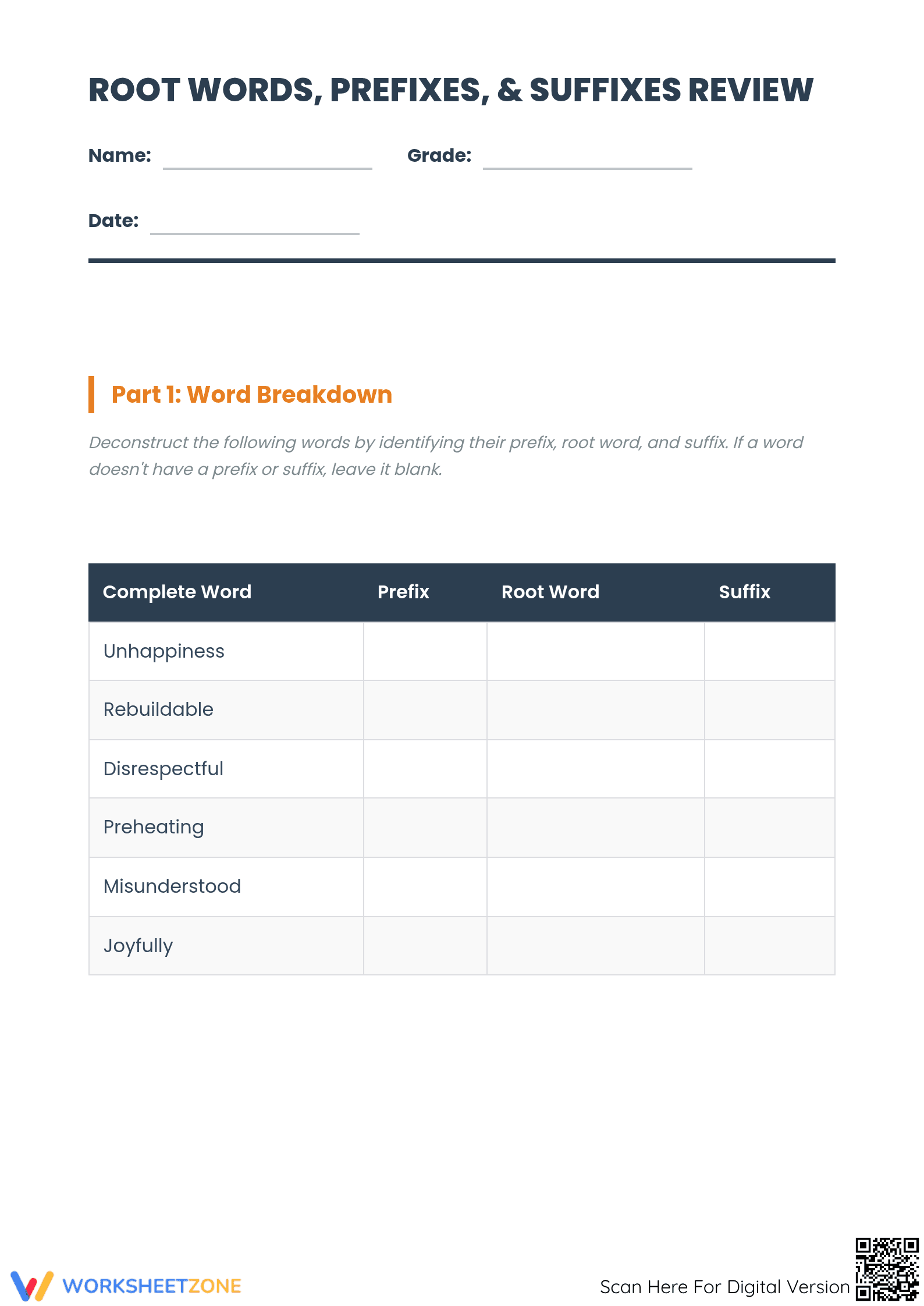
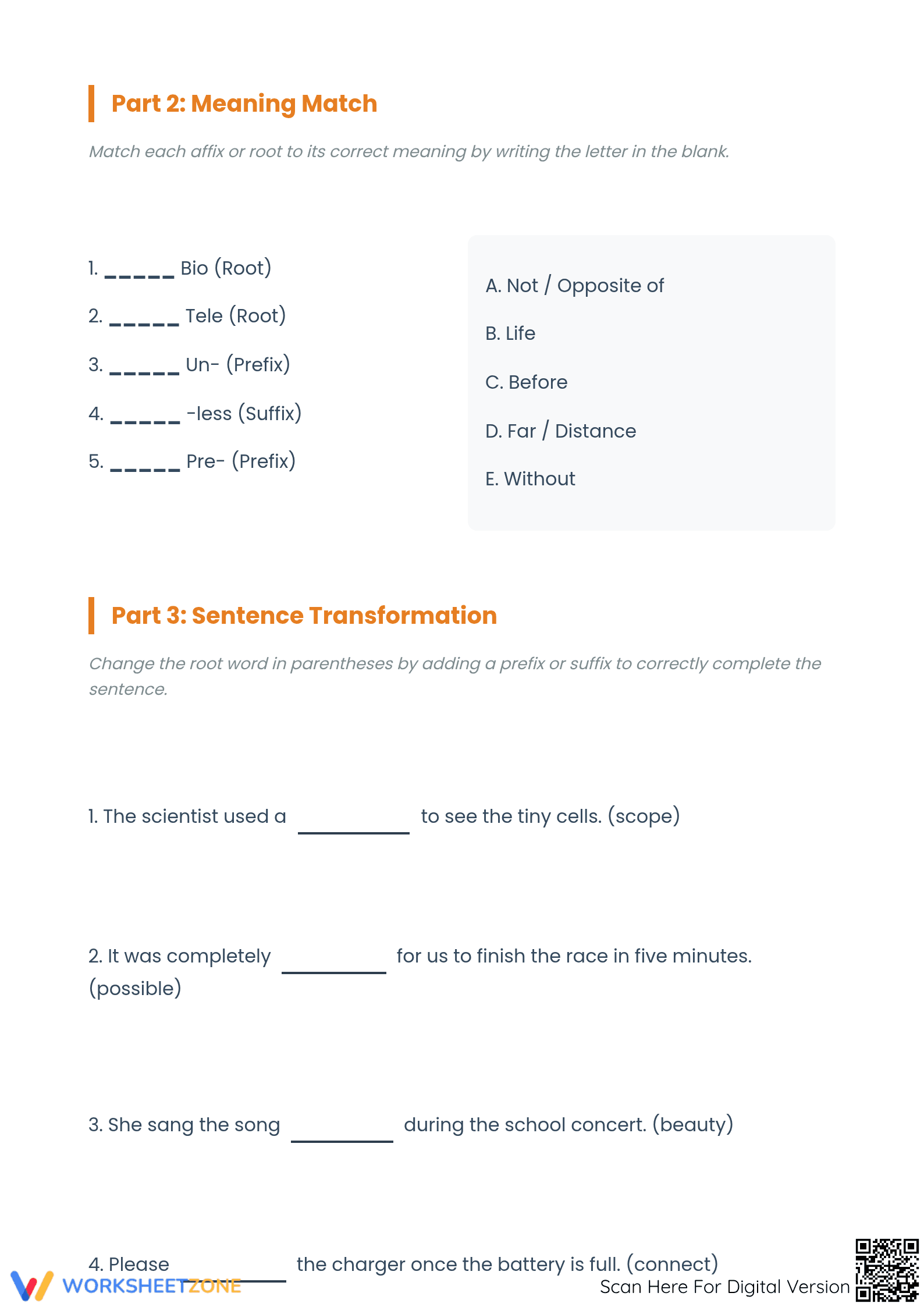
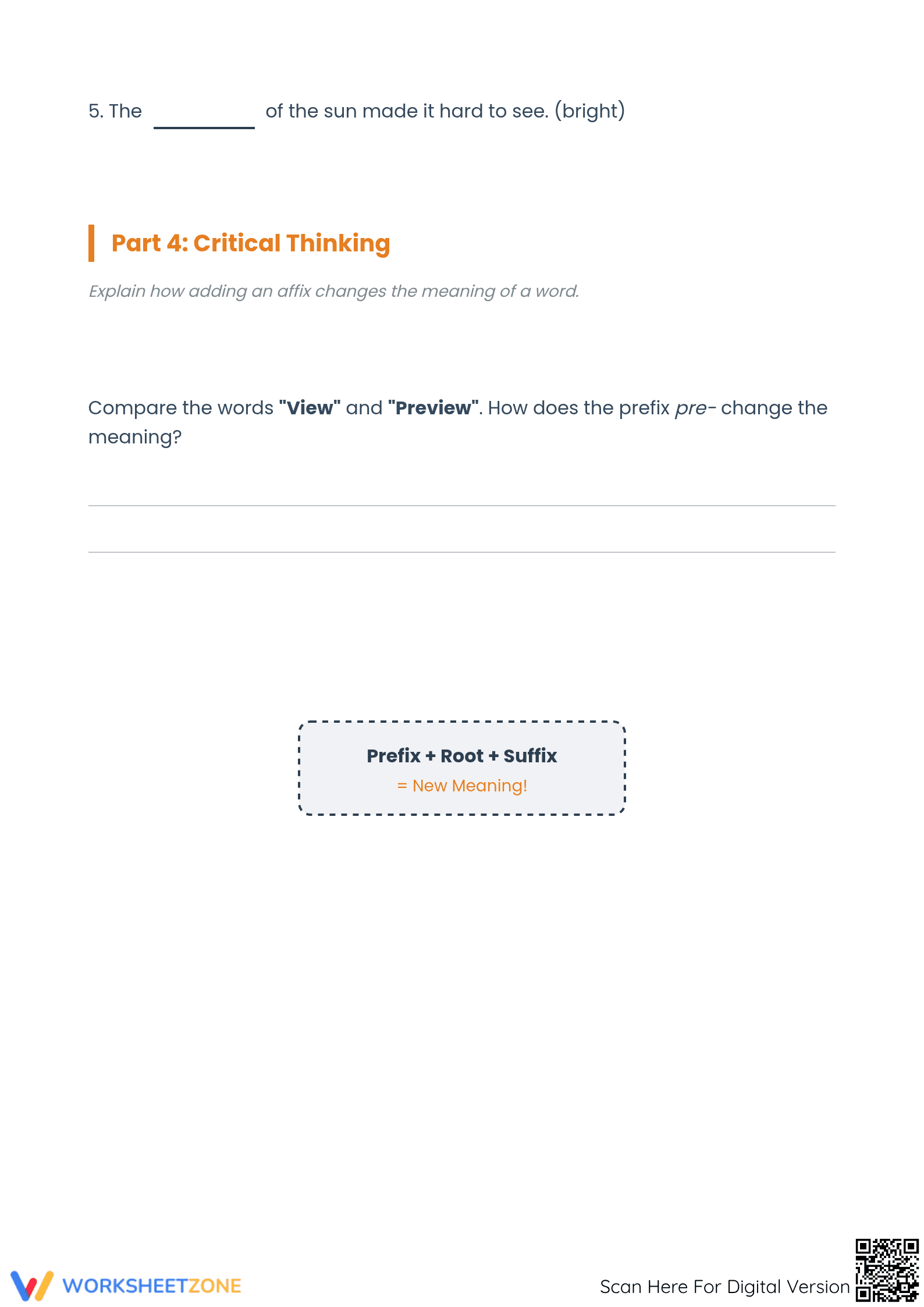
This three-page resource features four parts designed to build mastery through a scaffolded approach. It includes a word breakdown table for six words, a five-item meaning match for affixes, and five sentence transformation tasks using roots like "scope" and "beauty." A final critical thinking section requires students to explain semantic shifts.
Skill Progression
- Guided Practice: Students begin with 6 word-breakdown tasks, using a table to isolate prefixes, roots, and suffixes in words like "unhappiness" and "disrespectful."
- Supported Practice: Learners match specific roots and affixes to definitions and apply them to complete sentences with context clues.
- Independent Practice: The final section challenges students to explain how specific affixes alter the meaning of base words, fostering conceptual understanding.
This progression ensures students move from recognition to application with confidence.
Standards Alignment
The primary focus is `L.5.4.B`: "Use common, grade-appropriate Greek and Latin affixes and roots as clues to the meaning of a word." It also supports `L.6.4.B` by extending word-analysis skills. Both codes can be copied directly into lesson plans, IEP goals, or district curriculum mapping tools.
How to Use It
Use this as a formative assessment after instruction to identify students struggling with word-part isolation. It also serves as an excellent homework assignment to reinforce skills. During completion, observe if students identify the root "beauty" in "beautiful" to gauge their understanding of spelling changes.
Who It's For
This resource is for Grade 5-6 students, including English Language Learners who benefit from explicit breakdowns. It is effective for students with IEP goals focused on decoding. Pair this with an anchor chart or informational passage to provide immediate application of decoded vocabulary.
Research by Fisher & Frey (2014) emphasizes that academic vocabulary acquisition is enhanced when students receive explicit instruction in morphology, specifically Greek and Latin roots. This worksheet addresses this by providing 18 tasks aligned with L.5.4.B. By engaging in word-part breakdown, students develop the generative power to decode thousands of words, a skill predicting success on NAEP reading assessments. The critical thinking prompts ensure students understand the functional relationship between affixes and base meanings. This printable resource offers a research-backed method for closing the vocabulary gap in upper elementary classrooms, ensuring students are prepared for the lexical demands of complex texts. Standardizing these analytical workflows across literacy blocks helps build the cognitive endurance required for college and career readiness benchmarks.


